You’ve probably heard the term NFT tossed around in conversations about digital art, gaming, or even real estate. But have you ever stopped to wonder how a computer actually knows that one specific JPEG is unique and not just a copy of another? The answer lies in something called "token standards." Think of them as the instruction manuals for digital assets. Without these rules, your wallet wouldn’t know how to display an image, a marketplace couldn’t process a sale, and two different apps couldn’t talk to each other.
If you’re trying to navigate the world of crypto assets, understanding these standards is less about being a coding wizard and more about knowing which tool fits the job. Whether you are a creator looking to mint your first collection or a collector confused by why some items cost pennies to move while others cost dollars, this guide breaks down the messy, fascinating world of NFT protocols.
The Blueprint: Why We Need Standards
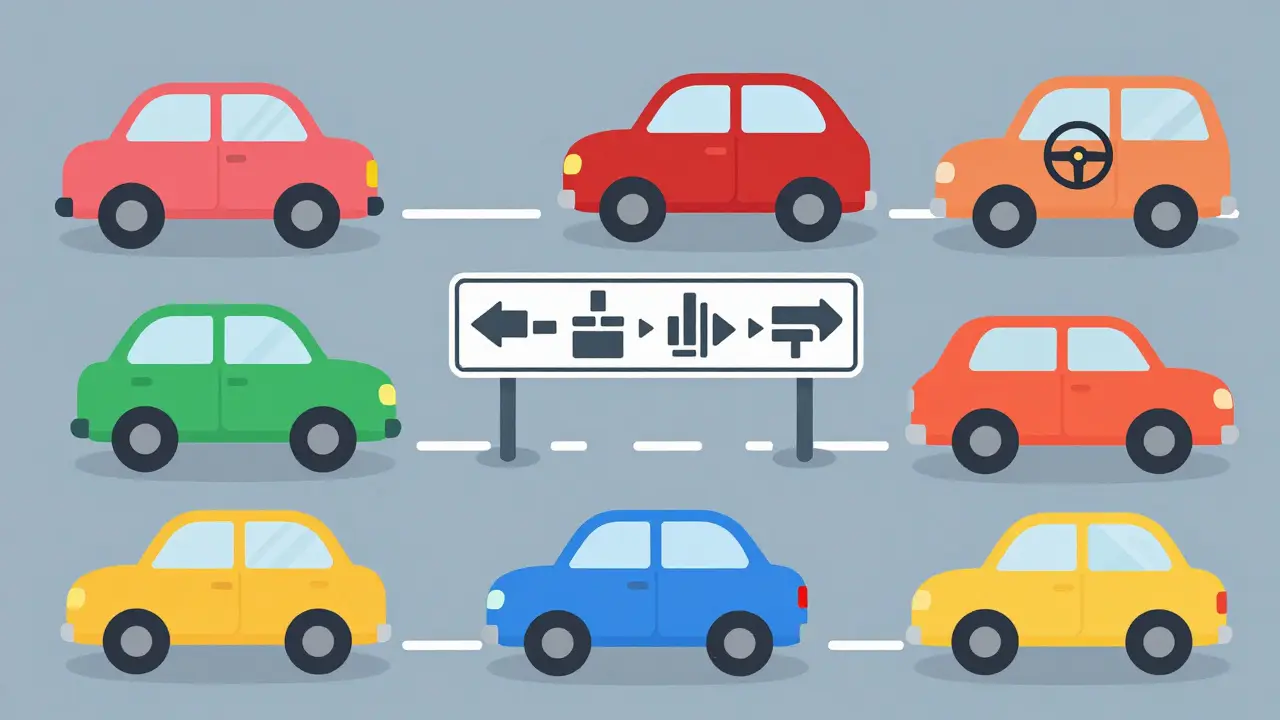
Imagine if every car manufacturer built vehicles with steering wheels on the right side, gas pedals that worked differently, and keys that only fit their own brand of locks. Driving would be a nightmare. Blockchain works the same way. Before standardized rules existed, developers had to write custom code for every single digital item they created. This meant that if you bought a virtual sword in one game, you couldn’t use it in another, and your wallet might not even recognize it as an asset.
Token standards solve this by creating a common language. They define exactly what data an NFT holds (like its name, image link, and owner) and how it behaves when transferred. The most famous example is Ethereum’s ERC-721, which was proposed in January 2017 by Dieter Shirley and formally accepted in June 2018. It was designed specifically to handle unique items, addressing the limitations of earlier standards that were built for identical tokens like Bitcoin or Ethereum itself.
The push for these standards came into sharp focus during the CryptoKitties craze in late 2017. When everyone tried to buy unique digital cats at once, the Ethereum network clogged up because there wasn't a streamlined way to handle such high volumes of unique transfers. This chaos proved that we needed specialized protocols for unique digital items, leading to the robust ecosystem we see today.
ERC-721: The Original Standard for Unique Items
When people say "NFT," they are usually talking about ERC-721. This standard treats every token as a completely separate entity. If you own three different Bored Apes, ERC-721 sees them as three distinct objects, each with its own ID number. You cannot split them; you can only transfer them whole.
This approach has huge benefits. First, it offers universal compatibility. As of 2023, nearly all major marketplaces like OpenSea support ERC-721 out of the box. Second, it provides clear ownership records. Each token has a unique identifier (a `uint256` number) that cannot be duplicated within the same contract. This makes it perfect for high-value collectibles, digital art, and real-world asset representation where uniqueness is paramount.
However, ERC-721 has a significant flaw: inefficiency. Because each token is treated individually, sending ten NFTs requires ten separate transactions. During peak times in 2023, minting a single ERC-721 NFT on Ethereum could cost over $80 in gas fees due to network congestion. For projects releasing thousands of items, this adds up quickly, making it expensive for both creators and buyers.
ERC-1155: The Multi-Token Powerhouse
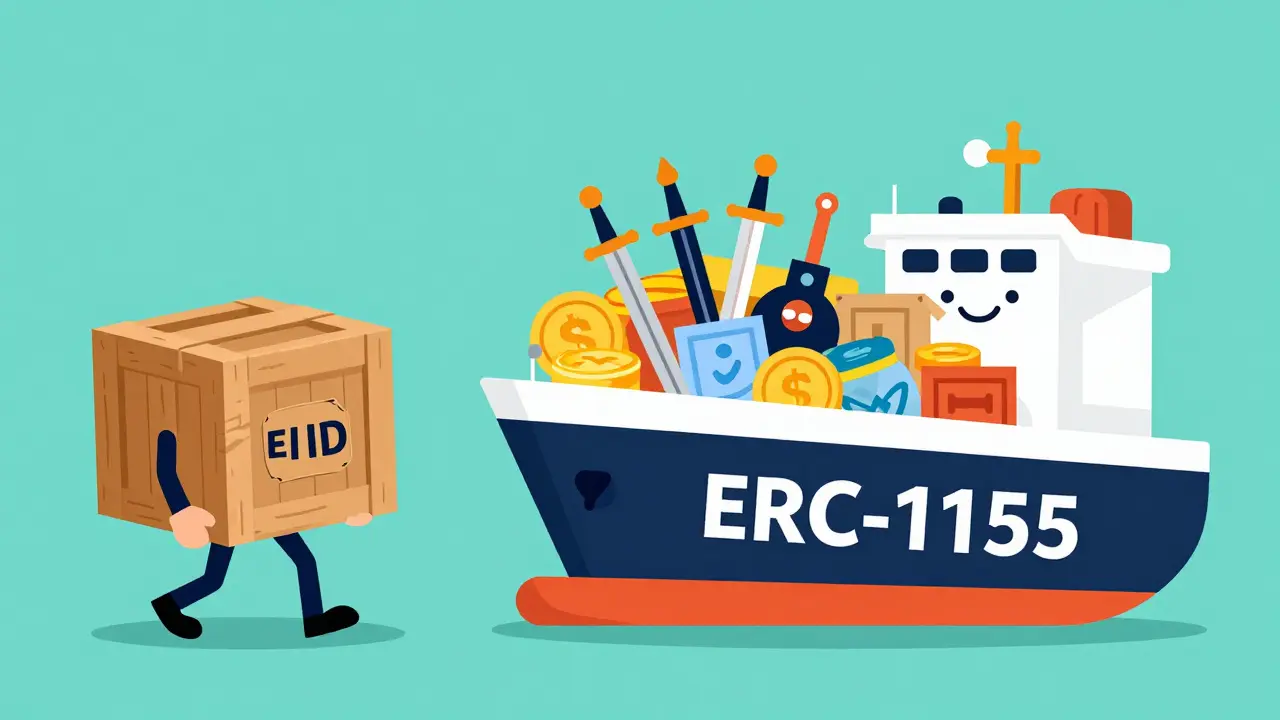
If ERC-721 is a single-item shipping crate, ERC-1155 is a massive cargo ship capable of carrying mixed loads. Proposed by Witek Radomski of Enjin in 2018 and adopted in 2019, this standard allows a single smart contract to manage multiple types of tokens-both fungible (identical) and non-fungible (unique)-simultaneously.
Why does this matter? Efficiency. With ERC-1155, you can bundle dozens of different NFTs into one transaction. Studies from Enjin showed this could reduce gas costs by up to 90% compared to ERC-721 for bulk operations. This makes it ideal for video games where players might receive a unique sword (non-fungible) and 100 gold coins (fungible) in the same loot drop.
The trade-off is complexity. Managing metadata for hundreds of different token types within one contract is harder for developers. Additionally, not all wallets and marketplaces supported ERC-1155 immediately after its launch, though adoption has grown significantly. If you are building a game or a platform with high-volume transactions, ERC-1155 is often the smarter choice than sticking to the older ERC-721 model.
Beyond Ethereum: Solana, Flow, and Tezos
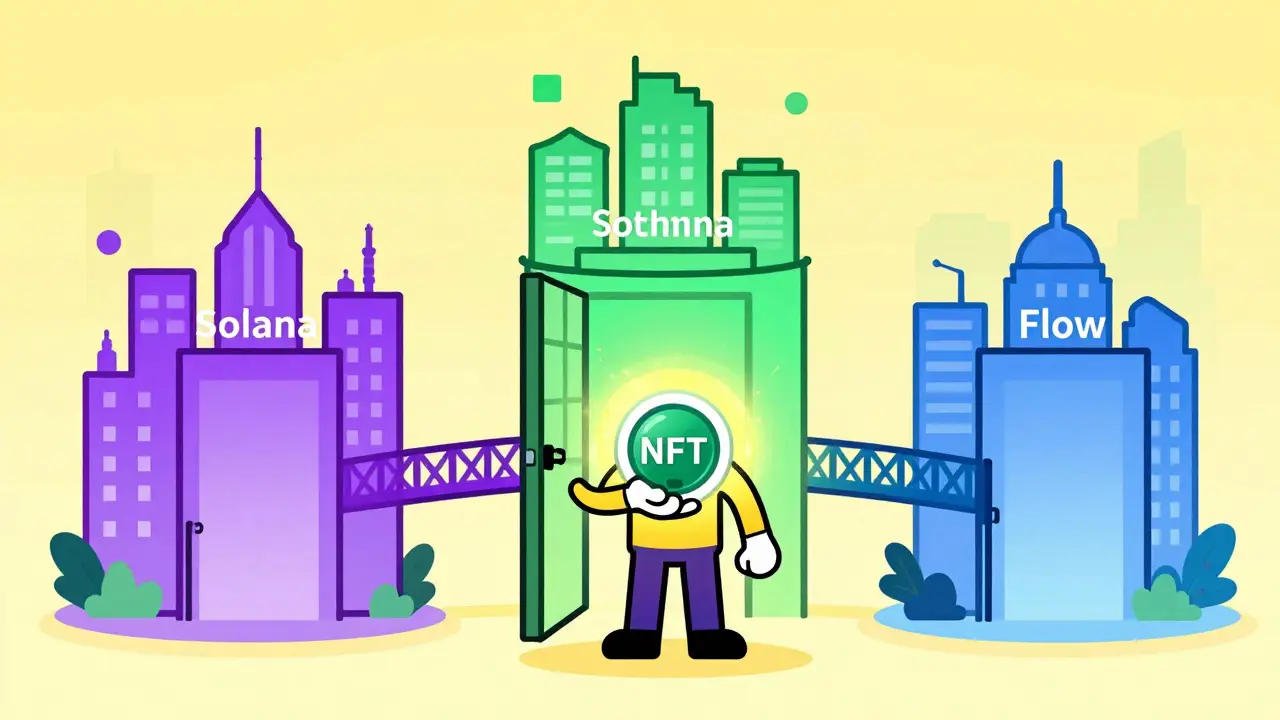
Ethereum isn’t the only player in town. Other blockchains have developed their own standards to address speed and cost issues.
- Solana: Uses the Token Metadata Program developed by Metaplex. Unlike Ethereum’s contract-based approach, Solana uses a separate account structure for metadata. This results in lightning-fast transactions (sub-second finality) and negligible fees (around $0.00025). However, wallet interoperability can be tricky, with some users reporting issues due to insufficient account space allocation.
- Flow: Created by Dapper Labs (the team behind NBA Top Shot), Flow uses a resource-oriented programming language called Cadence. It focuses on user experience, eliminating gas fees for end-users. While it supports high throughput (10,000 transactions per second), its ecosystem is smaller, with fewer marketplaces integrated compared to Ethereum.
- Tezos: Utilizes the FA2 standard, which emphasizes formal verification for security. It’s popular among eco-conscious artists due to its low energy consumption proof-of-stake consensus, though it represents a small fraction of total trading volume.
Comparing the Giants: Which Standard Fits Your Needs?
| Feature | ERC-721 (Ethereum) | ERC-1155 (Ethereum) | Solana (Metaplex) | Flow |
|---|---|---|---|---|
| Best For | Art, Collectibles, High-Value Assets | Gaming, Bulk Mints, Mixed Tokens | High-Frequency Trading, Low-Cost Collectibles | User-Friendly Apps, Sports Highlights |
| Transaction Cost | High ($8+ avg during peaks) | Medium-Low (Batched) | Very Low (~$0.00025) | Low (~$0.001) |
| Interoperability | Excellent (Universal Support) | Good (Growing Support) | Moderate (Wallet Issues) | Limited (Closed Ecosystem) |
| Complexity | Simple | High | Medium | Medium |
Emerging Trends: Composable and Token-Bound Accounts
The technology isn’t standing still. Newer standards are solving problems that early ones couldn’t. Take ERC-998, proposed by Nick Mudge. It introduces "composable NFTs," meaning an NFT can own other tokens. Imagine buying a virtual house (an NFT) that automatically includes the deed, the furniture, and the mortgage payments-all bundled into one transferable asset. This creates hierarchical ownership structures that mirror real-world complexity.
Another exciting development is ERC-6551, introduced in 2023. This standard gives NFTs their own wallets. Instead of the NFT sitting passively in your pocket, it becomes an active agent. Your virtual character could hold its own inventory, earn rewards, and interact with other contracts without you needing to manually approve every action. Early tests show this could reduce complex asset management transactions by 40%.
Practical Advice for Creators and Buyers
If you are a developer, your choice of standard depends on your audience. If you want maximum liquidity and access to the largest marketplaces, stick with ERC-721. If you are building a game with millions of items, look at ERC-1155 or consider Layer 2 solutions like Polygon to keep costs down. Learning Solidity for Ethereum or Rust for Solana takes time-expect an 8-12 week learning curve for experienced devs-but the resources for Ethereum are vastly superior, with tens of thousands of questions answered on Stack Overflow.
For buyers, always check the standard before purchasing. An ERC-721 item will likely be easier to resell on major platforms. An ERC-1155 item might offer better utility within a specific game but could be harder to move elsewhere. Also, watch out for gas fees. Minting on mainnet Ethereum during busy periods can eat into your profits, while alternatives like Solana or Polygon offer near-instant, cheap transactions.
The Future of Interoperability
One of the biggest hurdles remains fragmentation. Currently, an NFT on Ethereum doesn’t easily talk to an NFT on Solana. Industry groups like the Blockchain Interoperability Alliance are working on universal metadata schemas to fix this. By 2027, experts predict that multi-chain implementations will become the norm, with over 60% of new projects launching across two or more blockchains to balance cost, speed, and accessibility.
Regulation is also shaping the landscape. Laws like the EU’s MiCA legislation are starting to require specific metadata standards for certain types of tokens. This means future standards will need to be not just technically sound, but legally compliant. As the industry matures, expect to see tighter integration between digital assets and real-world legal frameworks, making NFTs safer and more reliable for enterprise use.
What is the difference between ERC-721 and ERC-1155?
ERC-721 treats every token as a unique, individual item, requiring separate transactions for each transfer. ERC-1155 is a multi-token standard that allows multiple types of tokens (both unique and identical) to be managed in a single contract, enabling batch transfers and significantly lower gas fees.
Which NFT standard is best for gaming?
ERC-1155 is generally considered the best for gaming because it efficiently handles large numbers of items and mixed token types (like weapons and currency) in a single transaction. Solana’s standards are also popular for gaming due to their high speed and low costs.
Do NFT standards affect the value of my token?
Indirectly, yes. Standards determine compatibility. ERC-721 tokens are widely supported on all major marketplaces, making them easier to sell. Less common standards may limit where you can trade your asset, potentially affecting liquidity and perceived value.
What is ERC-6551 and why is it important?
ERC-6551 introduces token-bound accounts, giving NFTs their own wallets. This allows NFTs to hold assets and interact with other contracts independently, turning passive collectibles into active digital agents capable of managing their own inventory and history.
Are Solana NFTs compatible with Ethereum wallets?
No, they are not directly compatible. Solana and Ethereum use different architectures and token standards. You need a Solana-specific wallet (like Phantom) to store Solana NFTs, and an Ethereum-compatible wallet (like MetaMask) for Ethereum NFTs. Cross-chain bridges exist but add complexity and risk.