SHRIMP Token Comparison & Risk Tool
Token Selection
Token Details
Select a token to view detailed information.
Comparison
| Aptos SHRIMP | Smithii SHRIMP | Shrimp.Finance SHRIMP | |
|---|---|---|---|
| Blockchain | Aptos | Solana | Ethereum |
| Token Standard | Move-based native token | SPL token | ERC-20 |
| Launch Year | 2023 | 2022-23 | 2022 |
| Unique Feature | Barbecue burn mechanism | Token-creation platform showcase | Pure speculation; no built-in utility |
| 24h Volume | Unavailable | Unavailable | $1.90 |
| Price Risk | Low (<$0.10) | Low (<$0.10) | Very High (99.9% drop) |
Transaction Cost Calculator
Risk Assessment
Select a token to see risk assessment information.
You've probably seen the ticker SHRIMP pop up on price trackers and wondered whether it’s a tasty snack or a legit crypto investment. The short answer: SHRIMP isn’t a single coin - it’s three unrelated tokens that all happen to share the same symbol. This article breaks down each version, shows how they differ on tech and market grounds, and tells you what red flags to watch for before you put any money in.
What the "SHRIMP" label really means
When a token calls itself SHRIMP it refers to a cryptocurrency token that uses the ticker “SHRIMP.”, the name alone gives you zero insight into its purpose, blockchain, or team. In practice three distinct projects have adopted the SHRIMP ticker:
- Aptos SHRIMP - an Aptos‑based token launched by the Aptomingos team with a quirky "Barbecue" burn mechanism.
- Smithii SHRIMP - a Solana‑based utility token that showcases the Smithii token‑creation platform.
- Shrimp.Finance SHRIMP - an Ethereum ERC‑20 token (contract 0x38c4102d11893351ced7ef187fcf43d33eb1abe6) positioned as a speculative asset.
Because they live on three different blockchains, none of them share liquidity, holders, or price data. The shared ticker is simply a source of confusion - and, as you’ll see, a major risk factor.
Technical snapshot of each SHRIMP variant
| Token | Blockchain | Standard | Launch year | Unique feature |
|---|---|---|---|---|
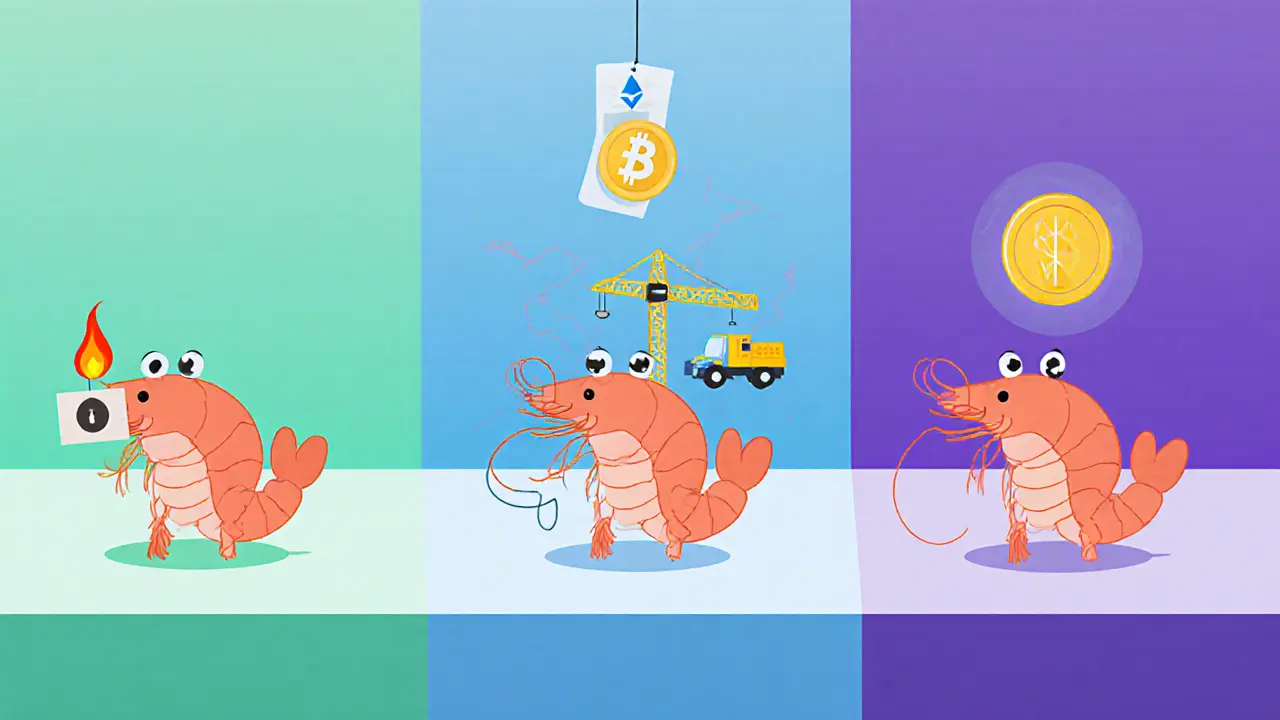
| Aptos SHRIMP | Aptos | Move‑based native token | 2023 | "Barbecue" burn mechanism that allocates funds when supply thresholds are hit |
| Smithii SHRIMP | Solana | SPL token | 2022‑23 | Demonstrates Smithii’s $100 token‑creation service |
| Shrimp.Finance SHRIMP | Ethereum | ERC‑20 | 2022 | Pure speculation; no built‑in utility |
Notice the stark contrast in transaction costs: Solana transactions cost around $0.00025, while Ethereum’s gas can swing from $2 to $20 per trade on busy days, making the Smithii version far cheaper to move.
Market performance - why the numbers matter
At the time of writing (Oct 25 2025), only the Ethereum‑based SHRIMP has a reliable market‑cap figure: roughly $225 k with a 24‑hour volume of $1.90. The other two tokens sit on obscure DEXes, so reliable volume data is unavailable. Price history paints a bleak picture: Shrimp.Finance SHRIMP peaked at $16.97 in early 2023, then fell 99.9 % to under $0.02. Aptos SHRIMP and Smithii SHRIMP have never broken $0.10, and daily trading activity is measured in a few dozen dollars at best.
Low volume equals high slippage. On BC.Game, the only exchange listing Shrimp.Finance SHRIMP, the bid‑ask spread averages 18.7 %. In practical terms, if you try to buy $100 worth, you’ll pay closer to $119 after the spread.
Why the same ticker is a red flag
Crypto analysts agree that duplicate tickers are a classic scam technique. CoinDesk’s "Altcoin Risk Assessment" flags identical symbols across blockchains as "confusion hazards" that exploit retail investors who skim the name but not the chain. The risk multiplies when the tokens share a low‑cap status (<$500 k) - a range where Chainalysis reports 63 % of scam tokens live.
Here’s a quick checklist to avoid the trap:
- Verify the blockchain: look for the contract address (Ethereum) or the token mint address (Solana, Aptos).
- Check the exchange: reputable platforms list the token with a clear ticker‑chain pairing (e.g., SHRIMP‑ETH).
- Read the whitepaper: genuine projects outline use‑cases, tokenomics, and team bios. All three SHRIMP tokens have scant documentation.
- Assess liquidity: a 24h volume under $10 k is a warning sign.
- Search community sentiment: Reddit, Discord, and Trustpilot threads are full of complaints about lost funds and empty promises for these tokens.
Deep dive into each token’s purpose (or lack thereof)
Aptos SHRIMP - community‑driven charity token?
The Aptomingos team pitched the token as “an engaging token for the whole Aptos ecosystem” with a charitable twist: when the total supply burns to certain percentages, a predefined amount of USD is donated to subgoals like “flamingo wildlife preservation.” In theory, the burn‑and‑fund model could create a virtuous loop, but the reality is shaky. Only two of the promised subgoals have materialised, and the fund‑allocation mechanism isn’t transparent - auditors have never posted a proof‑of‑reserve.
Technical specs are simple: a Move‑based token with a max supply of 10 billion. The burn function is invoked automatically on every transfer, but the % burned is tiny (0.01 %). Without significant trading volume, the burn never reaches the thresholds that would unlock the charitable payouts.
Smithii SHRIMP - a demo token for a token‑creation service
Smithii markets itself as a “no‑code token launch platform.” For $100, users can mint an SPL token on Solana, and the platform uses the SHRIMP token as a showcase. The token itself has no independent utility - it’s a proof‑of‑concept. Users who buy the token are essentially betting on Smithii’s ability to attract more token‑creation customers.
Because the token lives on Solana, transaction speed is high (2,400-4,000 TPS) and fees are negligible. However, the ecosystem suffers from poor documentation: the GitHub repo for the SHRIMP listing has a 1.8/5 rating, and support tickets frequently mention failed token transfers due to mis‑typed mint addresses.
Shrimp.Finance SHRIMP - pure speculation with almost no use‑case
Contract 0x38c4102d11893351ced7ef187fcf43d33eb1abe6 defines a standard ERC‑20 token with a total supply of 5 billion. Apart from being listed on BC.Game, there’s no wallet integration, DApp, or staking mechanism. The token’s entire narrative is built on hype - early marketing claimed “1000x potential” that never materialised.
Liquidity is dire: 24‑hour volume under $2, a handful of active holders (≈1,300), and a bid‑ask spread that makes even tiny trades expensive. In short, it behaves like a meme coin that never caught fire.
Risk profile - what the numbers and community feedback tell us
Multiple independent analyses converge on a bleak outlook:
- CryptoSlate’s token‑unlock report classifies any token under $500 k market‑cap as "extremely high risk" with "minimal liquidity and developer commitment."
- Messier’s tokenomics review calls the Aptos burn mechanism "theoretically interesting but practically untested" and labels the other two as "speculative with no sustainable tokenomics."
- BitInfoCharts notes that 97 % of tokens with daily volume below $10 k experience price manipulation - exactly where all three SHRIMP tokens sit.
Reddit anecdotes reinforce the data. Users report losing hundreds of dollars within hours of buying after a sudden price dump, and community threads are dominated by frustration rather than development updates.
How to safely research low‑cap tokens (a quick cheat‑sheet)
- Identify the chain. Look for the contract address (Ethereum) or token mint (Solana, Aptos).
- Check volume and market cap. Below $500 k market‑cap and under $10 k 24h volume = high risk.
- Read the audit. Reputable projects publish third‑party audits; none of the SHRIMP tokens have them.
- Gauge community health. Active Discord/Telegram with transparent updates indicates commitment. All three SHRIMP groups show low activity and missed promises.
- Know the exit strategy. With thin order books, you may not be able to sell at your desired price. Plan how much you’re willing to lose.
If any of these steps raise a red flag, it’s probably best to stay away.
Future outlook - will any of the SHRIMP tokens survive?
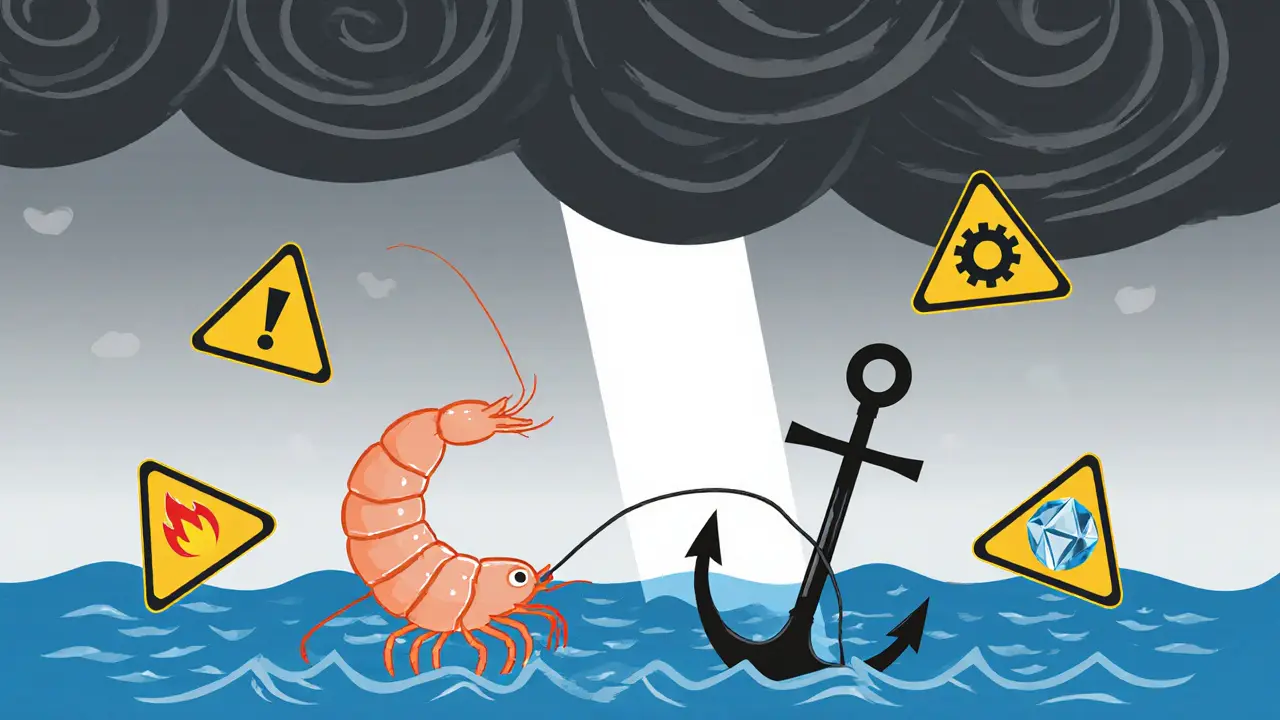
Analyst forecasts are uniformly pessimistic. Delphi Digital’s viability framework gives each token a score below 1 /10, citing "no sustainable tokenomics, minimal liquidity, and abandonment indicators." The broader micro‑cap market shows a 92 % failure rate within 18 months. The only glimmer of hope is a potential integration of Aptos SHRIMP with Aptos V2 mainnet upgrades, but even that is speculative and community sentiment remains skeptical.
Bottom line: the SHRIMP name is more of a cautionary tale than a promising investment. Unless you’re a collector of obscure tokens for personal curiosity, treat these assets as high‑risk experiments rather than portfolio builders.
Quick reference table
| Attribute | Aptos SHRIMP | Smithii SHRIMP | Shrimp.Finance SHRIMP |
|---|---|---|---|
| Blockchain | Aptos | Solana | Ethereum |
| Token Standard | Move‑native | SPL | ERC‑20 |
| Market Cap (Oct 2025) | ~$150 k (est.) | ~$120 k (est.) | $225 k |
| 24h Volume | Data unavailable | Data unavailable | $1.90 |
| Unique Feature | Barbecue burn & charity | Token‑creation demo | Speculative asset |
| Liquidity | Very low | Very low | Very low |
| Community Activity | Sparse (Telegram 1.2k, last post Sep 2023) | Minimal (GitHub issues) | None (no dev updates since 2022) |
Frequently Asked Questions
Is SHRIMP a legitimate cryptocurrency?
Legitimacy depends on which SHRIMP you mean. All three variants are real tokens on their respective blockchains, but they have tiny market caps, negligible liquidity, and no proven utility. Most analysts label them high‑risk micro‑caps rather than established assets.
How can I tell which SHRIMP token I’m looking at?
Check the blockchain and contract/mint address. Aptos SHRIMP lives on the Aptos network, Smithii SHRIMP is an SPL token on Solana, and Shrimp.Finance SHRIMP is an ERC‑20 on Ethereum (contract 0x38c4102d11893351ced7ef187fcf43d33eb1abe6). Price trackers often list the ticker with a suffix like SHRIMP‑ETH to avoid confusion.
Can I earn rewards by holding SHRIMP?
No reliable staking or reward program exists for any of the three. The Aptos version proposes charitable payouts when burn thresholds are hit, but those events have never occurred. The other two have no built‑in incentive mechanisms.
What’s the safest way to buy a low‑cap token like SHRIMP?
First, verify the contract address on a block explorer. Then use a reputable DEX or exchange that lists the exact chain version. Only allocate money you can afford to lose, because low volume means you may not be able to sell at your target price.
Are there any upcoming developments that could change SHRIMP’s outlook?
Aptos SHRIMP hinted at a potential integration with the upcoming Aptos V2 mainnet upgrade, but no concrete roadmap or funding has been announced. Smithii’s platform continues to focus on its core token‑creation service, not the SHRIMP token itself. Shrimp.Finance SHRIMP shows no development activity since 2022. Expect little change unless a new team takes over.
If you’ve made it this far, you now know why the "Shrimp Paste" moniker is more confusion than cuisine. Stick to tokens with clear utility, transparent teams, and healthy liquidity - and keep the SHRIMP tokens on a watchlist, not a portfolio.




Comments (9)