Raydium Slippage Calculator
Raydium isn’t just another crypto exchange. It’s a high-speed, low-cost trading platform built directly on Solana, and it’s become the go-to for traders who want to swap tokens faster than you can say "gas fee." If you’ve ever waited 10 seconds for a trade to confirm on Ethereum, Raydium feels like a breath of fresh air. Swaps happen in under a second. Fees are less than a penny. And with over 6,100 tokens available, you won’t struggle to find the next meme coin or DeFi gem. But here’s the catch: Raydium doesn’t hold your money. You’re trading peer-to-peer, with no customer service line to call when things go wrong. This isn’t Coinbase. This is DeFi - raw, fast, and unforgiving.
How Raydium Works: AMM Meets Order Book
Raydium’s secret sauce is its hybrid model. Most decentralized exchanges (DEXs) use something called an Automated Market Maker (AMM), where trades happen against a pool of tokens. Uniswap on Ethereum does this. But Raydium goes further. It connects directly to OpenBook, Solana’s decentralized order book system originally built from Serum. This means you can place limit orders - like on a traditional exchange - while still using AMM pools for instant swaps. It’s like having a stock market and a swap booth in one place.This hybrid setup gives Raydium deeper liquidity than most DEXs. When you trade RAY for SOL, your order might get filled by a liquidity pool, or it might match with another trader’s limit order. The system picks the best price automatically. That’s why Raydium processed $51.9 billion in trades in Q3 2025 - second only to Jupiter on Solana.
Trading Fees and Costs: Almost Free
You pay 0.25% per trade on Raydium, no matter if you’re making or taking liquidity. That’s standard for DEXs. But here’s what makes it different: the actual cost to your wallet is tiny. Because Solana is so fast and cheap, each swap transaction costs about $0.00025 in SOL fees. That’s 25 ten-thousandths of a dollar. On Ethereum, you’d pay $1.50 to $3.00 for the same trade. Even on other Solana DEXs, Raydium’s integration with OpenBook means fewer failed trades and better pricing.There are three types of pools on Raydium:
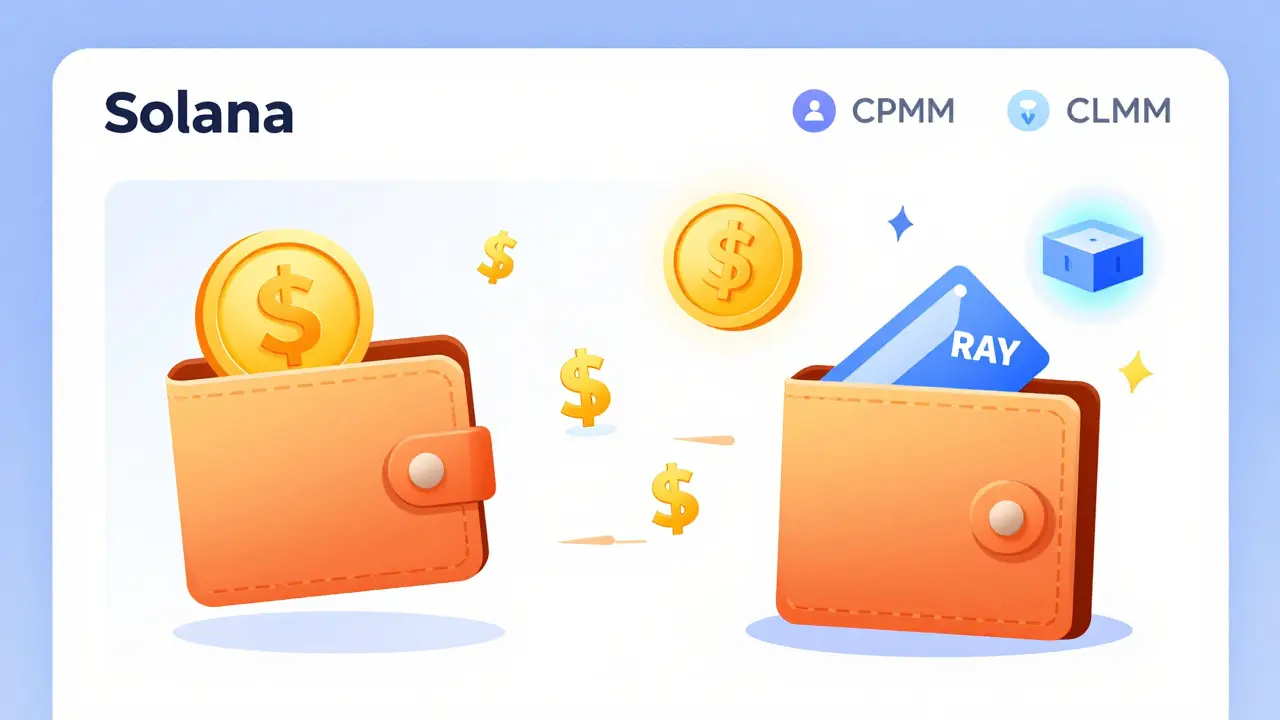
- CPMM (Constant Product Market Maker): The original pool type. Simple, stable, and used for most common pairs like SOL/USDC.
- CLMM (Concentrated Liquidity Market Maker): Lets liquidity providers focus their funds within a price range. More efficient, but harder to use.
- AMM Pools: These are the high-fee pools that generate most of Raydium’s revenue during meme coin spikes. They charge the same 0.25%, but they’re where speculative trading explodes.
For beginners, stick to CPMM. It’s the most reliable. CLMM pools are for advanced users who want to maximize yield but risk impermanent loss if prices swing outside their range.
What You Can Trade: 6,100+ Tokens
Raydium supports every SPL token on Solana - that’s over 6,100 tokens as of late 2025. That includes major DeFi coins like SRM, JUP, and MSOL, plus hundreds of obscure meme coins and new project tokens. You can even trade NFTs and tokenized assets through integrated platforms.But more tokens doesn’t mean safer trading. Low-liquidity pairs are dangerous. If you trade a token with only $50,000 in its pool, a $10,000 buy order could push the price up 20% - and when you sell, you’ll get crushed. Slippage on low-volume tokens averages 1.8-2.3%. Always set your slippage tolerance to 1-2% in your wallet settings. Never leave it at the default 0.5% unless you’re trading SOL or USDC.

Getting Started: Wallets, SOL, and Setup
You can’t buy crypto on Raydium with a credit card. No fiat on-ramps. No bank transfers. You need SOL first. That means you’ll have to buy SOL on a centralized exchange like Binance or Kraken, then send it to your Solana wallet.Use Phantom or Solflare - they’re the most reliable. Connect your wallet to Raydium’s website. You’ll need at least $0.50 in SOL to cover your first few trades. Once connected, you can swap tokens instantly. The interface is clean. No clutter. Just a swap box, a pool selector, and a few advanced options.
First-time users often get stuck on wallet connections. If Raydium says "Connect Wallet" but nothing happens, refresh the page. Disable ad blockers. Try a different browser. It’s usually a simple fix. The platform doesn’t have a mobile app, but the website works fine on iOS and Android browsers.
Why People Love Raydium: Speed and Cost
Users rave about two things: speed and price. On Reddit, one trader wrote: "Swapped 2.5 SOL for RAY in 0.8 seconds with a $0.00022 fee during peak market hours - unbeatable speed for a DEX." That’s not hype. Solana’s network handles 5,000-6,500 transactions per second. Raydium’s smart routing finds the best path across its pools and OpenBook, often completing swaps faster than you can check your phone.For active traders, especially those who scalp or trade volatile tokens, Raydium is the best tool on Solana. It’s cheaper than Jupiter for basic swaps, and it’s more integrated with the Solana ecosystem than any other DEX. Liquidity providers also benefit - they earn a share of the 0.25% fees, and since Raydium’s volume is so high, even small liquidity positions can generate decent returns.
The Dark Side: Network Failures and No Support
Raydium’s biggest weakness isn’t the tech - it’s Solana. When Solana goes down, Raydium goes down with it. In August 2025, a network outage caused 12-15% of trades to fail. One user lost $287 because their swap didn’t go through, but their SOL was still deducted. There was no refund. No helpdesk. No email reply.Customer support? There isn’t any. Raydium is decentralized. That means no live chat, no ticket system, no human to call. You get a Discord server with 48,000 members and a Telegram group with 27,000. Response times for non-urgent issues? 4-6 hours. For failed transactions? You’re on your own. The average resolution time for a stuck trade is 72 hours - if it gets resolved at all.
Traders Union gave Raydium a trust score of 1.86 out of 10 - the lowest among major DEXs. Their main complaint? No KYC, no regulation, no accountability. That’s the price of decentralization. You get freedom, but you also get risk.
Raydium vs. Jupiter: Which One Should You Use?
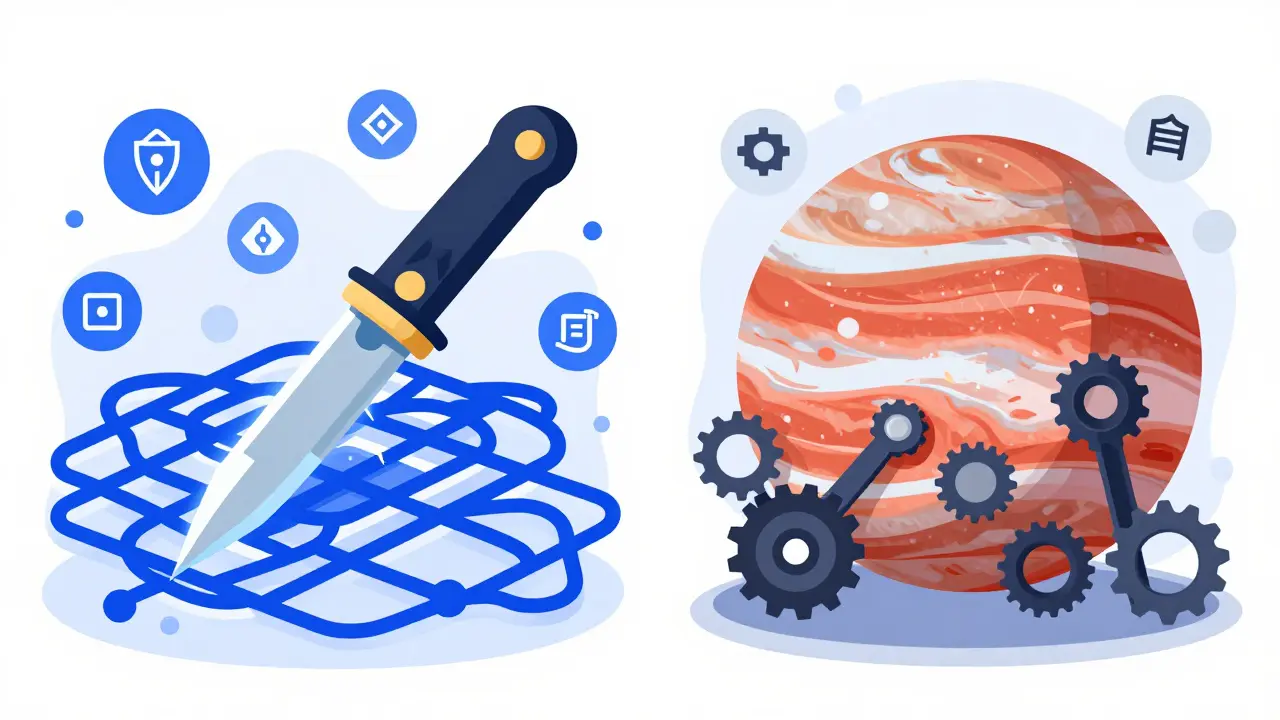
Jupiter is Raydium’s biggest rival on Solana. It has a higher market share (28.7% vs. 22.3%) and better aggregation - it scans 15+ liquidity sources to find the best price. That makes Jupiter better for complex swaps and large trades.But Raydium has something Jupiter doesn’t: deeper integration with Solana’s native order book (OpenBook). If you’re trading common pairs like SOL/USDC or RAY/SOL, Raydium often gives you tighter spreads and faster execution. Jupiter is the Swiss Army knife. Raydium is the scalpel.
Use Jupiter if you’re trading rare tokens or want the absolute best price. Use Raydium if you’re trading popular pairs, want speed, or want to provide liquidity in CPMM pools.
Future Updates: What’s Coming in 2026
Raydium isn’t standing still. In Q4 2025, they’re rolling out:- Firedancer integration: Solana’s new validator client, expected in Q1 2026, will make the network more stable. Fewer outages mean fewer failed trades.
- SuperState KYC module: A new feature that lets regulated entities list tokenized assets (like real estate or bonds) on Raydium’s CLMM pools. This could open the door to institutional use.
- Ethereum cross-chain bridge via Wormhole: Soon, you might be able to swap tokens between Solana and Ethereum without leaving Raydium. That’s a game-changer.
These updates suggest Raydium is moving from a retail-focused DEX to a platform that can handle institutional-grade activity - while still keeping its decentralized core.
Is Raydium Right for You?
Use Raydium if:- You trade on Solana regularly
- You want fast, cheap swaps
- You’re comfortable with self-custody and no customer support
- You’re okay with network risk (Solana downtime)
- You’re trading high-volume tokens like SOL, USDC, or RAY
Avoid Raydium if:
- You want to buy crypto with USD or EUR
- You need margin trading or leverage
- You expect customer service when things go wrong
- You’re trading low-liquidity tokens without adjusting slippage
Raydium isn’t for everyone. But for active Solana traders, it’s one of the most powerful tools available. It’s not perfect. It’s not safe. But it’s fast, cheap, and deeply integrated into the Solana ecosystem. If you understand the risks, it’s hard to beat.
Is Raydium a good exchange for beginners?
Raydium is not ideal for absolute beginners. You need to understand crypto wallets, SOL fees, and how decentralized exchanges work. If you’ve never used Phantom or Solflare, start with a centralized exchange like Binance to buy your first tokens. Once you’re comfortable sending and receiving crypto, Raydium becomes a powerful tool. But don’t jump in blind - test with small amounts first.
Can I trade fiat to crypto on Raydium?
No. Raydium is a decentralized exchange and doesn’t support fiat deposits. You must buy SOL or USDC on a centralized exchange like Kraken or Coinbase, then transfer it to your Solana wallet before using Raydium.
How safe is Raydium?
Raydium’s code has been audited, and its smart contracts are open-source. But safety on Raydium isn’t about the platform - it’s about you. If you send tokens to a fake contract, or if Solana goes down, you lose money. There’s no insurance, no recovery option. Your keys, your risk. Always verify token addresses before trading.
What’s the difference between CPMM and CLMM pools?
CPMM pools spread liquidity evenly across all price ranges - simple and safe for most users. CLMM pools let you concentrate your liquidity within a specific price range, which can earn higher fees but increases risk if the price moves outside that range. CPMM is for beginners. CLMM is for advanced users who want to optimize yield.
Why is my transaction failing on Raydium?
Most failures happen during Solana network congestion. Check Solana’s status page. If the network is slow, increase your priority fee to $0.001-$0.005. Also, make sure you have enough SOL for fees and that your slippage tolerance is set to 1-2% for volatile tokens. If it’s still failing, wait 10-15 minutes and try again.
Does Raydium support margin trading?
No. Raydium only supports 1:1 leverage - meaning you can only trade with the funds you have in your wallet. No borrowing, no shorting, no leverage. If you need margin, you’ll need to use a centralized exchange like Bybit or Binance.
How do I earn rewards on Raydium?
You can earn RAY tokens by providing liquidity to CPMM or CLMM pools. When users trade against your pool, you earn a share of the 0.25% swap fee. You can also stake RAY tokens directly to earn additional rewards. But be aware: liquidity provision carries impermanent loss risk, especially in volatile markets.
Raydium doesn’t promise safety. It promises speed. And for traders who know how to navigate the risks, that’s more than enough.