
POAP Gas Fee Calculator
Calculate the cost difference between minting POAPs on xDAI versus Ethereum mainnet. POAPs are minted on the xDAI sidechain for minimal gas fees, while Ethereum mainnet fees can be significantly higher.
Results will appear here after calculation
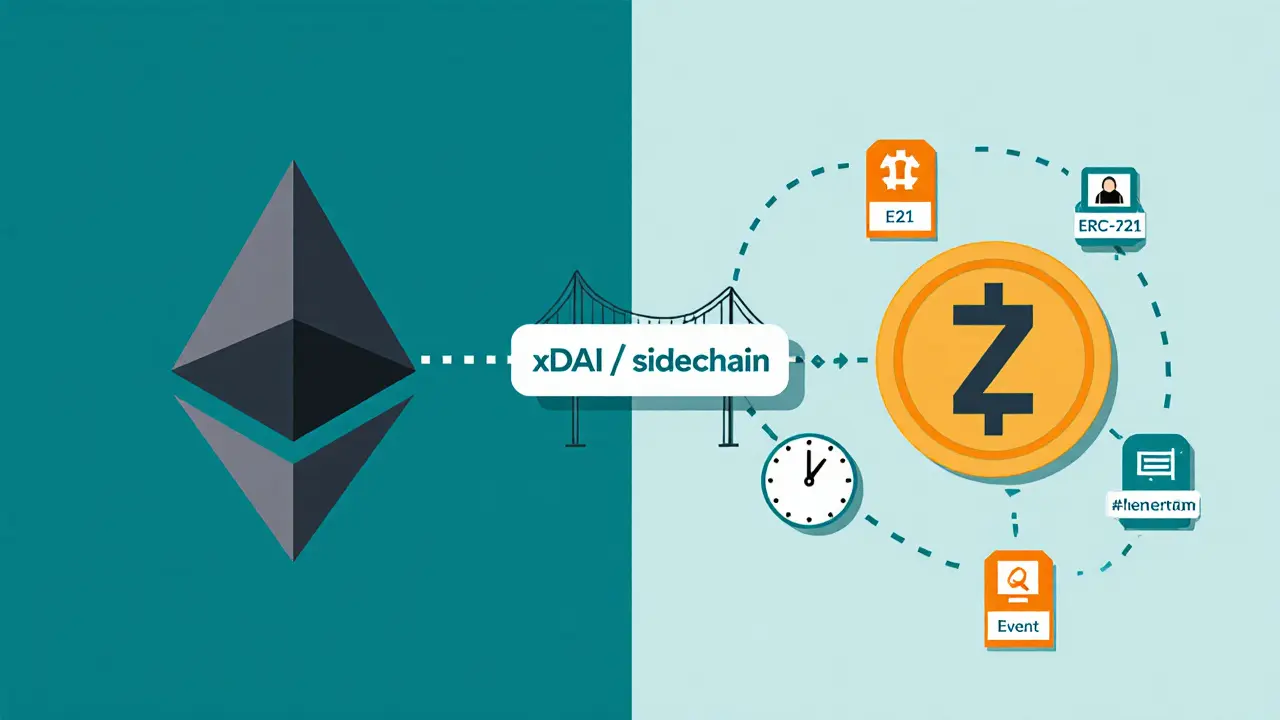
Why xDAI? POAPs are minted on the xDAI sidechain for minimal gas fees (typically $0.01 per POAP), making them accessible for large events with thousands of attendees.
Proof of Attendance Protocol (POAP) is a blockchain‑based system that issues digital badges as non‑fungible tokens to prove that someone attended a specific event. Since its debut at ETHDenver 2019, POAP has become the go‑to way for organizers to turn a moment into a verifiable, collectible token.
Why POAP matters in the NFT world
Traditional NFTs often chase price, but POAP flips the script. Its purpose is purely attestation-not speculation. That focus gives holders a personal “passport” of experiences, while giving event teams a tamper‑proof roll‑call.
How POAP works under the hood
Every POAP starts as an ERC‑721 token on Ethereum. To keep gas cheap, the token is later bridged to the xDAI sidechain managed by MakerDAO. Each token contains:
- A unique serial number.
- A timestamp of the event.
- An image that reflects the event’s branding.
- Metadata linking back to the event’s details.
Step‑by‑step: Creating and minting a POAP
- Sign up on the official POAP platform.
- Fill in event information: name, date, location, and a high‑resolution image.
- Generate a QR code or a claim link that attendees will use.
- When an attendee scans the code, the backend mints an Non‑fungible Token (NFT) on xDAI and sends it to their wallet.
- The holder can view the badge in the POAP app, add it to their digital scrapbook, or keep it as a proof of participation.
This workflow is designed for both tech‑savvy organizers and casual community managers. No smart‑contract coding is required unless you want custom logic.
Real‑world use cases
Beyond crypto meetups, dozens of brands have adopted POAP:
- SushiSwap handed out POAPs for liquidity‑mining contests, later unlocking exclusive swap fee discounts.
- Decentraland awards badges for attending virtual art openings, which double as entry tickets for future events.
- Traditional events like the U.S. Open have experimented with POAPs to give fans a digital souvenir that can be verified years later.
- Companies such as TIME Magazine use POAPs for webinar attendance, turning a simple login into a collectible token.
These examples show how POAP bridges the gap between DeFi‑centric communities and mainstream audiences.
Benefits over physical memorabilia
Physical tickets can be lost, faded, or forged. POAPs offer three concrete advantages:
- Durability: Once minted, the token lives forever on the blockchain.
- Verifiability: Anyone can check the ledger to confirm a badge’s authenticity.
- Interoperability: Badges can be displayed in wallets, linked to Discord roles, or used as keys to unlock future perks.
Because the protocol is open‑source, developers can build new experiences that read a holder’s POAP collection automatically.
Limitations and common pitfalls
POAPs are not designed as high‑value collectibles. Trading them for profit goes against the original intent and can dilute the community‑building purpose. Additionally, users need a wallet that supports xDAI; newcomers sometimes stumble over the “bridge” step. Finally, the visual design of each badge is only as good as the event organizer’s graphics, so low‑effort images can make a badge feel cheap.
Future outlook: From badge to credential
Many projects already treat POAPs as a resume entry. Imagine a future where your POAP collection proves you’ve spoken at a conference, contributed to an open‑source repo, or completed a blockchain certification. The protocol roadmap mentions:
- Integrating with on‑chain reputation systems.
- Allowing issuers to attach exclusive access rights (e.g., early‑beta launches).
- Supporting layered metadata for academic credentials.

Quick checklist for organizers
- Define clear event details and a memorable badge image.
- Test the claim link or QR code on multiple devices.
- Inform attendees they need an xDAI‑compatible wallet (Metamask works out‑of‑the‑box).
- Plan any post‑event perks tied to badge ownership.
- Archive the badge metadata for future reference.
Comparison: POAP vs regular NFT vs physical ticket
| Feature | POAP | Generic NFT | Physical Ticket |
|---|---|---|---|
| Primary purpose | Proof of attendance | Ownership of digital asset | Entry permission |
| Cost to mint | Low (xDAI gas) | Varies, often high | Printing & logistics |
| Resale market | Discouraged | Active marketplace | Not applicable |
| Verification | Blockchain ledger | Blockchain ledger | Holograms, barcodes |
| Community perks | Unlocks roles, airdrops | Depends on project | Usually none |
Wrap‑up
In a world where digital experiences keep expanding, Proof of Attendance Protocol gives you a simple, verifiable way to turn moments into lasting tokens. Whether you’re a community manager, a brand looking for new fan engagement, or an individual collector, POAP offers a durable, blockchain‑backed souvenir that can evolve into a credential for the future.
Can I claim a POAP without a crypto wallet?
You need a wallet that supports the xDAI network, such as MetaMask. The POAP platform will guide you through adding the network if you don’t have it already.
Are POAPs tradable on secondary markets?
Technically they can be transferred, but the community discourages trading because it undermines the badge’s purpose as personal proof of attendance.
What gases fees do I pay when minting a POAP?
Minting occurs on the xDAI sidechain, where fees are typically a few cents, far cheaper than Ethereum mainnet.
Can businesses use POAPs for loyalty programs?
Yes. Companies can issue POAPs for repeat purchases or event check‑ins, then grant exclusive discounts to badge holders.
How many POAPs can an event issue?
There’s no hard cap; some large conferences have minted tens of thousands of badges in a single day.



Comments (11)