Even in 2025, when decentralized finance (DeFi) has grown into a $100 billion ecosystem and self-custody wallets are more popular than ever, centralized exchanges still handle over 85% of all cryptocurrency trading volume. That’s not a fluke. It’s not legacy inertia. It’s because for most people-retail traders, institutional investors, and newcomers alike-centralized exchanges just work better.
Speed and Liquidity Are Non-Negotiable
If you’ve ever tried to trade a token on a decentralized exchange during a market spike, you know the frustration. You place your order, wait 12 seconds for the blockchain to confirm, and by the time it goes through, the price has moved 5% against you. That’s not trading. That’s gambling with gas fees. Centralized exchanges solve this with off-chain order matching. Your buy and sell orders are matched instantly on the exchange’s servers, not on the blockchain. This means trades execute in milliseconds, not seconds or minutes. Liquidity is deep because thousands of traders are all using the same platform. Binance, for example, handles over $30 billion in daily volume. Even the largest DEX, like Uniswap, only manages a fraction of that-often less than $1 billion on peak days. For active traders, this isn’t a nice-to-have. It’s survival. A 0.5% slippage on a $10,000 trade is $50 gone. On a CEX, you’re lucky to see 0.05%. That difference adds up fast.Trading Tools That DEXs Still Can’t Match
Think about what real trading looks like. It’s not just swapping ETH for USDC. It’s using limit orders, stop-losses, trailing stops, margin trading, futures, and options-all with leverage. Centralized exchanges offer all of this. Coinbase Pro, Kraken, and Binance have professional-grade dashboards built for day traders and hedge funds. You can set up automated strategies, track P&L in real time, and connect via API to algorithmic bots. Most decentralized exchanges? They’re still mostly token swap interfaces. A few, like dYdX or Hyperliquid, offer futures, but they’re the exception. Even then, they lack the depth of order books, the speed of execution, and the reliability of centralized systems. If you’re trading more than $500 at a time, you’re not using a DEX unless you have to.Fiat On-Ramps Are Still a CEX Thing
How do you get money into crypto? Most people still use bank transfers, credit cards, or PayPal. Decentralized exchanges don’t take dollars. They take crypto. So if you want to buy your first Bitcoin with your debit card, you have to go through a centralized exchange. Coinbase, Kraken, and Binance let you deposit USD, EUR, GBP, and dozens of other currencies directly. They handle the banking relationships, compliance, and conversion. DEXs? You need to already own ETH or another native token to pay gas, then swap it for what you want. That’s a multi-step process that requires wallets, bridge tools, and understanding of network fees. For 9 out of 10 new users, that’s a wall they won’t climb.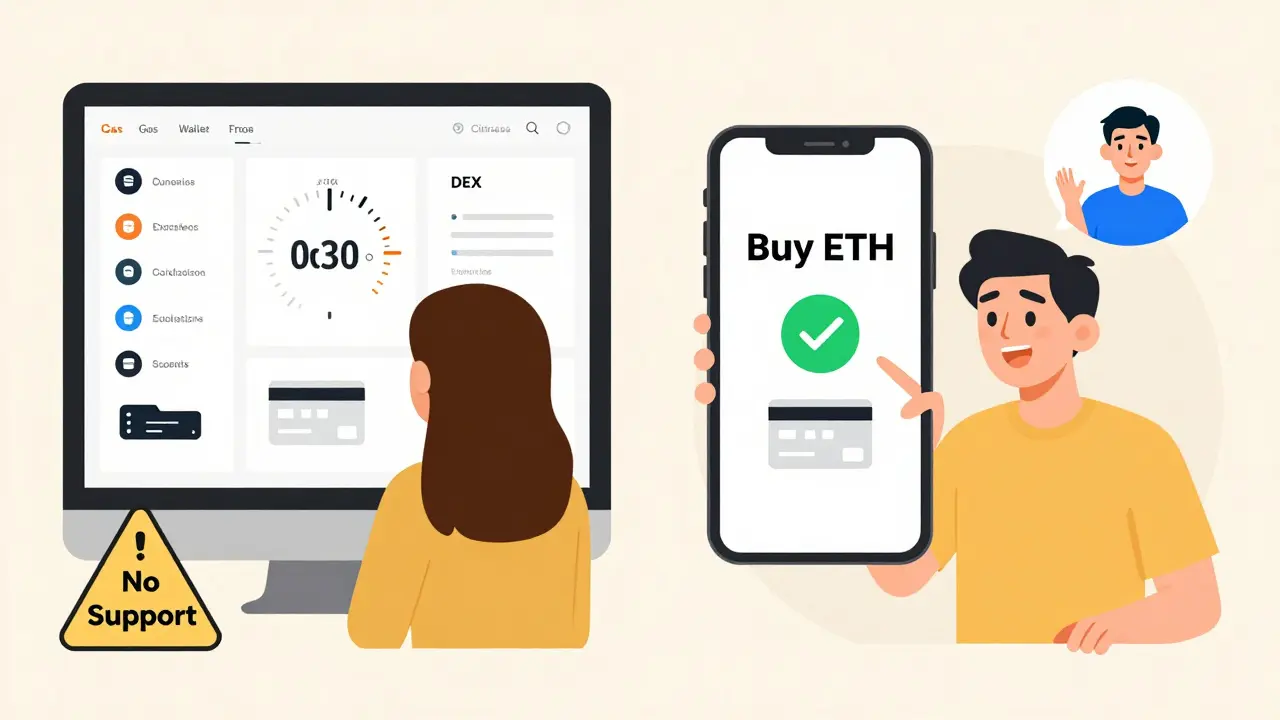
Customer Support Actually Exists
Ever lost access to your wallet? Ever sent funds to the wrong address? Ever been hacked? On a DEX, you’re on your own. No one to call. No live chat. No email ticket system. You’re left to Google forums, Reddit threads, or Discord groups hoping someone else had the same problem. Centralized exchanges have support teams. Real ones. Binance has 24/7 multilingual support. Coinbase has a dedicated fraud resolution team. If you’re locked out of your account or suspect a withdrawal was fraudulent, you can get help within hours. Some even offer insurance. Coinbase holds $230 million in cold storage insurance for user assets. No DEX offers anything close.Regulation Makes CEXs the Only Choice for Institutions
Big money doesn’t play by the same rules as hobbyists. Hedge funds, corporate treasuries, and family offices need compliance. They need audits. They need to know their assets are held by a licensed entity. Regulators in the U.S., EU, Japan, and Singapore all require KYC and AML checks. That’s why institutional capital flows almost entirely through CEXs. The SEC has made it clear: if you’re offering securities or acting as a broker-dealer, you need a license. DEXs can’t get that. They’re code on a blockchain-no legal entity, no accountability. That’s why BlackRock, Fidelity, and VanEck all use Coinbase or Binance for their crypto exposure, not Uniswap or PancakeSwap.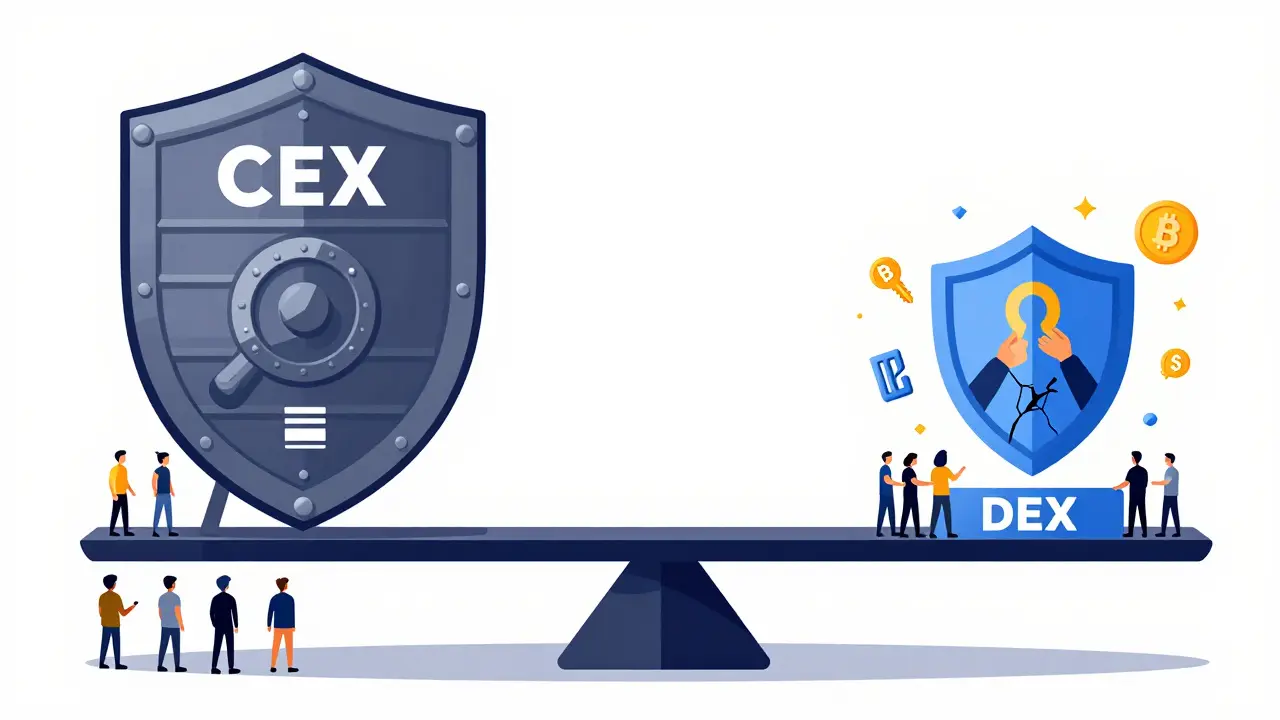
The User Experience Is Just Simpler
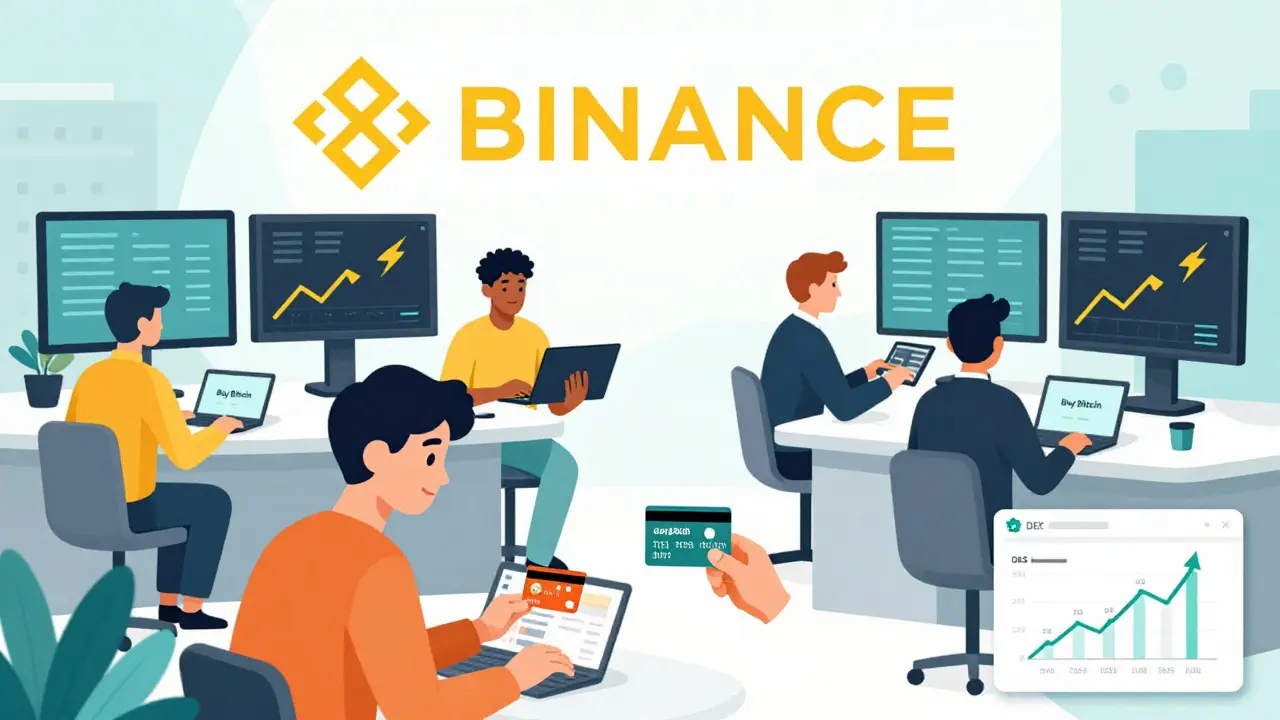
Try this: open the Binance app. Tap ‘Buy Bitcoin.’ Enter your card details. Confirm. Done. Five minutes later, you own BTC. Now try the same on a DEX. Download a wallet. Back up your seed phrase. Buy ETH on a CEX. Send it to your wallet. Connect your wallet to Uniswap. Approve a token. Pay gas. Wait for confirmation. Swap. Then, if you want to sell later, repeat the whole process. And hope the network isn’t congested. The difference isn’t just technical. It’s psychological. CEXs remove friction. They hide the blockchain. You don’t need to understand smart contracts, gas fees, or nonce values. You just need to know how to click ‘Buy’ and ‘Sell.’ That’s why retail adoption still skews heavily toward centralized platforms.Security Isn’t About Control-It’s About Consequences
DeFi fans say CEXs are insecure because you don’t control your keys. But let’s be real: most users don’t know how to secure private keys. They write them on sticky notes. They screenshot them. They store them in the cloud. They lose them. In 2024, over $1.2 billion in crypto was lost due to user error-mostly on self-custody wallets. CEXs don’t eliminate risk. They manage it. They use multi-sig wallets, cold storage, intrusion detection, and 24/7 security monitoring. When Binance was hacked in 2019, they covered the losses with their SAFU fund. When FTX collapsed, it was due to corporate fraud-not a smart contract bug. The point isn’t that CEXs are perfect. It’s that they’ve built systems to absorb failure. DEXs? A single code exploit can drain millions-and no one is responsible for fixing it.The Future Isn’t Either/Or-It’s Both/And
Hybrid models are starting to emerge. Some exchanges now offer non-custodial trading options where you keep your keys but still use their order book. Layer 2 solutions like Arbitrum and Optimism are making DEXs faster and cheaper. But none of this changes the core truth: most people want convenience over control. The crypto world will always have room for both. DEXs will thrive for privacy-focused users, DeFi power users, and those who want to avoid banks entirely. But for the vast majority-traders who want speed, support, liquidity, and simplicity-centralized exchanges aren’t just dominant. They’re the only practical choice.Until a decentralized platform can match the speed of Binance, the support of Coinbase, and the fiat access of Kraken-without requiring a blockchain degree-CEXs will keep winning.
Why do most people still use centralized exchanges instead of decentralized ones?
Most people use centralized exchanges because they’re faster, easier to use, and offer customer support. You can buy crypto with a credit card, trade with advanced tools like futures and margin, and get help if something goes wrong. Decentralized exchanges require you to manage your own wallet, pay gas fees, and figure out problems on your own-which is too complicated for most users.
Are centralized exchanges safe?
They’re safer than most people think. Major exchanges like Binance and Coinbase store over 90% of user funds in offline cold storage, use multi-signature systems, and have insurance funds to cover losses from hacks. While there have been high-profile failures like FTX, those were due to corporate fraud-not technical flaws in the exchange platform itself. The security systems in place today are far more robust than in the early days of crypto.
Can decentralized exchanges ever replace centralized ones?
Not in the way most people trade. DEXs are great for specific use cases like DeFi yield farming or privacy-focused swaps, but they can’t match the speed, liquidity, or user experience of centralized exchanges. Even with Layer 2 scaling, DEXs still lag in execution speed and support. Most users don’t want to manage private keys or pay gas fees-they want to buy crypto like they buy stocks on Robinhood. That’s why CEXs will remain dominant for mainstream trading.
Why do institutions only use centralized exchanges?
Institutions need compliance. They need to know their assets are held by a regulated entity that follows KYC and AML rules. Centralized exchanges are licensed and audited. DEXs are code on a blockchain-no legal entity, no accountability. Regulators like the SEC won’t allow institutions to use DEXs for custody or trading because there’s no way to verify who’s doing what. That’s why BlackRock and Fidelity use Coinbase, not Uniswap.
Do centralized exchanges have higher fees than decentralized ones?
Not necessarily. CEXs often charge lower fees for high-volume traders, especially with maker-taker fee structures. Many offer fee discounts if you pay with the exchange’s native token. DEXs may seem cheaper because they don’t have a platform fee, but you pay gas fees on the blockchain-which can spike during congestion. On Ethereum, a single swap can cost $5-$20. On a CEX, the same trade might cost $0.10. For frequent traders, the cost difference is huge.