KTO Token Value Calculator
How Much KTO Would You Actually Need?
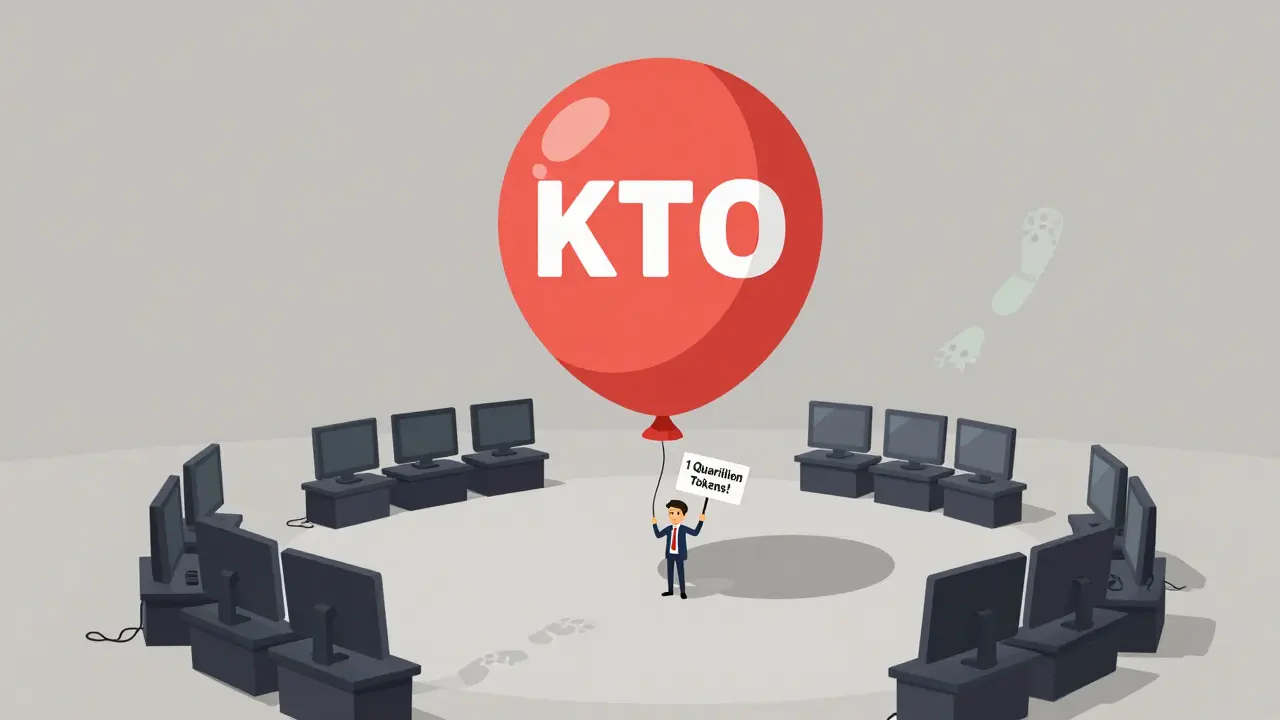
Kounotori (KTO) has a quadrillion token supply with a price of $0.000000000552. This calculator shows the real value behind the seemingly cheap price.
Current KTO price: $0.000000000552
Current USD value: $0.000000000552 per token
Warning: With a 24-hour trading volume of only $19.64 and over 90% slippage, KTO has almost no real market value. You'd lose more than 90% of your value just on transaction fees. This calculator only shows theoretical values based on current pricing.
Kounotori (KTO) isn't a cryptocurrency you should consider investing in. It's a high-supply, low-liquidity token with virtually no real use case, almost no trading volume, and a community so small it barely registers online. If you're wondering whether KTO is worth your time or money, the answer is simple: avoid it.
What Is Kounotori (KTO)?
Kounotori (KTO) is an ERC-20 token built on the Ethereum blockchain. Its contract address is 0x616ef40d55c0d2c506f4d6873bda8090b79bf8fc, and as of December 2025, it has a total supply of 1 quadrillion tokens - that’s 1,000,000,000,000,000 KTO. That’s more than any major cryptocurrency has in circulation. For comparison, Bitcoin has a fixed supply of 21 million, and Ethereum’s circulating supply is around 120 million. KTO’s supply is over 8 million times larger than Ethereum’s.
Despite this massive supply, the token’s price is near zero. CoinLore reports its value at $0.000000000552 (5.52E-10). That means you’d need nearly 1.8 billion KTO just to make one cent. The token’s whitepaper claims it’s designed to “revolutionize the crypto market” with lightning-fast transactions, enhanced security, and anti-manipulation features. But there’s no evidence of any of that working in practice.
Why Does KTO Have a Quadrillion Supply?
There’s no technical reason for a quadrillion-token supply. It’s a gimmick. Projects use huge supplies to make the price look cheap - a psychological trick to lure in retail investors who think, “It’s only a few nano-dollars per token, so I can buy a lot!” But price per token means nothing when the total market cap is what matters.
KTO’s market cap is around $552,000, based on CoinLore’s price and total supply. That’s less than the cost of a modest used car. Compare that to Uniswap (UNI), which has a market cap of over $1.2 billion and handles $1.2 billion in daily trading volume. KTO’s 24-hour trading volume? Just $19.64. Most of that comes from a single Uniswap V2 pool. That’s not a market - it’s a ghost town.
Does KTO Have Any Real Utility?
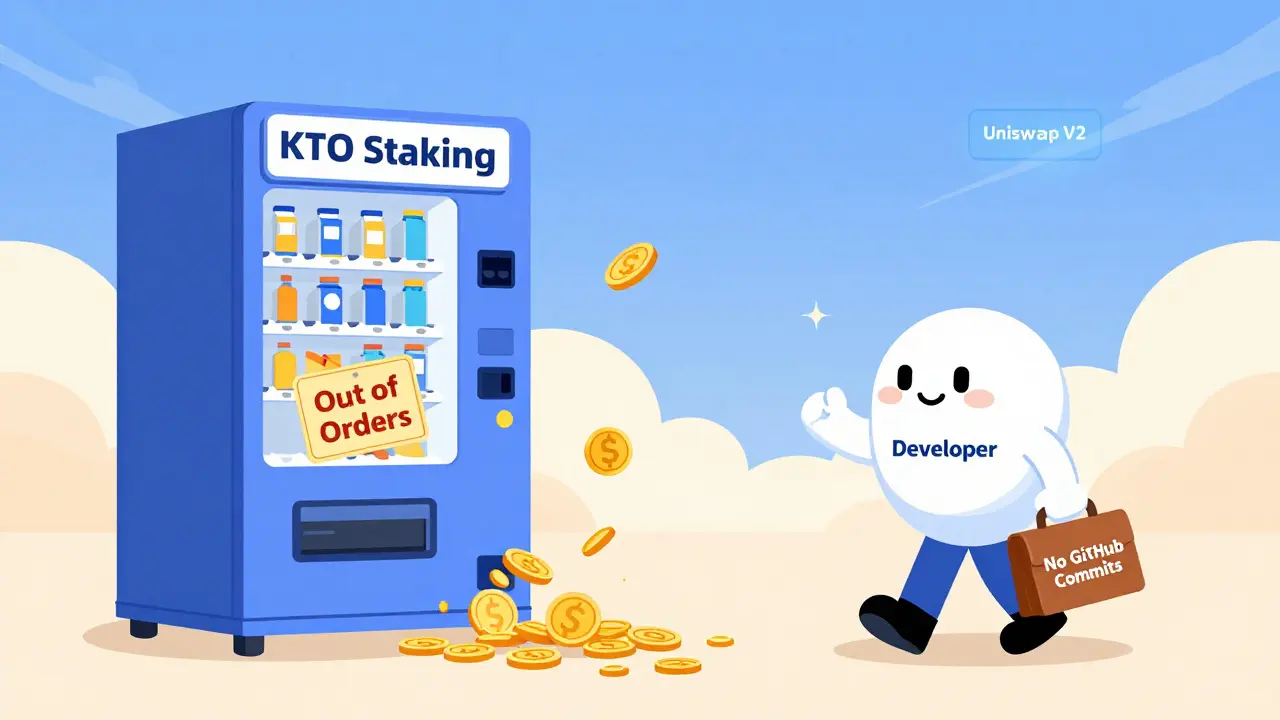
According to its website and Bitget’s description, KTO promises a staking platform that will offer “higher returns than other tokens.” But as of December 2025, that platform doesn’t exist. There are no code commits to any public GitHub repositories in the past six months. No API documentation. No developer tools. No wallet integrations. Nothing.
It also claims to have “anti-manipulation features” like maximum buy/sell limits per transaction. That’s technically true - the smart contract does have those limits. But that’s not innovation. It’s a basic safety net for a token that would otherwise collapse under its own weight. Real projects don’t need to lock their own tokens just to prevent their price from crashing instantly.
Market Performance: A Complete Disaster
KTO’s numbers tell the full story:
- Market cap: ~$552,000 (ranked #7475 out of 10,000+ cryptocurrencies)
- 24-hour trading volume: $19.64
- Price change (7-day): 0.00%
- Price change (30-day): -48.3%
- Price (CoinLore): $5.52E-10
- Circulating supply: 1 quadrillion (same as total supply)
- Wallets holding KTO: 1,842
- 92% of those wallets hold less than $1 worth
Even among meme coins - the wild west of crypto - KTO is an outlier. Most meme coins have at least some trading activity, a community, or a joke with traction. KTO has none of that. It’s not funny. It’s not useful. It’s just a number on a blockchain.
How Do You Even Buy KTO?
You can only trade KTO on decentralized exchanges like Uniswap V2. There are no centralized exchanges listing it. No Coinbase. No Binance. No Kraken. Not even a small altcoin exchange.
Buying KTO is a nightmare. Because there’s almost no liquidity, every trade causes massive slippage. Users report needing to set slippage tolerance between 49% and 99% just to complete a swap. That means if you send 0.01 ETH to buy KTO, you might end up with less than 0.001 ETH worth of tokens - and you still pay the gas fee. One Reddit user wrote: “Slippage ate 98% of my value. Complete waste of gas fees.”
Even worse, selling is harder than buying. The bid-ask spread is over 90%. That means if you buy KTO, you’d need the price to jump 900% just to break even after fees. That’s not investing - it’s gambling with a rigged wheel.
Community and Social Proof: Zero Engagement
Real crypto projects have active communities. KTO does not.
- Telegram group: 12 members
- Discord server: 3 active users
- Monthly social media mentions: 37 (all negative)
- Trustpilot reviews: 0
- CoinGecko user ratings: 1.2/5 stars from 12 reviews
- Top comment: “Market cap under $1M with quadrillion tokens screams scam coin - avoid at all costs.”
Compare that to Chainlink, which gets over 12,500 mentions daily. Or even Dogecoin, which still has thousands of active traders. KTO’s silence speaks louder than any marketing page.
Expert Opinions: “Pump-and-Dump”
Dr. Elena Rodriguez, Chief Cryptocurrency Analyst at Blockchain Insights Group, said in a November 2025 CoinDesk article: “Tokens with quadrillion-supply models and sub-$1,000 daily volumes typically represent speculative ventures with minimal utility, often exhibiting pump-and-dump characteristics.” That’s exactly what KTO is.
Technical analysis from CoinLore shows 6 sell signals versus 1 buy signal across 17 indicators. The price is trading below its simple moving average. Bollinger Bands are squeezed tight - a sign of low volatility and low interest. CoinCodex’s forecast predicts a -25% drop by January 2026, though their numbers are likely miscalculated due to decimal errors.
Delphi Digital and Messari both classify KTO as a “high-risk speculative asset” with less than a 5% chance of surviving past mid-2026. The token has already been added to CoinTelegraph’s “Dead Coin Index,” which tracks tokens that have lost all meaningful trading activity.
Regulatory Red Flags
The U.S. SEC’s December 2025 Token Transparency Framework explicitly flags tokens with quadrillion supplies and negligible utility as potential securities violations. Why? Because they’re often marketed with promises of future returns - exactly what KTO’s whitepaper does with its fake staking platform.
If you buy KTO, you’re not just risking your money - you could be unknowingly participating in an unregistered security offering. That’s not just a bad investment. It’s a legal gray zone.
Is KTO a Scam?
It’s not officially labeled a scam by regulators - yet. But it ticks every box for a classic pump-and-dump scheme:
- Massive supply to make price look cheap
- Zero real utility or development
- Minimal trading volume
- No community or support
- Promises of future features that never materialize
- High slippage and liquidity traps
There’s no team behind it. No roadmap updates. No press releases. No transparency. Just a contract address and a vague description on Bitget.
What Should You Do?
Don’t buy KTO. Don’t trade it. Don’t even look at it.
If you’ve already bought it, don’t try to “wait it out.” There’s no recovery coming. The liquidity is too low. The community is too dead. The developers are too silent. You’re not holding an asset - you’re holding digital trash.
If you’re looking for crypto opportunities, focus on projects with:
- Real development activity (GitHub commits, team updates)
- Trading volume over $1 million daily
- Clear use cases and working products
- Active communities (thousands of members, not dozens)
- Listing on major exchanges
Kounotori (KTO) has none of those. It’s not a hidden gem. It’s not a future star. It’s a warning sign.
Final Thoughts
Kounotori (KTO) is the epitome of what not to do in crypto. It’s a low-effort, high-supply token designed to trick beginners into thinking they’re getting a bargain. But in reality, it’s a liquidity trap with no exit strategy.
There’s no future for KTO. No roadmap. No team. No community. No hope. The only thing it’s good for is serving as a case study in how not to build a cryptocurrency.
If you see KTO promoted anywhere - on Twitter, Reddit, or Telegram - walk away. Fast.
Is Kounotori (KTO) a real cryptocurrency?
Kounotori (KTO) is technically a cryptocurrency because it exists as an ERC-20 token on the Ethereum blockchain. But it lacks the key traits of a real cryptocurrency: utility, liquidity, development activity, and community support. It’s more accurately described as a speculative token with no long-term viability.
Can I make money trading KTO?
It’s extremely unlikely. With a 24-hour trading volume of under $20 and slippage rates over 90%, you’ll lose money on every trade due to fees and price impact. Even if the price spikes briefly, there’s no buyer to sell to. Most traders who try KTO end up losing their entire investment - including gas fees.
Why is the supply so high?
A quadrillion supply makes the token price appear cheap - like a few nano-dollars - to trick inexperienced investors into thinking they’re getting a lot of tokens for little money. But market cap matters, not price per token. KTO’s market cap is under $1 million, meaning each token is worth almost nothing. It’s a psychological trick, not a technical advantage.
Does KTO have a staking platform?
No. The whitepaper and Bitget listing mention a future staking platform, but as of December 2025, there is no code, no website, and no way to stake KTO. No GitHub commits have been made in over six months. This is a classic red flag - promising future features to attract buyers while delivering nothing.
Is KTO listed on Binance or Coinbase?
No. KTO is not listed on any major centralized exchange. It’s only available on Uniswap V2, a decentralized exchange with extremely low liquidity. Binance explicitly states it won’t list tokens with market caps under $1 million - KTO’s is under $600,000.
What should I do if I already bought KTO?
If you bought KTO, your best option is to cut your losses and move on. Trying to sell will likely cost you more in gas fees than you can recover. There is no buyer interest, and the price won’t recover. Don’t throw good money after bad. Learn from this experience and avoid tokens with zero liquidity, no team, and inflated supplies in the future.
Is KTO a scam or just a bad investment?
It’s not officially a scam - yet - but it has all the hallmarks of one. No team, no development, no community, fake promises, and a liquidity trap. It’s designed to lure people in with a low price, then leave them with worthless tokens. That’s the definition of a pump-and-dump scheme. Treat it as a scam until proven otherwise.