SushiSwap V3 Reward Calculator
Key Takeaways
- SushiSwap V3 (Core) offers concentrated liquidity, lower fees and a dual‑tier reward system.
- It holds about $3.99 B in TVL and $69.32 B cumulative trading volume as of Oct 2025.
- Fee split: 0.25% to liquidity providers, 0.05% to SUSHI stakers (xSUSHI).
- Supports 3 coins, 5 pairs, 6 wallets and fiat on‑ramps like Apple Pay.
- Competes with Uniswap but has fewer tokens; best for users who value rewards over sheer variety.
When you hear SushiSwap V3 (Core) is a decentralized cryptocurrency exchange built on Ethereum that uses an automated market maker model, the first thing to check is whether it lives up to the hype.
What is SushiSwap V3 (Core)?
SushiSwap V3 (Core) launched in 2023 as the next generation of the original SushiSwap fork. It runs on the Ethereum blockchain and operates as an AMM, meaning trades are executed against liquidity pools rather than a traditional order book.
The platform’s native governance and reward token, the SUSHI token is a utility token that grants voting rights and earns fee sharing, while staked versions (xSUSHI) collect a portion of protocol fees.
Technical Specs at a Glance
- Total Value Locked (TVL): $3.99 B
- Cumulative Trading Volume: $69.32 B
- Supported Chains: Ethereum mainnet + Polygon (multichain layer)
- Coins & Pairs: 3 coins, 5 trading pairs
- Average Bid‑Ask Spread: 0.634 %
- Liquidity Providers (LPs): Earn 0.25 % of each trade
- Stakers (xSUSHI): Earn 0.05 % of each trade
- Wallet Support: MetaMask, WalletConnect, Coinbase Wallet, Ledger, Fortmatic, Trust Wallet (6 total)
- Fiat On‑Ramp: Bank transfers, Apple Pay
Fee & Reward Structure
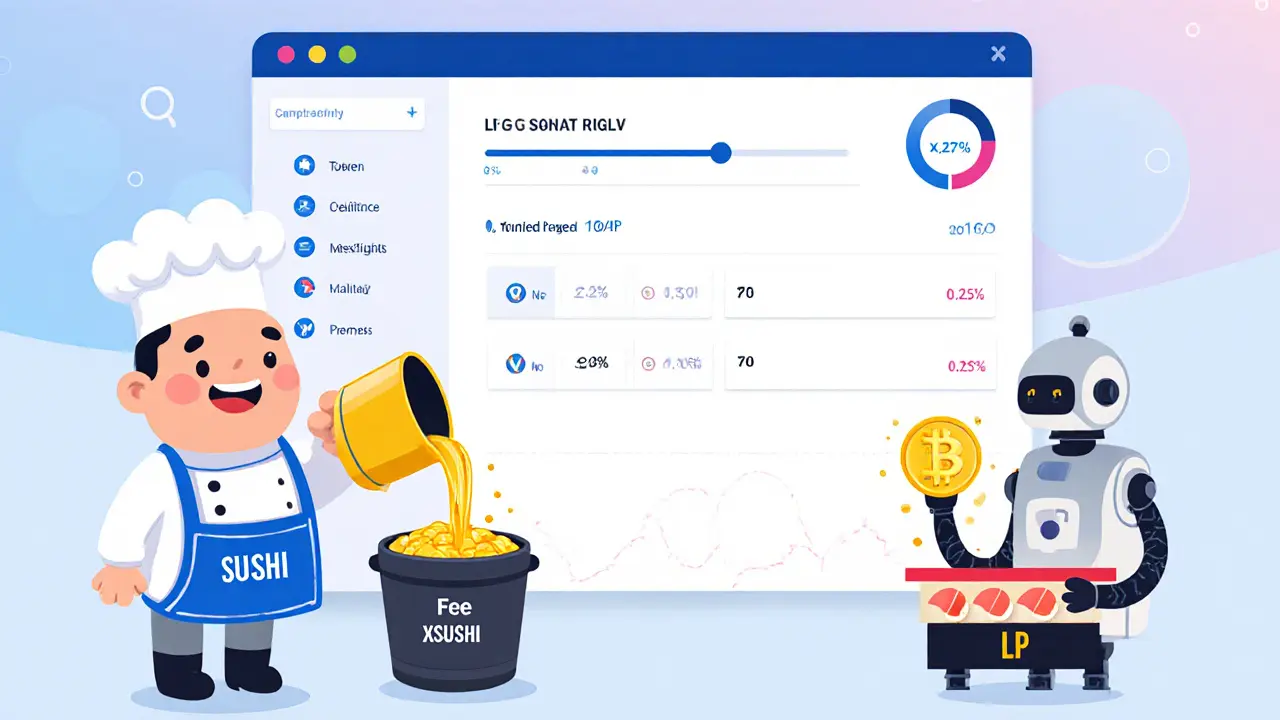
The fee model is split into two clear slices. Every trade incurs a 0.30 % protocol fee. Of that, 0.25 % goes straight to the LPs who supplied the pool, while 0.05 % is funneled to SUSHI holders who stake their tokens in the SushiBar (xSUSHI).
This dual‑tier system creates a direct incentive for both liquidity provision and token holding-a contrast to Uniswap, which sends the full 0.30 % only to LPs.
Additional reward programs include:
- Onsen Program: Boosted SUSHI rewards for new token pairs, encouraging early liquidity.
- Limit Orders & DCA (Dollar‑Cost Averaging): Launched July 8 2025, allow users to set price‑targeted swaps and recurring purchases.
Comparing SushiSwap V3 to Uniswap
| Feature | SushiSwap V3 (Core) | Uniswap |
|---|---|---|
| Launch Year | 2023 | 2018 |
| TVL (Oct 2025) | $3.99 B | ≈ $4.5 B |
| Average Spread | 0.634 % | ≈0.68 % |
| Fee Split | 0.25 % LPs / 0.05 % xSUSHI stakers | 0.30 % fully to LPs |
| Concentrated Liquidity | Yes (V3) | Yes (V3) |
| On‑Chain Limit Orders | Implemented (2025) | Not native |
| Token Variety (coins) | 3 | ≈ 50+ |
Bottom line: SushiSwap gives extra earnings to SUSHI holders and adds limit‑order functionality, but it still lags behind Uniswap on sheer token breadth.
User Experience & Interface
The UI is built with beginners in mind. The main swap screen is a single‑page form: select token, enter amount, click “Swap”. Connecting a wallet is a one‑click process via MetaMask or WalletConnect.
Advanced users can dive into the “Concentrated Liquidity” tab, which shows price‑range sliders and tick markers. The learning curve here is akin to options trading: you must understand price ticks, impermanent loss and gas costs.
Sushi Academy, the platform’s education hub, offers short videos, step‑by‑step guides and a glossary. It’s especially valuable for newcomers who might be intimidated by concepts like LP tokens or xSUSHI.
Security, Risks & Regulatory Landscape
Being a decentralized protocol, SushiSwap V3 is unaudited by any central regulator. The code is open‑source and community‑reviewed, but past incidents (e.g., flash‑loan exploits on early Sushi versions) remind users to stay vigilant.
Key risks include:
- Smart‑contract bugs: Vulnerabilities could lead to fund loss.
- Impermanent loss: Concentrated liquidity amplifies this when price moves outside your chosen range.
- Gas fees: Ethereum network congestion can make small swaps uneconomical.
- Regulatory uncertainty: No KYC/AML means higher compliance risk in some jurisdictions.
There is no demo account, so new users should start with tiny amounts to test the flow.
Future Outlook & Development Roadmap
Since July 2025 the team has added Limit Orders and DCA-features that bring DEXs closer to traditional order‑book exchanges. The roadmap hints at:
- Cross‑chain bridges beyond Polygon, potentially adding Arbitrum or Optimism.
- More UI‑driven analytics for LPs to track fees, APY and price‑range performance.
- Expansion of the Onsen Program to include low‑cap tokens, broadening yield opportunities.
Analysts forecast the SUSHI token could reach $0.87 by 2030, though that’s speculative. The platform’s survival will hinge on retaining liquidity, keeping gas‑costs manageable, and delivering user‑friendly upgrades faster than rivals.
Bottom Line: Should You Use SushiSwap V3 (Core)?
If you value lower fees, direct rewards for holding SUSHI, and the ability to set limit orders without leaving the DEX, SushiSwap V3 (Core) is a strong choice. It shines for traders who already own SUSHI or plan to stake it.
However, if you need access to a wide array of tokens or want a fully regulated environment, a centralized exchange or a larger DEX like Uniswap might serve you better.
Start small, explore Sushi Academy, and keep an eye on gas prices-those three habits will let you enjoy the benefits while limiting exposure.
Frequently Asked Questions
Is SushiSwap V3 (Core) safe to use?
The protocol is open‑source and has been audited by several firms, but like any DeFi platform it carries smart‑contract risk. Use small amounts at first and consider staking SUSHI only if you trust the code.
How do I earn rewards on SushiSwap V3?
Supply liquidity to any pool and you earn 0.25 % of each trade. Additionally, stake your SUSHI in the SushiBar to receive 0.05 % of all protocol fees as xSUSHI.
Can I trade fiat directly on SushiSwap?
Yes. The platform partners with fiat on‑ramp providers that accept bank transfers and Apple Pay, turning fiat into wrapped assets that can be swapped.
What is concentrated liquidity?
It lets LPs allocate capital to a specific price range instead of the whole curve, which can boost fee earnings but also raises impermanent‑loss risk if price moves outside that range.
How does SushiSwap V3 compare to Uniswap on fees?
Both charge a 0.30 % protocol fee, but SushiSwap splits 0.05 % to xSUSHI stakers, giving SUSHI holders a direct revenue share that Uniswap does not provide.




Comments (11)