Augur Prediction Market Calculator
Calculate potential earnings from betting on Augur prediction markets. Enter your bet amount and select the outcome you think will happen. The calculator will show what you'd earn if your prediction is correct.
Results will appear here after calculation
Augur isn’t a coin you buy to flip for quick profits. It’s not like Bitcoin or Ethereum, where value comes from speculation alone. Augur is a platform - a betting system built on Ethereum - and its token, REP, is the engine that keeps it running. If you’ve ever wondered how people predict election results, sports outcomes, or even stock movements using crypto, Augur is where it all happens - without a middleman.
How Augur Works: Betting on Real Events
Imagine a world where you can bet on whether the next U.S. president will be a Democrat or Republican - not through a shady offshore site, but on a blockchain that can’t be shut down. That’s Augur. Users create markets around real-world events: Will Bitcoin hit $100,000 by June 2025? Will the Fed cut interest rates this year? Will Taylor Swift release a new album before October? Once the event happens, the outcome is reported and settled automatically.
There are three roles:
- Market Creators - They propose the question and define the possible outcomes.
- Traders - They buy shares in outcomes they believe will happen. If they’re right, they cash out.
- Reporters - They use REP tokens to report what actually happened. Get it right? You earn fees. Get it wrong? You lose your stake.
There’s no CEO. No company. No bank. Just code running on Ethereum. That’s what makes it decentralized.
What Is REP? The Reputation Token
REP stands for Reputation. It’s not mined. You can’t earn it by staking like you do with Ethereum 2.0. You get REP by buying it on exchanges like Binance or Coinbase, or by winning it as a reporter.
Every REP token gives you a tiny slice of Augur’s total market fees - about 1/22,000,000 of all fees ever collected. That’s not much on its own, but here’s the kicker: REP is your credibility score. When you report an outcome, you lock up your REP. If your report matches what most other reporters say, you get rewarded. If you lie or mess up, you lose it.
This system is designed to make lying expensive. Why? Because if reporters are dishonest, the whole market collapses. So the protocol punishes bad behavior and rewards accuracy. It’s a self-correcting system.
In 2020, Augur upgraded from REPv1 to REPv2 to fix security flaws. If you held REP before then, your tokens were automatically swapped. No action needed. Today, all REP on the network is REPv2.
Why Augur Was a Big Deal - and Why It’s Struggling Now
When Augur launched its mainnet in July 2018, it was the first real decentralized prediction market. In its first month, over $1.5 million was staked across 800+ markets. It had backing from top crypto names, including Vitalik Buterin, who called it “one of the most promising use cases for decentralized oracles.”
But here’s the problem: it’s complicated.
Most people don’t want to learn how to report on whether a sports game ended in a draw or a win. They don’t want to deal with MetaMask wallet errors, dispute cycles, or gas fees. Traders just want to bet. Reporters want to be paid. But without enough reporters, markets can’t resolve. And without resolution, traders leave.
By 2023, daily active users dropped from 1,842 to just 627. Market share fell from 35% in 2020 to 22% in 2023. Newer platforms like Polymarket, with simpler interfaces and fiat on-ramps, pulled ahead with 45% of the decentralized market.
Trustpilot reviews show 78% of negative feedback blames the learning curve. One Reddit user lost 8.3 REP after misreporting a tennis match. Another earned 12.5 REP over six months by consistently getting it right. That’s the reality: it’s a game of skill, not luck.

How to Use Augur (If You’re Still Interested)
Using Augur isn’t like opening a Coinbase account. Here’s what you need:
- An Ethereum wallet (MetaMask is the most common).
- Ethereum (ETH) to pay for gas fees.
- REP tokens to report outcomes (if you’re acting as a reporter).
- Patience. The interface is clunky. The help docs are dense.
First, go to app.augur.net and connect your wallet. You’ll see hundreds of open markets - political, sports, tech, even weather. Pick one. Buy shares in the outcome you think will happen. If you’re right when the event ends, you get paid in ETH.
Want to be a reporter? You need REP. When a market closes, you’ll get a notification to report the outcome. Choose the correct result. If you’re in the majority, you earn a cut of the fees. If you’re wrong? Your REP gets slashed.
Most new users take 3-5 hours to get comfortable. GitHub has over 1,200 contributions to its FAQ because people keep asking the same questions: How do I dispute? Why is my transaction stuck? What does “invalid” mean?
The “Invalid” Outcome - A Clever Anti-Scam Feature
Every Augur market has a hidden option: Invalid. It’s not a typical outcome. It’s a safety net.
Let’s say someone creates a market: Will Elon Musk become U.S. president in 2026? That’s impossible - he’s not eligible. But if the market didn’t have an “Invalid” option, people might bet on it anyway, hoping to manipulate prices or scam others.
With “Invalid,” reporters can declare the market void if the question is nonsensical, ambiguous, or fraudulent. If “Invalid” wins, all traders get their money back. Reporters who choose “Invalid” correctly earn rewards. Those who try to trick the system lose REP.
This feature stops scams before they start. It’s one of the smartest parts of Augur’s design.
Regulatory Risks and the Future of Augur
Augur operates in a legal gray zone. In 78% of countries, prediction markets aren’t clearly legal or illegal. The U.S. Commodity Futures Trading Commission (CFTC) has warned that platforms like Augur could be classified as unregistered gambling or derivatives exchanges.
That’s why most users are crypto-native. Only 13% of Augur users don’t hold other DeFi tokens. It’s still a niche tool for tech-savvy believers.
Looking ahead, Augur’s future depends on Ethereum scaling. The team plans to move to Optimism’s Layer 2 by Q2 2024. That means lower fees, faster trades, and better UX. If they pull it off, it could bring back users. If they don’t, Augur may fade into crypto history - a brilliant idea ahead of its time.
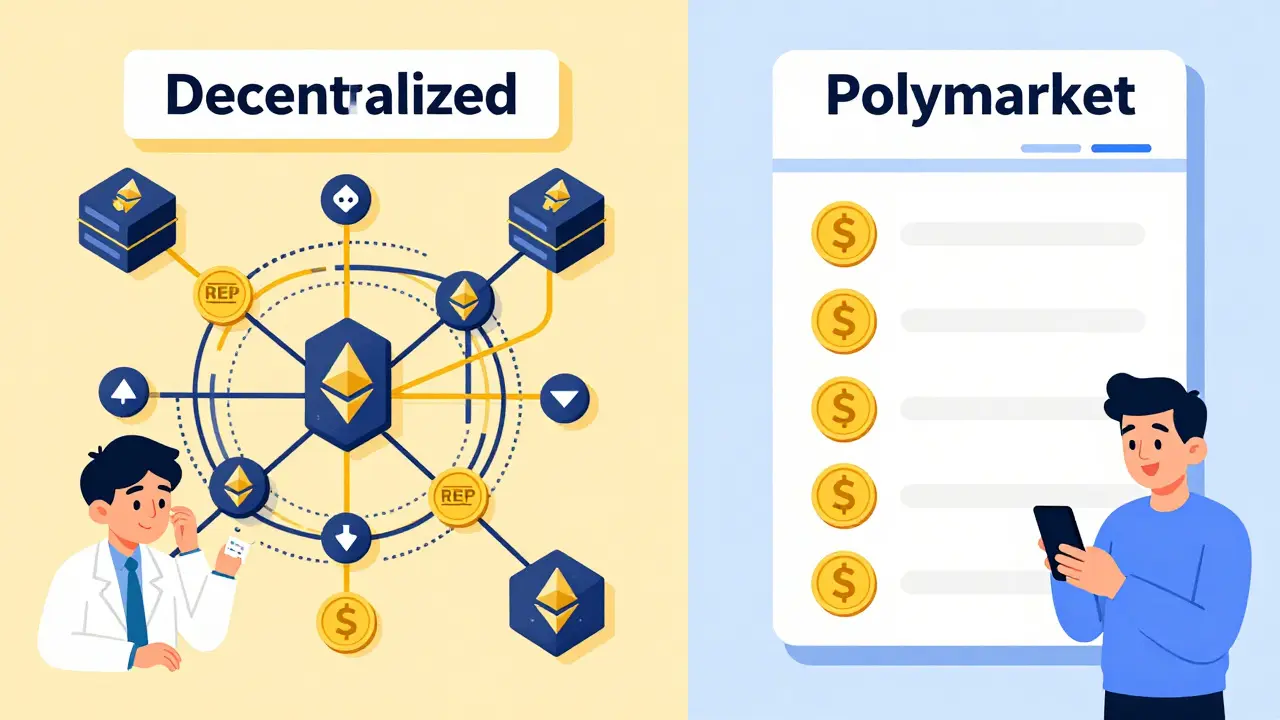
Augur vs. Polymarket: The Real Competition
Here’s how Augur stacks up against its biggest rival:
| Feature | Augur | Polymarket |
|---|---|---|
| Decentralized? | Yes - fully on-chain | No - centralized backend |
| Token Used | REP (Ethereum-based) | None - uses USDC |
| Learning Curve | Steep - requires understanding reporting | Easy - like betting on DraftKings |
| Fees | Higher (Ethereum gas) | Lower (Layer 2) |
| Market Volume (Q3 2023) | $19.2M | $45.6M |
| Regulatory Risk | High - fully decentralized | Lower - KYC required |
Polymarket wins on usability. Augur wins on ideology. If you care about censorship resistance and true decentralization, Augur is still the only option. If you just want to bet on the next presidential election without reading a 50-page manual, Polymarket is easier.
Who Should Use Augur?
Augur isn’t for everyone. It’s for people who:
- Believe in decentralized systems and want to help build them
- Enjoy analyzing real-world events and predicting outcomes
- Don’t mind a steep learning curve and occasional bugs
- Want to earn passive income by reporting accurately
If you’re looking for a quick crypto flip, skip it. If you’re curious about how blockchain can replace traditional institutions - and you’re willing to put in the work - Augur is one of the most fascinating experiments in crypto.
Is Augur (REP) a good investment?
REP isn’t a traditional investment. Its value doesn’t come from price speculation alone. It’s a utility token tied to the health of the Augur platform. If usage grows, REP could gain value from fees. But if the platform stays stagnant, REP’s price will likely stay flat or decline. Don’t buy it hoping to get rich. Buy it if you want to participate in prediction markets.
Can I mine REP tokens?
No, you cannot mine REP. Unlike Bitcoin, REP isn’t created through mining. All REP was distributed during the 2015 ICO. Today, you can only get REP by buying it on exchanges or earning it as a reporter by correctly predicting outcomes on the platform.
What happens if no one reports on a market?
If no one reports within the reporting window, the market enters a dispute phase. Anyone can step in to report, but they must stake REP. If their report matches the final consensus, they earn rewards. If not, they lose their stake. This system ensures markets always resolve - but only if enough people care enough to participate.
Why does Augur use Ethereum?
Augur runs on Ethereum because it needs smart contracts to automate market creation, trading, and dispute resolution. Ethereum’s open, permissionless network lets anyone interact with Augur without approval. Other blockchains don’t offer the same level of security, developer tools, or community trust that Ethereum has.
Is Augur legal?
Augur’s legal status is unclear. In many countries, prediction markets fall into a gray area between gambling, derivatives trading, and information markets. While users haven’t been targeted yet, regulators in the U.S., UK, and EU have issued warnings. Always check your local laws before participating.
Final Thoughts
Augur is crypto’s quiet rebel. It doesn’t chase trends. It doesn’t have a flashy app or celebrity endorsements. It’s just code - stubborn, complex, and principled. It’s not the biggest prediction market anymore. But it’s still the purest. If you believe in open systems, transparency, and trustless technology, Augur is worth understanding - even if you never place a single bet.