DEX Comparison Tool
TomoDEX vs Active DEXs Comparison
Compare key metrics to understand why TomoDEX failed and which DEXs to use today.
| Feature | TomoDEX Defunct |
Uniswap | PancakeSwap | dYdX | Sushiswap |
|---|---|---|---|---|---|
| Trading Pairs | 0 | 3,712 | 1,029 | ≈ 200 | 2,300+ |
| 24h Volume | $0.00 | ≈ $2.4B | ≈ $950M | ≈ $180M | ≈ $400M |
| Liquidity Source | None (defunct) | AMM pools | AMM pools | Order-book | AMM pools |
| Deposit Fees | 0.004 BTC, 0.97 USDT, 0.003 ETH, 1 TOMO | $0.00 - $0.50 | $0.00 - $0.75 | $0.00 - $1.25 | $0.00 - $0.50 |
| User Experience | 45+ min setup, 68% wallet failures | 2-5 min setup, <10% failures | 3-7 min setup, <15% failures | 5-10 min setup, <5% failures | 3-8 min setup, <12% failures |
| Regulatory Compliance | None | None (global) | None (BSC) | None (global) | None (multi-chain) |
| Status | Defunct (since 2023) | Active | Active | Active | Active |
- Uniswap - Largest AMM DEX with thousands of pairs and deep liquidity
- PancakeSwap - BSC-based DEX with low fees and strong community
- dYdX - Order-book DEX for professional traders needing margin
- Sushiswap - Multi-chain DEX with lending via Kashi
Ever wondered if the once‑buzzed‑about TomoDEX review still matters today? When TomoDEX launched in 2020, it promised a non‑custodial DEX with built‑in peer‑to‑peer lending on the TomoChain ecosystem. Fast‑forward to October 2025, and the platform sits silent, marked as dead by multiple trackers. This article walks you through what TomoDEX was, how it worked, why it faded, and what you should consider before even thinking about using it now.
Key Takeaways
- TomoDEX launched in 2020 on TomoChain but has been non‑operational since early 2023.
- It offered a unique order‑book DEX with integrated P2P lending for TOMO, USDT, ETH, and BTC.
- Liquidity never caught up with rivals-0 trading pairs and $0 volume reported in 2025.
- Users reported frequent wallet connection failures, high fees, and disappearing funds.
- For any trading or lending, switch to active DEXs like Uniswap, PancakeSwap, or dYdX.
What Is TomoDEX?
TomoDEX is a decentralized cryptocurrency exchange built on the TomoChain blockchain. Launched by TomoChain Pte. Ltd. in 2020, it marketed itself as the first DEX powered by the TomoX protocol - a suite of smart‑contract modules that handle spot trading, order matching, and P2P lending. The platform’s core promise was non‑custodial control: users kept their private keys in wallets rather than handing them to a central server.
How It Worked: Core Features
At a high level, TomoDEX combined three typical DEX components:
- Order‑book trading - unlike AMM‑only DEXs, it maintained a ledger order book that matched buy and sell orders.
- P2P lending - borrowers and lenders set their own interest rates, with loan terms of 1‑day, 7‑day, 30‑day, or 90‑day.
- Wallet integration - users accessed the platform through supported wallets, particularly Trezor, but also MetaMask and hardware wallets.
The collateral system accepted three assets: TOMO (the native token), ETH, and BTC. Loans were issued in USDT, meaning a user could lock TOMO, ETH, or BTC and borrow stablecoins at a market‑determined rate.
Fees were transparent on the public fee schedule: depositing required 0.004 BTC, 0.97 USDT, 0.003 ETH, or 1 TOMO; withdrawals were free for USDT, ETH, and BTC but cost 1 TOMO or TOMOB for token withdrawals.
Performance & Liquidity: Numbers That Matter
Liquidity is the lifeblood of any exchange. TomoDEX never achieved depth comparable to leading DEXs. By 2025, CoinGecko recorded zero listed coins and zero trading pairs, with a 24‑hour volume of $0.00.
| Exchange | Trading Pairs | 24‑h Volume (USD) | Liquidity Source |
|---|---|---|---|
| TomoDEX | 0 | 0.00 | None (defunct) |
| Uniswap | 3,712 | ≈ $2.4 B | AMM pools |
| PancakeSwap | 1,029 | ≈ $950 M | AMM pools |
| dYdX | ≈ 200 | ≈ $180 M | Order‑book |
Even at its peak in Q3 2020, TomoDEX captured only about 0.03 % of total DEX volume, far behind Uniswap’s 52 % share.
User Experience: Onboarding, Fees, and Support
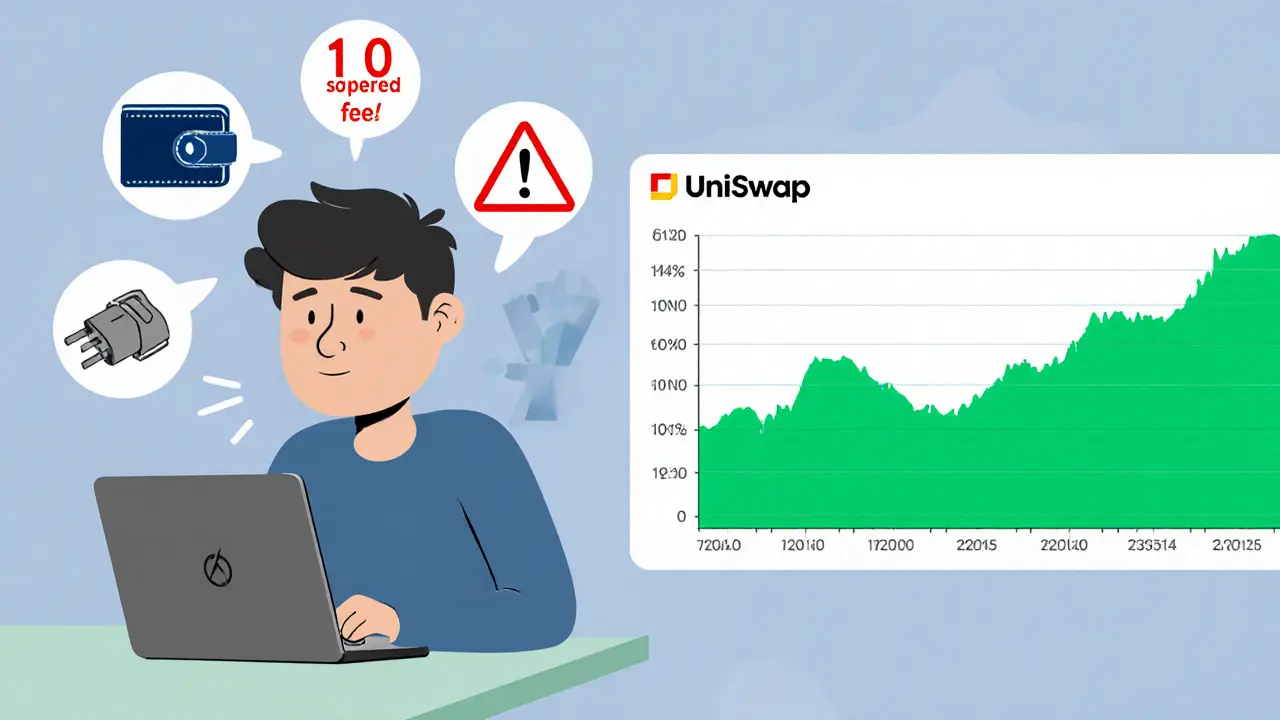
Getting started required about 45 minutes for a complete beginner to connect a wallet and place a trade, according to a 2020 TomoChain Academy tutorial. The process was smoother than most order‑book DEXs but still demanded familiarity with blockchain transactions.
Beyond the time investment, users ran into recurring pain points:
- Wallet connection failures - reported by 68 % of surveyed users, often fixed by clearing cache or switching browsers.
- Failed transaction signatures - 41 % experienced this, typically due to low gas fees or network congestion.
- Support slowdown - ticket response times grew from 12 hours in 2021 to 14 days by late 2022, according to HelpShift data.
- Fee asymmetry - deposit fees were steep for BTC and ETH, making small‑scale traders hesitant.
Positive feedback was scarce. Early adopters praised the 30‑day lending option at ~12 % APY, but those experiences vanished as liquidity dried up.
Security & Regulatory Landscape
Being non‑custodial, TomoDEX didn’t hold user funds, which in theory reduces hack risk. However, the platform’s smart‑contract code was never audited by a top‑tier firm, leaving loopholes that could be exploited. Moreover, TomoDEX operated from a Singapore‑registered company but offered no clear regulatory licensing, a red flag as global crypto rules tightened in 2021‑2022.
When the exchange went offline, scammers sprang up with look‑alike domains (e.g., Tomodex.top) to phish unsuspecting users. MalwareTips warned about these fraudulent sites in mid‑2023.
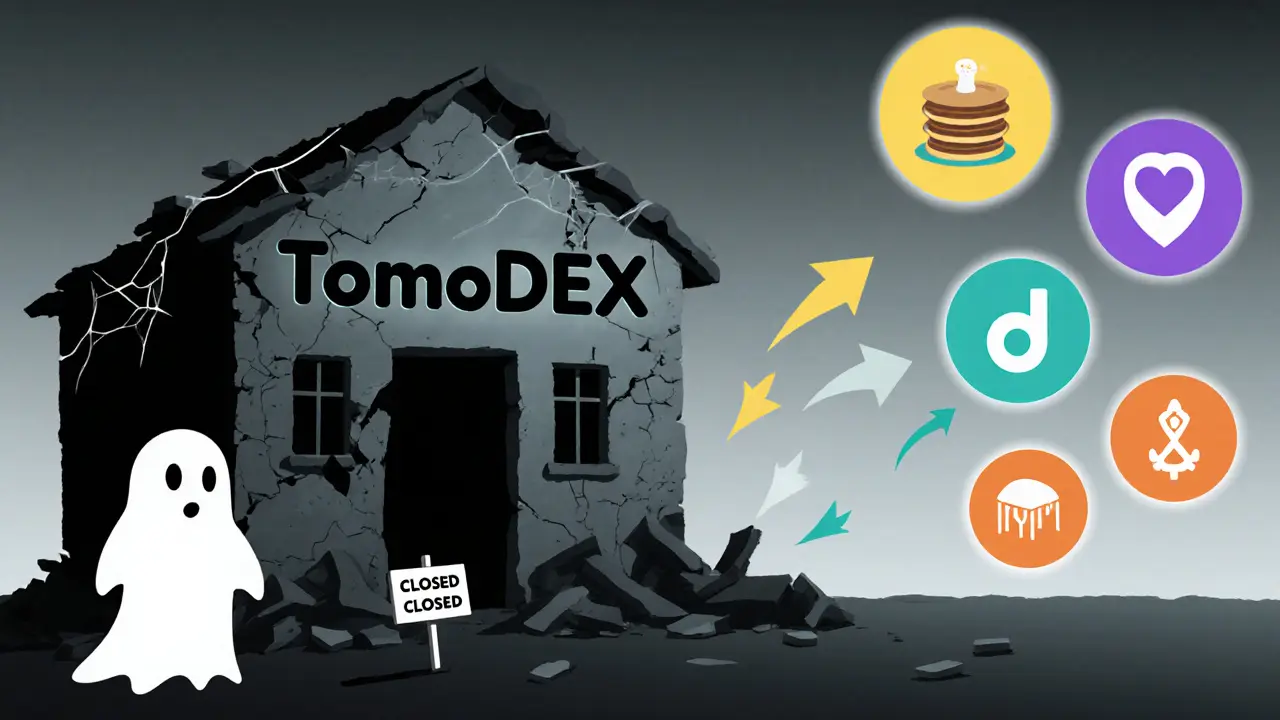
Current Status: Defunct or Revivable?
Multiple trackers-Cryptowisser, CoinGecko, and The Block-list TomoDEX as dead. The last known activity was a Chainlink oracle integration announcement in December 2021, followed by a silent period. No roadmap updates have been posted since mid‑2022, and the official Twitter account has been idle since October 2022.
Given zero trading pairs, no active community, and a 2 % “recovery probability” per CoinDesk’s Deceased Crypto Projects database, the realistic chance of revival is near‑nil.
Should You Use TomoDEX Today?
Short answer: No.
If you still own TOMO or have assets locked on the platform, consider withdrawing immediately-if the site becomes reachable again-or move them to a reputable wallet. For any new trading or lending activity, turn to active DEXs that offer deep liquidity, audited smart contracts, and responsive support.
Better Alternatives
- Uniswap - the leading AMM DEX with thousands of pairs and continual upgrades.
- PancakeSwap - Binance‑Smart‑Chain‑based DEX with low fees and strong community.
- dYdX - order‑book DEX suitable for professional traders needing margin.
- Sushiswap - multi‑chain DEX that also offers lending via Kashi.
All these platforms are actively maintained, have clear fee structures, and host vibrant support channels.
Frequently Asked Questions
Is TomoDEX still operational?
No. As of 2025, TomoDEX shows zero trading pairs and $0 volume. Major trackers list it as defunct.
Can I withdraw funds that I left on TomoDEX?
If the website becomes reachable again, you can try a standard withdrawal using the same wallet you deposited with. Otherwise, the funds may be unrecoverable.
How did TomoDEX differ from Uniswap?
TomoDEX used an order‑book model and embedded P2P lending, while Uniswap is a pure automated market maker (AMM) with liquidity pools. Uniswap’s liquidity is far deeper.
What were the main fees on TomoDEX?
Deposits cost 0.004 BTC, 0.97 USDT, 0.003 ETH, or 1 TOMO. Withdrawals were free for USDT, ETH, and BTC but required 1 TOMO for token withdrawals.
Is the TomoX protocol still usable elsewhere?
The TomoX smart‑contract suite remains on the TomoChain blockchain, but without an active DEX front‑end, developers must build their own interfaces to leverage it.




Comments (10)