Every time you sell Bitcoin, trade Ethereum for Solana, or even use crypto to buy coffee, the IRS sees a taxable event. Starting in 2025, the rules got stricter. If you own cryptocurrency, you must report every single transaction on Form 8949 - no exceptions, no loopholes. Even if you didn’t make a profit. Even if you didn’t get a 1099 form. The IRS isn’t guessing anymore. They’re tracking everything.
What Is Form 8949 and Why Does It Matter?
Form 8949 is the IRS’s official form for reporting the sale or exchange of capital assets. That includes stocks, real estate, and now - cryptocurrency. The IRS treats crypto as property, not money. That means every trade, every sale, every swap triggers a capital gain or loss. Form 8949 forces you to list each one, line by line.It’s not optional. It’s not a suggestion. The IRS has been auditing crypto users since 2021, and in 2025, they’ve got new tools. Form 1099-DA is now required from exchanges, but it only reports gross proceeds - not your cost basis. That means you still have to calculate your own profit or loss. If you skip Form 8949, you’re risking an audit, penalties, or worse.
What Transactions Must You Report?
You don’t just report selling crypto for dollars. You report every time you dispose of crypto:- Selling Bitcoin for USD
- Trading Ethereum for Dogecoin
- Using Litecoin to buy a laptop
- Sending crypto to a friend as a gift (if it’s over $18,000)
- Receiving crypto from a fork or airdrop and later selling it
- Staking rewards that you later trade or spend
Even if you broke even, you still have to report it. The IRS doesn’t care if you lost money. They care that you moved the asset. A single trade between two cryptos counts as two taxable events: you sold one, you bought another.
What Information Goes on Form 8949?
Each line on Form 8949 needs six exact details:- Description of property: “BTC,” “ETH,” “UNI,” etc.
- Date acquired: The exact day you got the crypto - not when you bought it, but when it landed in your wallet.
- Date sold or disposed: The day you traded, sold, or spent it.
- Gross proceeds: The USD value at the time of sale or trade. Use the exchange rate from the date and time of the transaction.
- Cost basis: What you paid for it, including fees. This is the hardest part.
- Gain or loss: Gross proceeds minus cost basis. If negative, it’s a loss.
Example: You bought 0.5 BTC for $18,000 on March 15, 2023. On January 10, 2025, you traded it for 12 ETH when BTC was $42,000. Your gross proceeds are $21,000. Your cost basis is $18,000. Your gain is $3,000. That’s one line on Form 8949.
Short-Term vs. Long-Term: The Big Difference
Form 8949 splits your trades into two categories:- Short-term: Held one year or less. Taxed at your regular income rate - up to 37% in 2025.
- Long-term: Held more than one year. Taxed at lower rates - 0%, 15%, or 20%, depending on your income.
That’s why holding crypto for over a year matters. A $10,000 gain held for 11 months could cost you $3,700 in taxes. Hold it 13 months? Maybe just $1,500. The difference isn’t just math - it’s money in your pocket.
Form 1099-DA Is Here - But It’s Not Enough
Starting in 2025, exchanges like Coinbase, Kraken, and Binance must send you Form 1099-DA. Sounds good, right? Not quite.Form 1099-DA only reports gross proceeds - the total USD value of your sales. It doesn’t tell you your cost basis. That’s still on you. And it doesn’t cover:
- Transfers between your own wallets
- DeFi swaps on Uniswap or Aave
- P2PE trades
- Airdrops or hard forks
So even if you get a 1099-DA, you still need to pull data from your wallets, DeFi platforms, and blockchain explorers. You can’t rely on the exchange. You still need Form 8949.
Wallet-by-Wallet Accounting: The New Rule
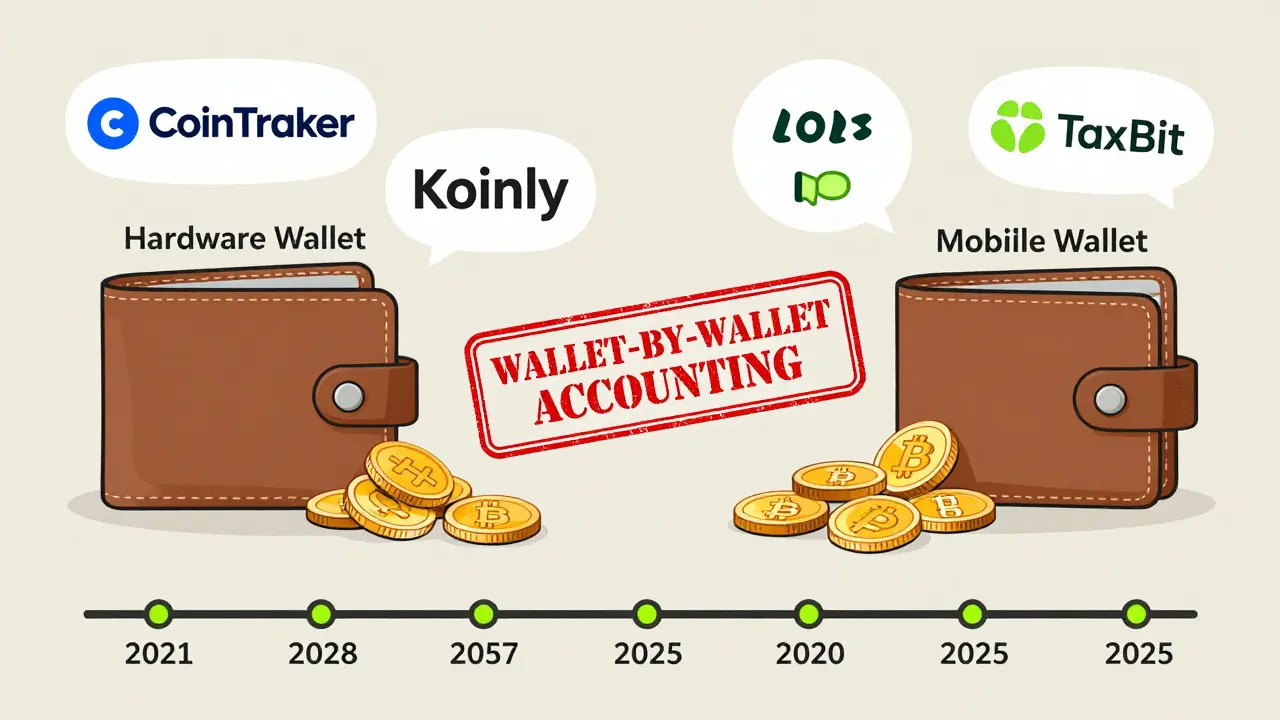
Before 2025, you could use “universal accounting” - averaging your cost basis across all your Bitcoin holdings. No more.Starting January 1, 2025, the IRS requires wallet-by-wallet accounting. That means if you bought 1 BTC in 2021 for $30,000 and another in 2024 for $60,000, you can’t average them. When you sell, you must track which specific coins you sold. This is called specific identification.
It’s messy. If you transferred coins between wallets, you need to know the original purchase date and price for each one. If you used a hardware wallet and a mobile wallet and a custodial exchange, you now have three separate ledgers to reconcile. This is why most people use crypto tax software.
How to Track Everything Without Losing Your Mind
Most people who file Form 8949 for crypto use software. Here are the top tools trusted by tax pros:- CoinTracker: Best for beginners. Connects to most exchanges and wallets. Auto-calculates gains.
- Koinly: Strong on DeFi and NFTs. Good for complex traders.
- TaxBit: Used by accountants. Handles large portfolios and multi-jurisdictional transactions.
These tools pull transaction history from your wallets and exchanges. They calculate cost basis using FIFO, LIFO, or specific identification. Then they generate Form 8949 and Schedule D automatically.
But they’re not perfect. Airdrops, forks, and gas fees can trip them up. Always review the final report. Check one or two random transactions manually. If your software says you made $5,000 on a trade you don’t remember, dig deeper.
What Happens If You Don’t File?
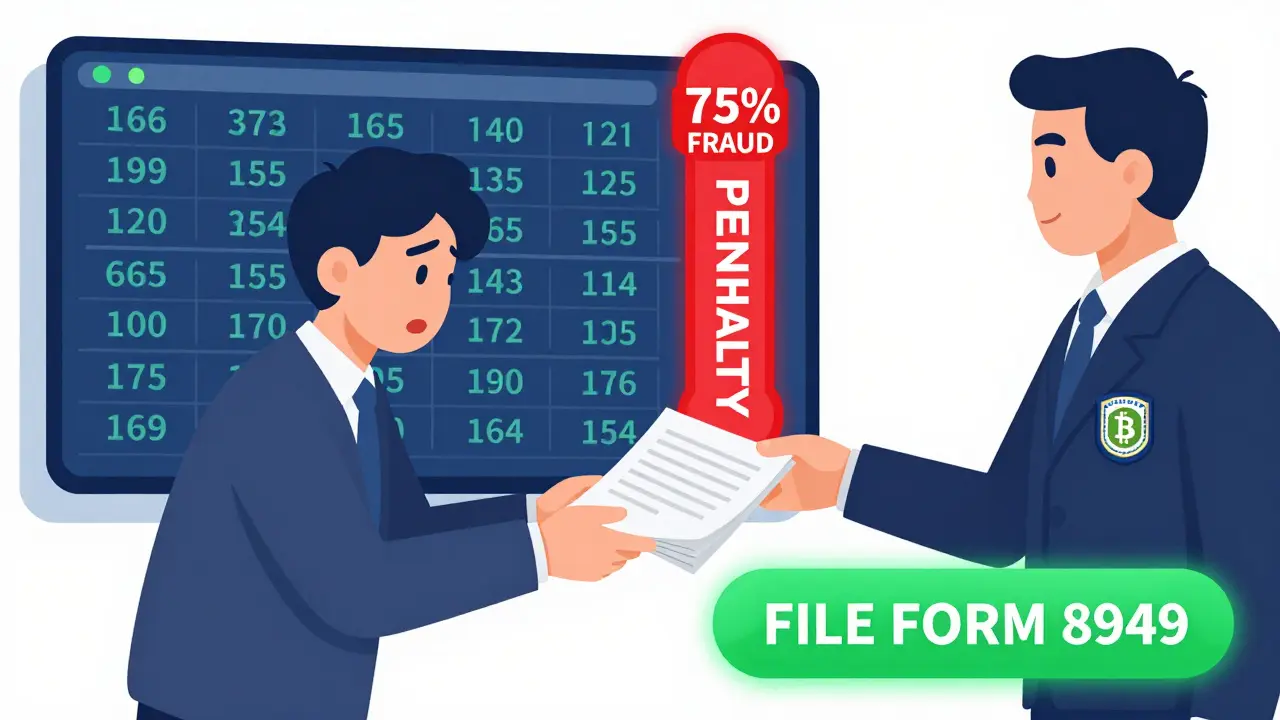
The IRS has a crypto-specific audit team. They cross-reference exchange data with your tax return. If you didn’t file Form 8949 but your exchange sent a 1099-DA, you’ll get a letter. First, it’s a notice. Then, a penalty.Penalties for underreporting can be:
- 20% of the underpaid tax (for negligence)
- 75% if the IRS proves fraud
- Up to $10,000 per unreported transaction for failure to file
Worse, if you’re audited and can’t prove your cost basis, the IRS assumes your basis is $0. That means your entire sale amount is taxable. If you sold $50,000 in crypto and have no records? You owe tax on $50,000 - not $5,000 profit.
Pro Tips to Avoid Mistakes
- Record every transaction as it happens. Don’t wait until December.
- Save screenshots of trade confirmations and wallet addresses.
- Use a consistent exchange rate source (CoinMarketCap or CoinGecko timestamps).
- If you received crypto as income (staking, mining, airdrops), report it on Schedule 1 - not Form 8949.
- Keep records for at least seven years. The IRS can audit you for that long.
When to Call a Pro
If you’ve done more than 20 crypto transactions this year, or if you’ve used DeFi, NFTs, or multiple wallets, hire a CPA who specializes in crypto. General tax preparers don’t know the rules. A crypto-savvy accountant will know how to handle:- Loss harvesting to offset gains
- Correctly allocating cost basis across wallets
- Handling foreign exchanges
- Filing amended returns if you made past errors
It’s not expensive. Most crypto tax CPAs charge $300-$800 to file Form 8949. That’s cheaper than an IRS penalty.
What’s Next After 2025?
In 2026, Form 1099-DA will start reporting cost basis too. That’s a big step forward. But until then, you’re still on the hook. The IRS is also pushing for clearer rules on DeFi, staking, and NFTs. Don’t assume the rules will get easier. They’re getting tighter.Bottom line: Crypto isn’t tax-free. It’s not a gray area. Form 8949 is your legal responsibility. Do it right, or pay the price.
Do I have to report crypto if I didn’t sell it?
No, you only report crypto when you sell, trade, spend, or exchange it. Holding crypto without disposing of it is not a taxable event. But if you bought crypto with fiat and never touched it, you don’t need to report it on Form 8949.
What if I lost money on crypto trades?
You still report every loss on Form 8949. Losses offset gains first. If you have more losses than gains, you can deduct up to $3,000 per year against your ordinary income. Any extra losses roll over to next year.
Do I report crypto received from airdrops or forks?
Yes. When you receive crypto from an airdrop or hard fork, you owe income tax on its fair market value at the time you gain control of it. That value becomes your cost basis. When you later sell it, you report the gain or loss on Form 8949.
Can I use FIFO for crypto cost basis?
Yes, but only if you don’t specifically identify which coins you sold. FIFO (first in, first out) is the default method if you don’t track individual coins. But since 2025, the IRS requires wallet-by-wallet accounting, which means you must track each coin’s origin. FIFO is still allowed, but it’s not always the most tax-efficient method.
Do I need to report crypto transactions under $600?
Yes. The $600 threshold applies only to Form 1099-NEC for income, not capital gains. There’s no minimum for crypto sales. Even a $5 trade must be reported on Form 8949 if you made a profit or loss.
What if I used a non-U.S. exchange?
You still must report all crypto transactions, regardless of where the exchange is based. The IRS has jurisdiction over U.S. taxpayers’ worldwide income. If you used Binance, KuCoin, or any foreign platform, you’re still required to file Form 8949. You may need to manually export transaction history from those platforms.