You try to log in, and the screen goes blank. A message pops up: "Service unavailable in your region." It’s frustrating, especially when you know people just across the border are trading freely. This is the reality for millions of crypto users today. The difference between a Centralized Exchange (CEX) and a Decentralized Exchange (DEX) isn't just about who holds your keys; it's about who decides if you can access them at all.
In 2026, the gap between these two worlds is widening. Regulators are cracking down on centralized platforms with surgical precision, while decentralized protocols are fighting to stay open. If you live in a restricted jurisdiction, understanding this divide is the only way to keep your assets moving. Here is how geographic restrictions work, why they exist, and what they mean for your wallet.
Why Centralized Exchanges Block You
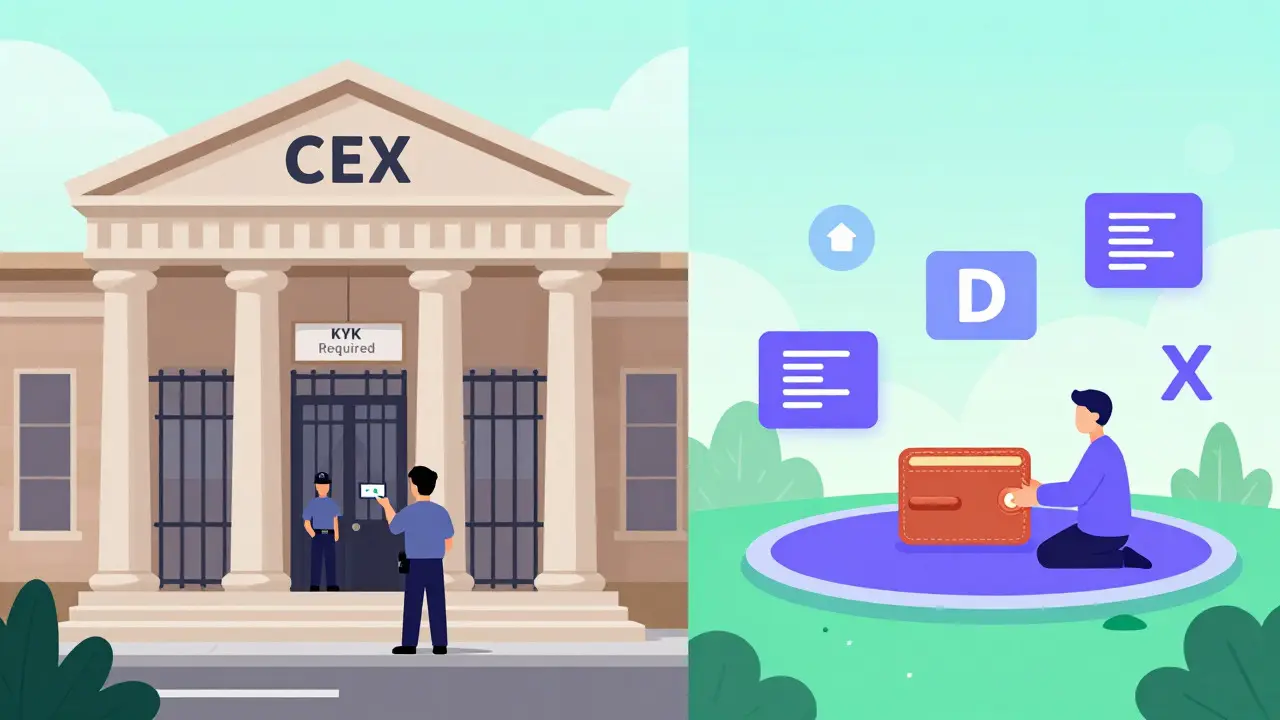
A Centralized Exchange operates like a traditional bank. It has a physical headquarters, a legal team, and a license to operate. Because it acts as an intermediary holding your funds, it is legally responsible for preventing money laundering and terrorist financing. This responsibility comes with a heavy price: compliance.
To comply, CEXs must implement strict Know Your Customer (KYC) procedures. Before you can trade significant amounts, you upload your passport, take a selfie, and prove your address. But KYC is only half the battle. The other half is geographic filtering.
Regulators in countries like the United States, China, and parts of the European Union have specific rules. For example, U.S. regulators may ban certain high-risk tokens or restrict derivatives trading for retail investors. Since a CEX wants to keep its banking licenses, it cannot afford to ignore these laws. So, they build walls.
- IP Address Blocking: The exchange checks your internet connection's location. If it matches a banned country, access is denied instantly.
- Device Fingerprinting: Advanced systems analyze your browser and device history to detect if you've ever been associated with a restricted region.
- Banking Sanctions: Even if you get past the login, fiat withdrawals often fail because local banks refuse to process transactions linked to sanctioned entities or regions.
The result is a patchwork world. One user in Berlin might have full access, while their neighbor in a neighboring country with stricter local laws gets locked out. The centralization that makes CEXs easy to use also makes them easy to shut down.
The Illusion of Freedom on Decentralized Exchanges
Now, look at the other side. A Decentralized Exchange has no CEO, no headquarters, and no customer support line. It consists of Smart Contracts running on a blockchain like Ethereum or Solana. When you trade on a DEX, you are interacting directly with code.
Because there is no central entity to sue or fine, DEXs traditionally offered true global accessibility. You connect your wallet-like MetaMask or Phantom-and you trade. No ID required. No IP check. Theoretically, anyone with an internet connection can participate. This is the core promise of DeFi (Decentralized Finance): permissionless finance.
However, "theoretically" is doing a lot of heavy lifting in 2026. While the protocol itself cannot easily block you, the bridges to and from the real world can. Most DEXs do not handle fiat currency. You need cryptocurrency to start. If your local bank blocks transfers to crypto ramps, you are stuck before you even reach the DEX.
Furthermore, the rise of Layer 2 Solutions like Arbitrum or Optimism has complicated things. These networks speed up transactions but often rely on sequencers or interfaces that *can* be pressured by regulators. We are seeing early signs of Layer 2 providers implementing subtle geographic filters to protect themselves, blurring the line between centralized control and decentralized freedom.
How Access Mechanisms Differ
The technical architecture of each platform dictates how restrictions are enforced. Understanding this helps you see where the choke points are.
| Feature | Centralized Exchange (CEX) | Decentralized Exchange (DEX) |
|---|---|---|
| Identity Verification | Mandatory KYC/AML checks | None (Wallet-only) |
| Geographic Filtering | Strict IP & Device blocking | Minimal (Protocol level) |
| Fiat On-Ramp | Built-in (Card/Bank Transfer) | External (Third-party bridges) |
| Regulatory Target | High (Easy to sanction) | Low (Hard to target) |
| User Responsibility | Platform handles security | User manages keys & risk |
On a CEX, the order book is controlled by the company. They can remove a token from listing overnight if a regulator demands it. On a DEX, liquidity is provided by users through pools. To stop trading, a regulator would need to censor the entire network, which is nearly impossible for public blockchains. However, they can target the front-end interfaces-the websites you use to interact with the DEX. If a DEX website is blocked in your country, you can still access the underlying smart contracts using alternative interfaces or command-line tools, but this requires technical skill.
The Regulatory Gray Zone in 2026
The landscape has shifted significantly since the early days of crypto. In 2026, regulators are no longer just watching; they are adapting. The U.S. Securities and Exchange Commission (SEC) and the European Union's Markets in Crypto-Assets (MiCA) regulation have set new standards.
MiCA, fully implemented across the EU, creates a clear framework for CEXs. It mandates strict consumer protections but also clarifies that decentralized protocols operating without a central administrator fall into a different category. This has led to a strange situation: CEXs are safer but more restrictive, while DEXs are freer but riskier.
For users in restricted regions, this means relying on DEXs is becoming the default strategy. But it’s not without pitfalls. Some DEX aggregators, which help you find the best prices across multiple pools, have started integrating KYC checks for large trades to avoid being classified as money service businesses. The pressure is mounting on the infrastructure layer, not just the application layer.
We are also seeing increased scrutiny on Stablecoins. USDT and USDC issuers actively blacklist wallets associated with sanctioned entities. If you use a DEX to trade against a stablecoin, and your wallet is flagged, your funds could be frozen. This introduces a form of geographic restriction that bypasses the exchange entirely and hits your personal wallet.
Navigating Restrictions: Practical Steps
If you are facing geographic restrictions, here is how to navigate the current environment safely and effectively.
- Verify Your Status: Check if your country is explicitly banned by major CEXs like Binance or Coinbase. If so, assume you will face issues with any centralized platform.
- Use Non-Custodial Wallets: Move away from exchange-hosted wallets. Use hardware wallets like Ledger or Trezor to store your assets. This ensures you control your private keys, regardless of what happens to the exchanges.
- Leverage DEX Aggregators: Tools like 1inch or Matcha scan multiple DEXs to give you the best rate. While some aggregators are adding restrictions, many remain accessible via direct contract interaction.
- Be Cautious with Stablecoins: Understand that algorithmic stablecoins or decentralized stablecoins like DAI may offer less censorship resistance than expected due to oracle dependencies. Diversify your holdings.
- Check Local Laws: Just because you *can* access a DEX doesn't mean you *should*. Ignoring local regulations can lead to legal trouble, including asset seizure or fines. Knowledge is your first line of defense.
The goal isn't to evade the law, but to understand the technological options available to you. In a fragmented regulatory world, sovereignty over your assets starts with understanding the tools.
Security Implications of Geographic Blocks
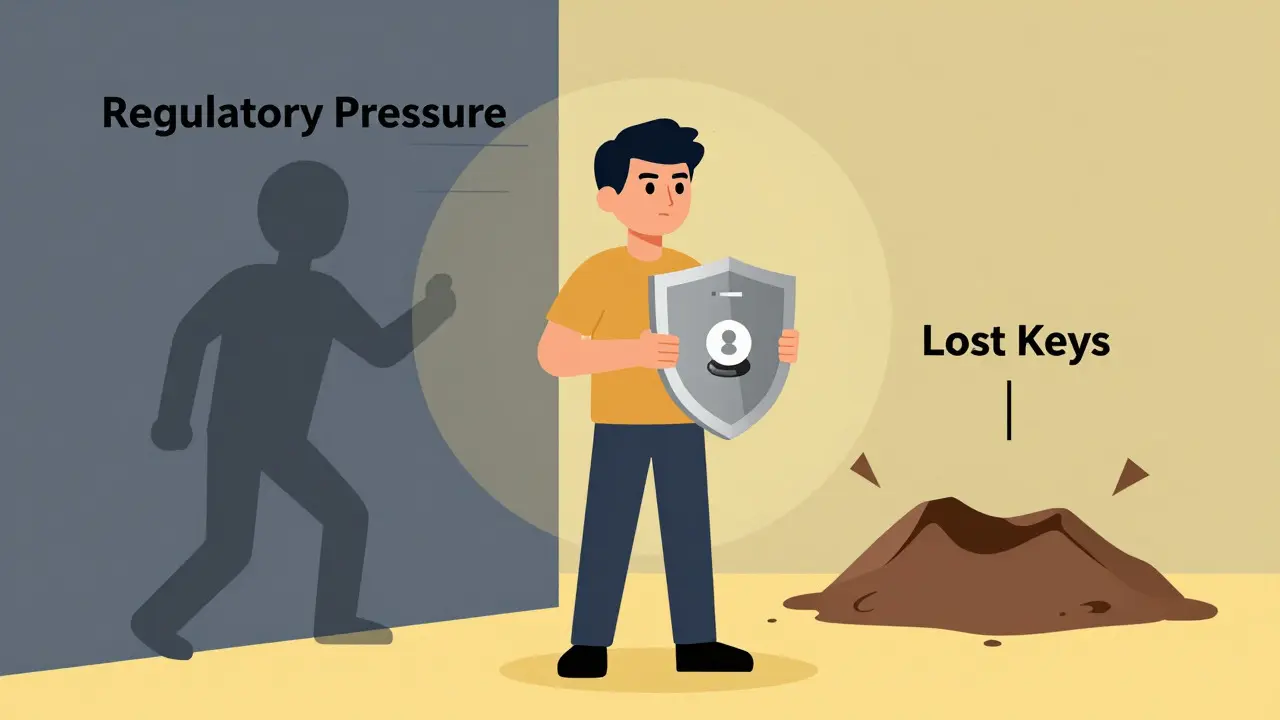
When you are forced off a CEX due to geographic restrictions, you lose more than just convenience; you lose institutional security. CEXs offer insurance funds, multi-signature cold storage, and recovery services if you lose your password. DEXs offer none of this.
On a DEX, if you lose your seed phrase, your money is gone forever. If you send funds to the wrong address, there is no support team to reverse the transaction. This shift in responsibility is the hidden cost of avoiding geographic restrictions. You trade ease of use and safety nets for autonomy and access.
This dynamic encourages users to become more security-conscious. It pushes adoption of hardware wallets and better hygiene practices around private key management. In a way, geographic restrictions have accelerated the maturation of the crypto user base, forcing people to learn self-custody rather than relying on intermediaries.
Can I use a VPN to access a Centralized Exchange in a restricted country?
Technically, yes, but it is risky. Most major CEXs detect VPN usage and will block accounts that appear to be using one. Additionally, violating the terms of service by hiding your location can lead to permanent account suspension and loss of funds. It is generally safer to use decentralized alternatives.
Are Decentralized Exchanges completely free from government regulation?
Not entirely. While the protocol itself is hard to regulate, the interfaces (websites) and the stablecoins used within them can be targeted. Regulators are increasingly pressuring Layer 2 networks and frontend developers to implement geographic filters. True anonymity is becoming harder to maintain.
What happens if my country bans crypto entirely?
If a country bans crypto, centralized exchanges will likely cease operations there immediately. Decentralized exchanges will remain accessible technically, but converting crypto back to fiat currency becomes extremely difficult and illegal. You may hold assets that you cannot spend locally.
Is it safe to use a DEX if I am in a regulated region?
Using a DEX does not inherently violate regulations in most jurisdictions, but tax reporting requirements still apply. You are responsible for tracking your trades and paying taxes on gains. DEXs do not provide tax forms like CEXs do, so you must use third-party tracking software.
Why do some DEXs require KYC now?
Some hybrid platforms or DEX aggregators are introducing optional or mandatory KYC to offer fiat on-ramps or to comply with emerging regulations like MiCA in Europe. Pure peer-to-peer DEXs like Uniswap do not require KYC, but the ecosystem is fragmenting based on compliance levels.