Iran Crypto Business Compliance Calculator
Business Eligibility Assessment
Determine if your business can legally accept cryptocurrency in Iran based on regulatory requirements.
Cryptocurrency acceptance by Iranian businesses is a regulated activity overseen by the Central Bank of Iran (CBI). Since early 2025 the government has allowed firms to deal with digital assets, but only through a tight‑roped system that forces every transaction through state‑approved channels.
What the law actually says
The cornerstone is Presidential Directive No. 1403/12456 (issued 15 January 2025). It appoints the CBI as the sole authority for licensing, monitoring and enforcement of any crypto‑related business activity. The directive builds on the CBI’s "Policy and Regulatory Framework for Cryptocurrencies" adopted 27 December 2024.
Key provisions include:
- All crypto trades must be routed through CBI‑approved exchanges.
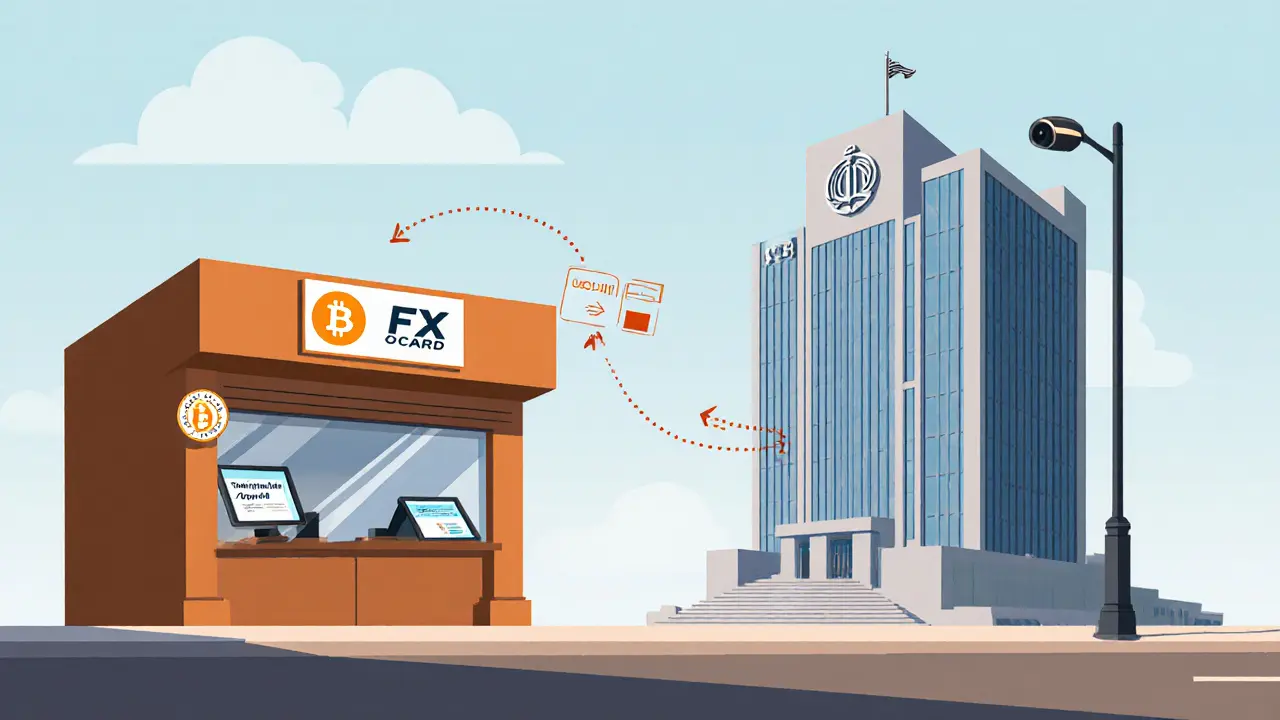
- Businesses must use a government‑issued Foreign Exchange Card (FX Card) for every conversion.
- Direct crypto‑to‑rial payments to customers are prohibited; conversion must happen in a CBI‑controlled account.
- The Central Bank has 100 % real‑time access to every transaction via its API gateway.
Licensing - how to get the green light
Obtaining a licence is a three‑tier verification process. Companies must submit 17 documents, among them commercial registration, tax ID, and an energy consumption certificate. As of April 2025 the average processing time sits at 23 business days, with a rejection rate of roughly 32 % for small firms.
Once approved, the business receives a unique CBI merchant identifier that must be attached to every API call. Failure to embed the identifier triggers an automatic block and a fine equal to 200 % of the transaction value.
Technical requirements - the FX Card and API
The FX Card links crypto purchases to foreign‑exchange obligations. After buying a digital asset, the firm must repatriate an equivalent amount of foreign currency to the card within one year. The current fee schedule adds about 1.8 % to each transaction, and processing typically takes 2-3 business days.
Integration is done via the CBI’s RESTful API. Each request must contain 55 data points, ranging from buyer’s national ID to the exact block hash of the crypto trade. The extra payload adds roughly 4.7 seconds to checkout time, according to a May 2025 technical report from Ramzinex.com.
Taxes and financial reporting
On 15 August 2025 Iran enacted the Law on Taxation of Speculation and Profiteering. Crypto profits over 50 million rials (≈ $1,000) are taxed at 25 %, with a progressive scale up to 35 % for earnings above 500 million rials. Monthly reporting is mandatory using Form CR‑2025/07, which adds an estimated 8.3 hours of accounting work per month for an average midsize firm.

Operational challenges businesses face
Survey data from the Iran Chamber of Commerce (May 2025) shows that 74 % of firms cite the foreign‑exchange repayment requirement as a major cash‑flow hurdle. Many resort to short‑term loans at an average annual rate of 22.4 % to meet the one‑year deadline.
Additional pain points include:
- Advertising ban - firms cannot publicly promote crypto payment options.
- Energy restrictions - unlicensed mining leads to fines of 200 % of electricity costs.
- Higher transaction fees - the FX Card layer adds roughly 1.8 % on top of exchange spreads.
Real‑world examples
Digikala, Iran’s largest e‑commerce platform, processed $4.2 million in crypto transactions through approved channels in Q1 2025 with zero compliance breaches. By contrast, many small retailers report an average 17‑day verification period and a 32 % chance of licence denial.
Platforms such as Nobitex dominate the market, handling 54.2 % of business‑related crypto volume, followed by Wallex.ir (12.7 %) and Bitpin.ir (10.4 %). The concentration reflects the high barrier to entry for new exchanges.
Comparison with other jurisdictions
| Country | Legal stance | Key requirements | Foreign‑exchange rule |
|---|---|---|---|
| Iran | Permitted via CBI‑approved channels only | FX Card, CBI API, licensing | Repatriate equivalent FX within 1 year |
| El Salvador | Bitcoin legal tender, mandatory acceptance | No licensing, direct BTC payments | No FX obligation |
| Nigeria | Allowed with reporting | Annual filing, tax on gains | No mandatory repatriation |
| Russia | Digital Financial Assets regime | License, AML/KYC | FX repatriation within 6 months |
Iran’s model sits between China’s outright ban and El Salvador’s open‑door policy, offering a “controlled leak” that lets firms tap crypto while keeping the state in the driver’s seat.

Future outlook - CBDC and stablecoins
The Central Bank is piloting a Rial‑backed CBDC ("Rial Currency") slated for Q4 2025. If successful, the need for foreign stablecoins could shrink dramatically.
Meanwhile, stablecoins like DAI on the Polygon network have become the preferred vehicle for businesses because they bypass the Tether freeze that hit 42 Iranian addresses in July 2025. Forecasts from Chainalysis (June 2025) predict that by Q2 2026, 85 % of crypto‑related business volume will be in DAI or similar non‑Tether assets.
Checklist for Iranian firms considering crypto
- Confirm sector eligibility - mining is prohibited.
- Gather the 17 required documents (registration, tax ID, energy certificate, etc.).
- Apply for a CBI licence; anticipate 23 days processing.
- Integrate the CBI API and obtain the merchant identifier.
- Set up an FX Card and plan for the one‑year foreign‑exchange repayment.
- Implement monthly accounting for crypto trades and file Form CR‑2025/07.
- Stay updated on tax rate changes (15‑35 % progressive).
- Monitor stablecoin trends; DAI on Polygon currently offers the lowest compliance friction.
Key takeaways
Iran does allow businesses to accept cryptocurrency, but only under a strict supervisory regime that demands licensing, FX Card usage, full data transparency, and a hefty tax burden. The system is designed to let the state reap foreign‑exchange benefits while keeping capital flight in check. Firms that can navigate the bureaucracy and manage the FX repayment window can still tap a growing market that moved $22.3 million daily in mid‑2025.
Can a small shop accept crypto without a CBI licence?
No. The law requires every business that wants to handle digital assets to obtain a licence from the Central Bank of Iran, regardless of size.
What happens if a business bypasses the FX Card?
The transaction is automatically blocked and the firm faces a fine equal to 200 % of the transaction amount, plus possible licence revocation.
Are stablecoins like DAI allowed?
Yes, provided the conversion is done through a CBI‑approved exchange and recorded via the API. DAI has become popular because it avoids the Tether‑freeze risk.
When will the new Rial CBDC be usable for businesses?
The pilot is planned for Q4 2025. Full commercial rollout could follow in 2026, subject to regulatory approval.
How is crypto income taxed?
Profits above 50 million rials are taxed at 25 %. Higher brackets apply: 15 % for 0‑100 million, 35 % for over 500 million rials.





Comments (13)