
Imagine a cryptocurrency that doesn't try to stay at exactly $1.00 like a stablecoin, but also isn't as wild and unpredictable as Bitcoin. It sits in the middle, backed by real assets, yet free to float on the open market. That is Olympus v1 (OHM). If you have ever wondered how a protocol can act like a central bank without actually being one, this is your guide.
Most people know Bitcoin for its scarcity or USDC for its stability. But Olympus DAO offers something different: a decentralized reserve currency. It’s a concept that sounds complex but boils down to a simple idea-backing a token with valuable assets so it has intrinsic value, while letting the market decide the final price. Let’s break down what OHM is, how it works, and why it matters in the world of Decentralized Finance (DeFi).
The Core Concept: A Treasury-Backed Token
At its heart, Olympus DAO is a community-owned protocol that manages a treasury filled with other cryptocurrencies. The primary asset in this treasury is DAI, a dollar-pegged stablecoin. When you buy an OHM token, you aren’t just buying a digital receipt; you are buying a share of this growing pile of collateral.
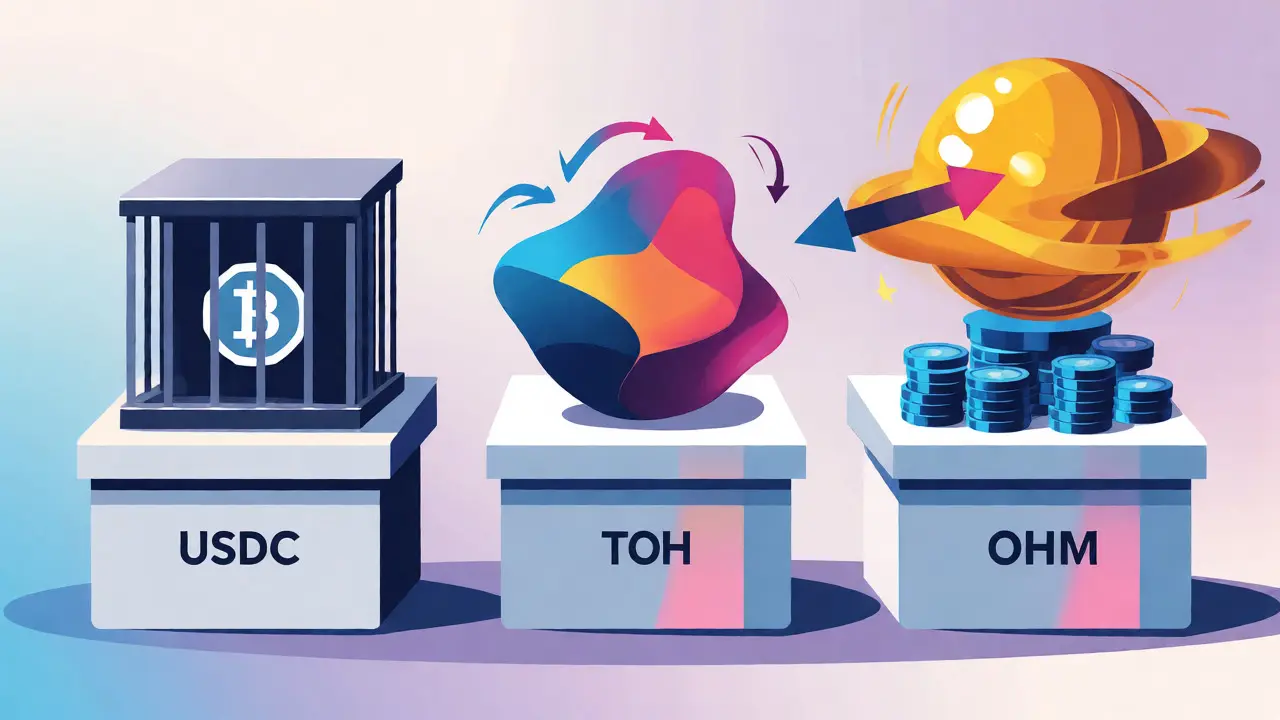
Unlike traditional stablecoins that enforce a strict peg (like USDC staying at $1), OHM does not have a fixed price target. Instead, it uses a mechanism called "bonding" to manage supply and demand. Think of it like a central bank issuing bonds. If the price of OHM drops below its "fair value," the protocol encourages users to sell their DAI to buy OHM at a discount, effectively taking OHM out of circulation. This reduces supply and pushes the price back up. If the price gets too high, the protocol issues more OHM to capture liquidity.
This approach allows OHM to maintain a floor price-technically defined as 1 DAI-but trade above it based on market sentiment. It’s a floating exchange rate model, similar to how major world currencies fluctuate against each other, but entirely automated by code rather than government policy.
How Protocol Owned Liquidity Changes the Game
One of the biggest problems in early DeFi was "mercenary capital." Users would provide liquidity to earn rewards, then dump the reward tokens and leave, causing volatility. Olympus solved this with a feature called Protocol Owned Liquidity (POL). In simple terms, POL means the protocol owns its own liquidity pools instead of renting them from external users.
Here is why that matters: when the protocol owns the liquidity, it controls the trading environment. There are no third-party market makers who might pull their funds during a crisis. This creates a more stable trading pair, specifically the LUSD/OHM pool on Sushiswap, which serves as the primary venue for trading OHM. By owning the liquidity, Olympus ensures that there is always a place to buy or sell OHM, reducing the risk of sudden price crashes due to lack of buyers or sellers.
Bonding vs. Staking: Two Ways to Earn
If you are interested in getting involved with OHM, you will encounter two main mechanisms: bonding and staking. They serve different purposes, and understanding the difference is crucial before you put any money in.
Bonding is essentially buying OHM at a discount. You deposit a reserve asset, usually DAI or LUSD, into the protocol. In return, you get OHM tokens that vest over time (meaning you receive them gradually over several days). This is attractive because you get OHM for less than the current market price. However, you cannot sell those vested tokens immediately, which locks up your capital temporarily.
Staking, on the other hand, involves locking up your existing OHM tokens to earn more OHM. The protocol pays you a yield, often referred to as the "rebasing" mechanism, though modern implementations handle this differently. As of late 2026, staking rewards on platforms like Atomic Wallet have advertised rates around 7% to 20%, depending on market conditions and lock-up periods. Staking helps reduce circulating supply because staked tokens aren't being sold, which supports the price.
| Feature | Bonding | Staking |
|---|---|---|
| Action | Buy OHM using DAI/LUSD | Lock existing OHM |
| Reward | Discounted OHM (vested over time) | Additional OHM tokens (yield) |
| Liquidity | Locked until vesting completes | Locked during stake period |
| Best For | New investors entering the market | Holders wanting passive income |

Why OHM Isn't Just Another Stablecoin
It is easy to confuse Olympus with algorithmic stablecoins like Ampleforth (AMPL) or Fei (FEI). While they all operate in the DeFi space, their mechanics are fundamentally different.
Ampleforth, for example, adjusts its supply daily to maintain a price target but does not hold a significant treasury backing its token. Its value relies heavily on market confidence and arbitrage. Olympus, however, holds actual assets-mostly DAI-in its treasury. This provides a tangible "floor" for the token's value. Even if market sentiment turns negative, the underlying assets in the treasury give OHM intrinsic worth.
Fei, another popular protocol, tries to keep its token strictly pegged to $1.00. If the price deviates, the protocol aggressively buys or sells to correct it. Olympus takes a hands-off approach to the exact price point. It allows OHM to trade freely, only intervening through bond discounts to influence supply. This makes OHM more volatile than a true stablecoin but potentially more rewarding for investors who believe in the protocol's growth.
| Token | Price Mechanism | Treasury Backing | Primary Goal |
|---|---|---|---|
| USDC | Strict Peg ($1.00) | Fiat & Cash Equivalents | Payment Stability |
| Ampleforth (AMPL) | Rebase to Target | Minimal/None | Volatility Hedge |
| Olympus (OHM) | Floating Market Price | High (DAI, LUSD, etc.) | Reserve Asset Growth |
Technical Details and How to Buy OHM
Olympus v1 operates on the Ethereum network, making it compatible with most standard crypto wallets. If you use MetaMask, you can add OHM manually using the contract address: 0x383518188c0c6d7730d91b2c03a03c837814a899. Alternatively, many aggregators like CoinGecko allow one-click imports.
Trading OHM is primarily done on decentralized exchanges (DEXs) rather than centralized ones like Coinbase or Binance. The most active venue is Sushiswap, where the LUSD/OHM pair sees the most volume. Because it trades on DEXs, you need to be comfortable with gas fees and interacting directly with smart contracts. Always double-check the contract address before sending funds, as fake tokens are common in the DeFi space.
As of October 2026, OHM has seen significant price fluctuations. It reached an all-time high of approximately $494.69 but currently trades significantly lower, around $80-$160 depending on the aggregator. This volatility is part of the package. The fully diluted valuation assumes a maximum supply of 280,000 OHM tokens, creating scarcity compared to tokens with billions in supply.
The Risks: What Could Go Wrong?
No investment is without risk, and Olympus is no exception. The primary risk is regulatory scrutiny. Since Olympus functions somewhat like a central bank issuing its own currency, regulators could view it as a security or challenge its classification. Additionally, smart contract bugs remain a threat. While Olympus has undergone audits, the complexity of its emissions manager and treasury management systems means there is always a non-zero risk of exploits.
Another consideration is liquidity fragmentation. While Protocol Owned Liquidity helps, relying on a single primary pair (LUSD/OHM) can create bottlenecks. If LUSD itself faces issues, it could indirectly impact OHM's perceived stability. Diversifying the treasury assets, which Olympus has been doing by accepting ETH and other tokens, mitigates this but doesn't eliminate it.
Final Thoughts on Olympus v1
Olympus v1 represents a bold experiment in monetary theory applied to blockchain technology. It moves beyond the binary choice of "volatile asset" vs. "stable coin" by offering a reserve-backed asset that grows with adoption. For investors, it offers a way to participate in DeFi's evolution with a focus on treasury value rather than pure speculation.
If you are looking for a token that behaves like a commodity with a hard floor but unlimited upside potential, OHM deserves a spot in your research list. Just remember: do your own diligence, understand the bonding mechanics, and never invest more than you can afford to lose in the fast-moving world of DeFi.
Is Olympus DAO (OHM) a stablecoin?
No, OHM is not a stablecoin in the traditional sense. Unlike USDC or USDT, it does not maintain a strict $1.00 peg. Instead, it is a decentralized reserve currency with a floating price determined by market forces, backed by a treasury of assets like DAI. It aims for price stability through economic incentives rather than a fixed peg.
How do I buy OHM tokens?
You typically buy OHM on decentralized exchanges like Sushiswap. You will need an Ethereum-compatible wallet like MetaMask. First, acquire DAI or LUSD, then swap it for OHM. Alternatively, you can use the "Bond" feature on the Olympus website to purchase OHM at a discount using DAI, though these tokens vest over time.
What is Protocol Owned Liquidity (POL)?
Protocol Owned Liquidity means the Olympus DAO treasury owns the liquidity pools used to trade OHM, rather than individual users providing them. This gives the protocol control over its trading environment, ensuring consistent liquidity and reducing the risk of market makers withdrawing funds during volatile periods.
Can I stake OHM for rewards?
Yes, OHM holders can stake their tokens to earn additional OHM. Staking rewards vary based on market conditions and the specific platform used. Platforms like Atomic Wallet offer staking services, with yields that have historically ranged between 7% and 20%. Staking locks your tokens for a set period, contributing to reduced circulating supply.
What is the maximum supply of OHM?
The Olympus protocol is designed with a maximum supply cap of 280,000 OHM tokens. This scarcity is a key component of its value proposition, distinguishing it from inflationary tokens. The current circulating supply is well below this cap, allowing for future issuance through bonding and staking mechanisms.