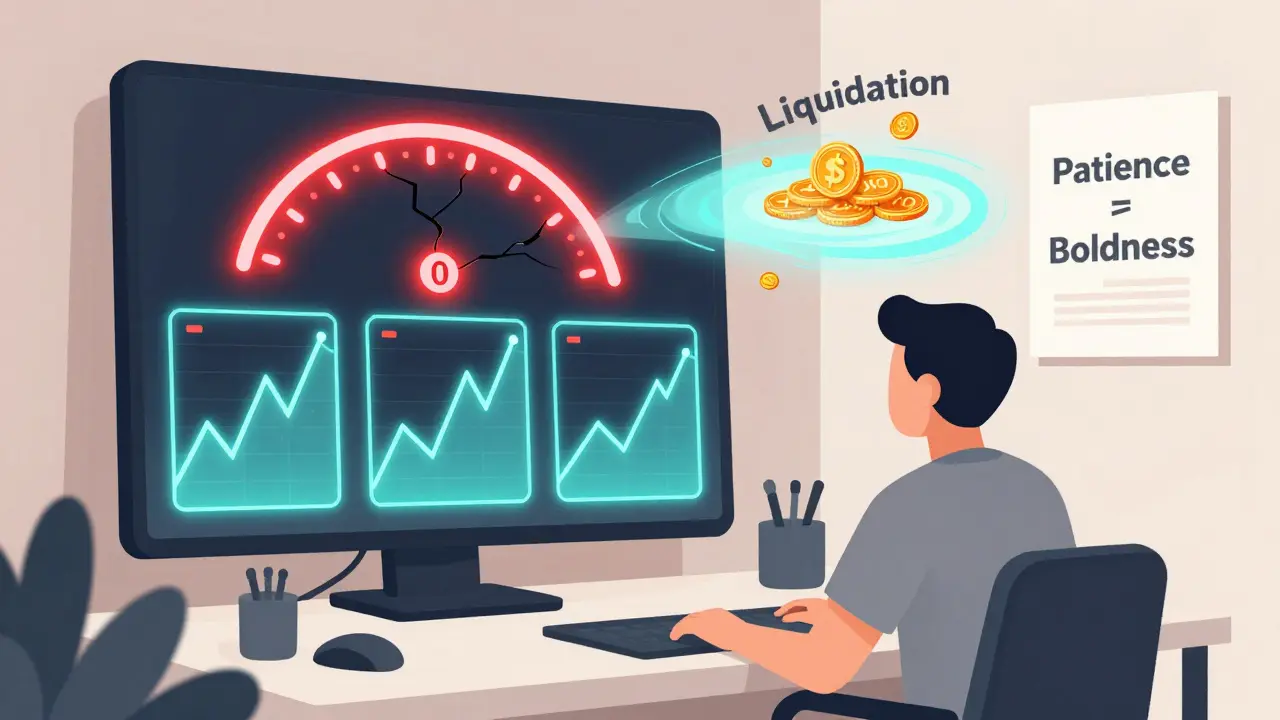
When you trade cryptocurrency with margin, you’re not just betting on price movements-you’re betting with borrowed money. This can turn a 5% price swing into a 20% profit… or a 20% loss. It’s not magic. It’s math. And if you don’t understand the math, you’ll get crushed. Many beginners jump into margin trading after seeing someone make a quick kill on Twitter. What they don’t see are the hundreds of traders who lost everything because they didn’t know how to manage risk. Margin trading isn’t about being bold. It’s about being precise.
How Margin Trading Works in Crypto
Unlike traditional stock markets, crypto margin trading doesn’t always follow Federal Reserve Regulation T. Most crypto exchanges let you borrow up to 10x your account balance. Some even offer 125x on perpetual futures. That sounds insane, and it is. But here’s the reality: margin in crypto means you deposit your own funds-say, $1,000-and the exchange loans you the rest. Now you control $10,000 worth of Bitcoin. If BTC goes up 5%, you make $500. That’s a 50% return on your $1,000. Sounds great. But if BTC drops 5%, you lose $500. That’s 50% of your account gone. And if it drops 10%, you’re liquidated. No warning. No second chance.
Every exchange has two key numbers: initial margin and maintenance margin. Initial margin is how much you need to open a position. If you’re using 10x leverage, your initial margin is 10% of the total trade value. Maintenance margin is the minimum you must keep in your account to avoid being forced out. For most crypto platforms, this is around 5%. So if your account drops below that, the system automatically sells your position. No human intervention. No appeals.
There’s no such thing as a “margin call” like in stocks. Crypto doesn’t give you time to deposit more cash. One tick below maintenance, and you’re out. That’s why many traders lose money-not because the market moved against them, but because they didn’t leave room for volatility.
Four Margin Strategies That Actually Work
Not all margin trading is the same. Some strategies are for day traders. Others are for swing traders. Some are for when the market is calm. Others are for when it’s on fire.
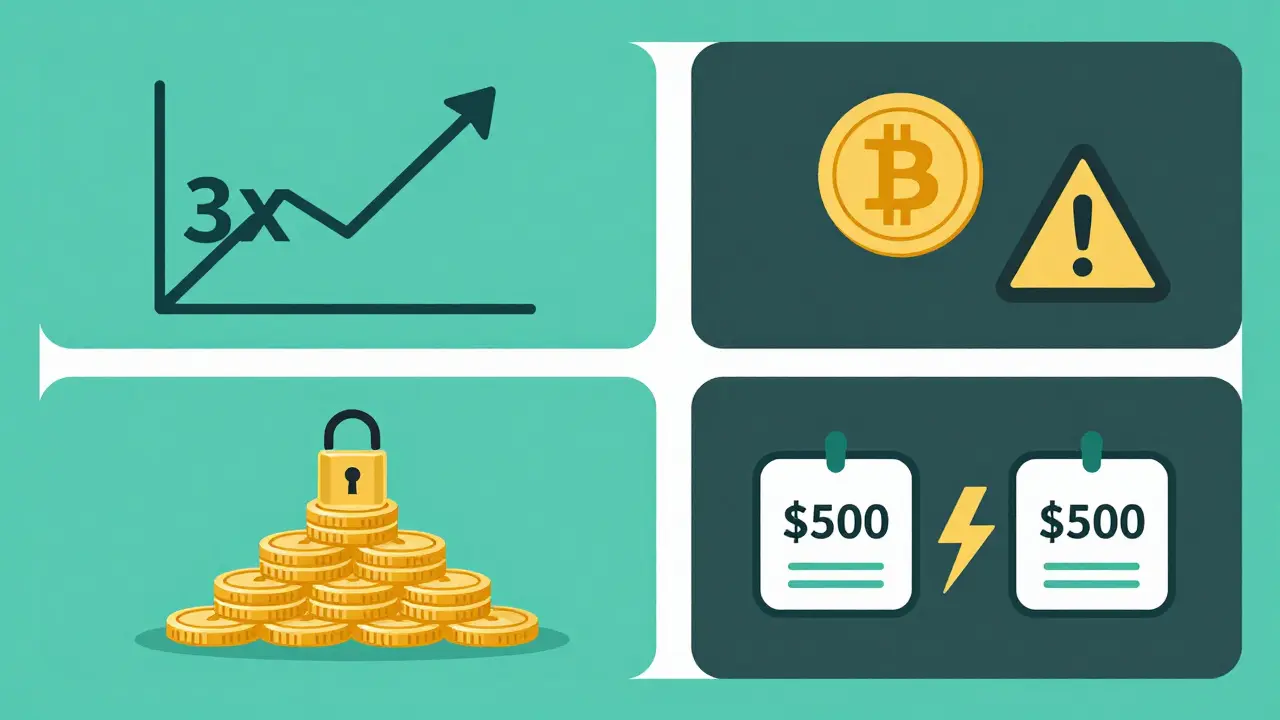
- Long Leverage: This is the simplest. You believe a coin will rise. You borrow funds to buy more than you could with cash alone. Use this when you have strong on-chain data, clear support levels, or institutional buying signals. Don’t go all-in. Stick to 3x-5x leverage. Higher than that, and you’re gambling.
- Short Selling: You borrow a coin, sell it immediately, then buy it back later at a lower price. This works well during bear markets or after major rallies that lack volume. But shorting crypto is dangerous. There’s no upper limit to how high a coin can go. A single tweet from Elon Musk can erase months of gains. Only short when volume is low, RSI is above 70, and whale wallets are dumping.
- Pyramiding: You start with a small position, then add more as it moves in your favor. Each new layer uses profit from the previous one as collateral. Sounds smart? It is-if you’re disciplined. Most people add too fast. They turn a 2x position into 5x, then 10x, then 15x. Then the market dips 2%. Gone. Pyramiding only works if you lock in profits at each step. Never let your total leverage exceed 6x.
- Arbitrage with Margin: You use margin to exploit price differences between exchanges. For example, Bitcoin is trading at $68,000 on Binance and $68,500 on Kraken. You buy on Binance, sell on Kraken, and pocket the difference. But you need speed. And you need to account for withdrawal fees, transfer delays, and slippage. This strategy requires API access, automated bots, and real-time monitoring. Not for beginners.
Why Most People Fail at Margin Trading
People think margin trading is about predicting the market. It’s not. It’s about managing risk. Here are the top three mistakes:
- Over-leveraging: Using 20x leverage because you “feel lucky.” A 5% move against you wipes you out. No trader survives long-term with leverage above 10x. Even 5x is aggressive.
- Ignoring funding rates: On perpetual futures contracts, you pay or receive funding every 8 hours. If you’re long in a bull market, you might be paying 0.05% every 8 hours. That’s 0.15% per day. Over 30 days, that’s 4.5% of your capital-gone. If you’re short in a bear market, you might be collecting it. But if the market reverses, you get hit with massive negative funding. Always check the funding rate before opening a position.
- Not using stop-losses: A stop-loss isn’t a suggestion. It’s your lifeline. Set it at 2-3% below your entry for longs, or 2-3% above for shorts. Never trade without one. Even if you’re “sure” the market will bounce. Crypto doesn’t care if you’re sure.
Tools and Platforms That Help
Not all exchanges treat margin the same. Some are designed for beginners. Others are built for professionals.
- Binance: Offers up to 125x leverage on BTC and ETH futures. Has a clear margin calculator, real-time liquidation price display, and auto-deleveraging protection. Best for experienced traders who want control.
- Bybit: Known for its user-friendly interface and high liquidity. Offers 100x leverage and a “trailing stop” feature that moves your stop-loss as the price moves in your favor. Good for swing traders.
- Kraken: Only offers up to 5x leverage on spot margin. More conservative. Better for traders who want to avoid liquidation. Also has transparent funding rates and lower fees for high-volume users.
- BitMEX: The OG of crypto margin. Still used by professionals. Offers 100x leverage. But the interface is outdated, and customer support is nearly nonexistent. Only use if you’ve traded here before.
Most platforms now offer margin alerts via SMS or app notifications. Turn them on. Also, use third-party tools like CoinGlass or Coinglass to track liquidation levels across exchanges. If $200 million in BTC longs are about to be wiped out at $67,500, that’s a support level you can trade with-not against.
Market Conditions That Change Everything
Margin trading in 2024 is not the same as in 2021. Back then, interest rates were near zero. Funding rates were low. Volatility was high. Now? The Federal Reserve hasn’t cut rates since 2023. Crypto borrowing costs have climbed. Stablecoin yields are higher than margin rates on some platforms. That means holding USDC might earn you 6% a year. Borrowing to trade? You need to beat that. Otherwise, you’re losing money even if you break even on the trade.
Also, regulatory pressure is growing. The SEC has started targeting exchanges that offer high leverage. Some platforms have already reduced max leverage from 100x to 20x. More cuts are coming. If you’re using 50x leverage today, you might not be able to in six months. Plan for change.
When to Walk Away
Margin trading isn’t for everyone. You don’t need to do it. Here’s when you should stop:
- You’re trading to recover losses from a previous margin trade.
- You’re staying up at night worrying about your positions.
- You’re borrowing from friends or using credit cards to fund your margin account.
- You don’t know what your liquidation price is.
- You’ve lost 30% or more of your account in one month.
If any of these sound familiar, step away. Take a break. Learn. Come back in 3 months. Margin trading rewards patience, not aggression.
Can you lose more than you deposit in crypto margin trading?
On most major exchanges like Binance and Bybit, no. They have auto-deleveraging systems and insurance funds that prevent your account from going negative. But on some lesser-known platforms, especially those without proper risk controls, it’s possible to owe money if liquidation triggers during extreme volatility. Always check the exchange’s terms before trading.
What’s the safest leverage level for beginners?
Stick to 2x-3x leverage. This gives you room for price swings without being wiped out by normal market noise. At 5x, you’re already in high-risk territory. At 10x, you’re gambling. Most professional traders use 3x or less. They win by consistency, not by doubling their account in one trade.
Do funding rates affect long-term margin trades?
Yes. If you hold a long position for weeks during a bull market, you’ll pay funding fees every 8 hours. Over time, those fees can eat into or even erase your profits. Always calculate the total cost: potential profit minus funding fees minus slippage. If the net is less than 1%, don’t take the trade.
Is margin trading legal in the U.S.?
Yes, but with restrictions. U.S.-based exchanges like Kraken and Coinbase offer margin trading with max leverage of 5x. Offshore exchanges (Binance, Bybit) are not regulated by the SEC, so U.S. users access them at their own risk. The SEC has signaled it may crack down on offshore platforms offering high leverage. Use caution.
How do I know if a margin trade is worth it?
Ask yourself: Is the expected profit greater than the risk? And is the risk manageable? If you’re risking $500 to make $100, walk away. Only take trades where potential reward is at least 2x your risk. And always use a stop-loss. No exceptions.
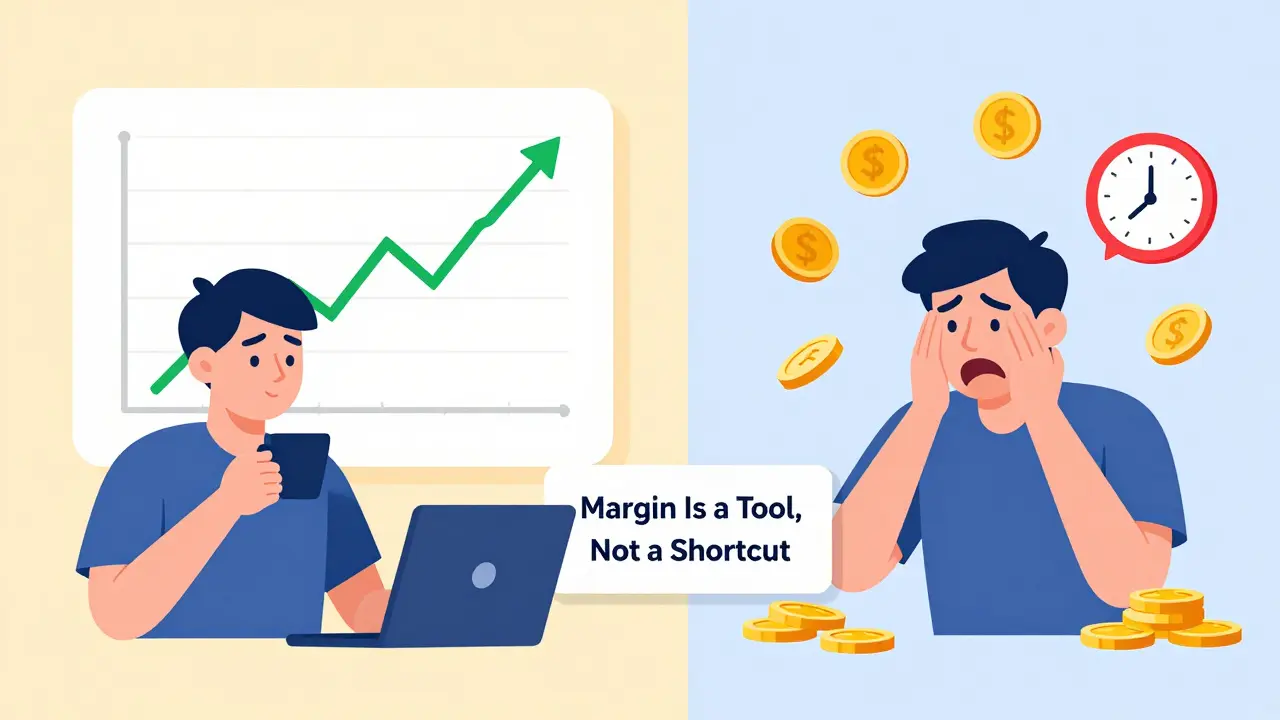
Final Thought: Margin Is a Tool, Not a Shortcut
Margin trading doesn’t make you rich. It just makes your wins bigger-and your losses faster. The best traders don’t chase 10x returns. They aim for 5% a week. Consistent. Repeatable. Safe. If you can do that with 3x leverage, you’ll outperform 95% of traders who use 10x or more. The market rewards discipline. Not bravery.