KLAUS Token Risk Calculator
WARNING: KLAUS is an extremely high-risk speculative token. Based on the article data, it has a market cap of approximately $112k, very low liquidity, and no verifiable utility. 99%+ risk of total loss
Investment Analysis
Key Risk Factors
Ever stumbled upon a token called Klaus (KLAUS) and wondered what the hype is about? You’re not alone. Launched in 2024, the coin claims to blend artificial intelligence, big data, and meme culture, but the details are scattered and sometimes contradictory. This guide pulls together the latest data, clears up the platform confusion, and lays out the risk factors you need to know before you even think about buying.
What is Klaus (KLAUS) actually?
At its core, Klaus (KLAUS) is a cryptocurrency token that markets itself as an AI‑themed meme coin. The project’s own site (klausoneth.com) pitches the token as a bridge between cutting‑edge AI narratives and the viral nature of meme assets. In practice, the token’s utility is vague - there is no public whitepaper, no documented AI integration, and no clear use‑case beyond speculative trading.
Where does the token live? Ethereum or Solana?
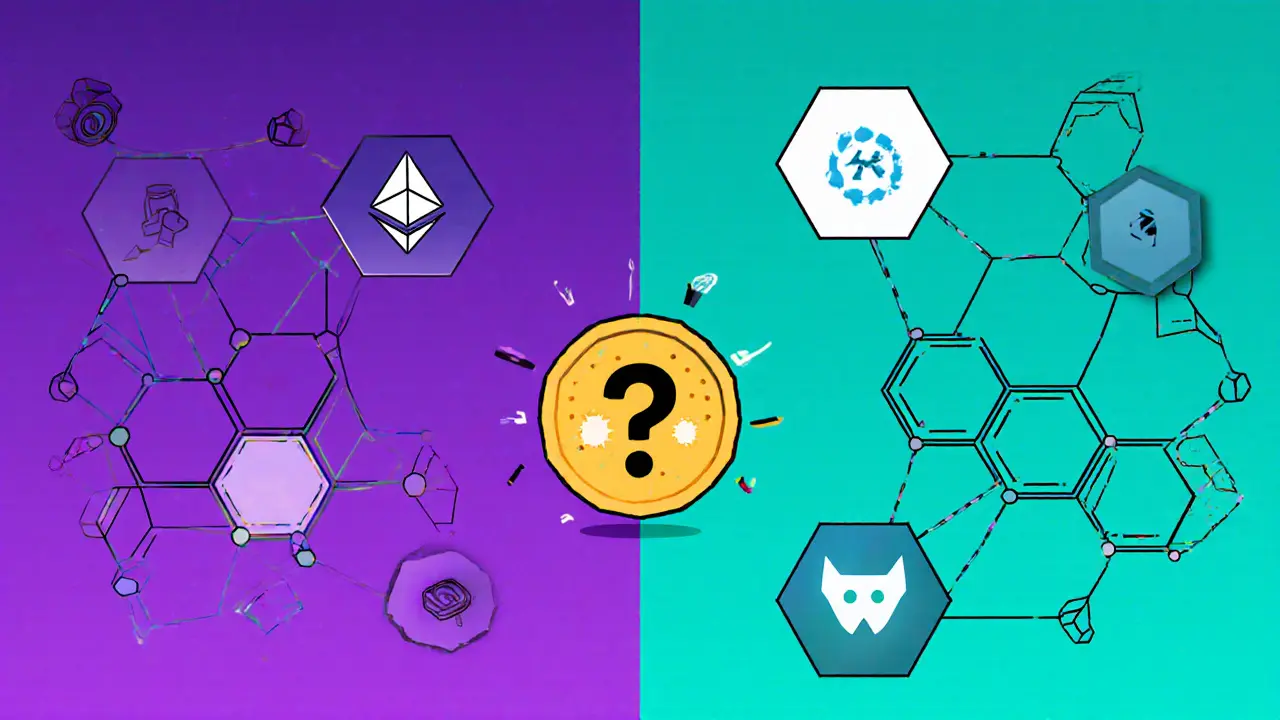
One of the biggest questions buyers face is the underlying blockchain. Two reputable data aggregators disagree:
- Liquidity Finder lists KLAUS as an Ethereum ERC‑20 token.
- Coinswitch describes it as a native Solana SPL token.
The discrepancy matters because transaction fees, speed, and wallet compatibility differ wildly between the two chains. Until the project publishes an official contract address on a single blockchain, you’ll have to treat the token as a high‑uncertainty asset.
Token economics at a glance
All sources agree on a simple supply model: a fixed total of 1 billion KLAUS tokens, all of which are already in circulation. This means there’s no inflation built into the protocol, but it also implies that market cap is purely a function of price and the current circulating supply.
| Metric | Value |
|---|---|
| Total Supply | 1,000,000,000 KLAUS |
| Circulating Supply | 1,000,000,000 KLAUS |
| Current Price (average) | $0.00011 - $0.00072 (varies by exchange) |
| Market Cap | ≈ $112,000 (CoinMarketCap) |
| 24‑h Volume | $72,000 - $0 (inconsistent data) |
| All‑time High | $0.0438 (Coinlore) |
| All‑time Low | $0.00011 (current range) |
Price swings are extreme. The token slid from a high of $0.0438 to under $0.0002, a drop of roughly 99.7%. Such volatility is typical for meme coins but is amplified here by very low liquidity.
How does KLAUS compare to other AI‑themed tokens?
To put the numbers in perspective, let’s look at a few better‑known projects:
- Fetch.ai - market cap ~$1.3 billion, functional AI agent network, multiple enterprise partnerships.
- Dogwifhat (WIF) - meme coin with AI branding, market cap > $2 billion, strong community presence.
- Klaus (KLAUS) - market cap $112 k, no verifiable AI product, minimal community.
The contrast is stark. While Fetch.ai and Dogwifhat have clear roadmaps and active developer ecosystems, KLAUS offers none. Its market cap places it in the bottom half‑percent of all tracked cryptocurrencies, meaning it’s more likely to disappear than to grow.
Risk factors you can’t ignore
Every crypto investment has risk, but KLAUS stacks several red flags together:
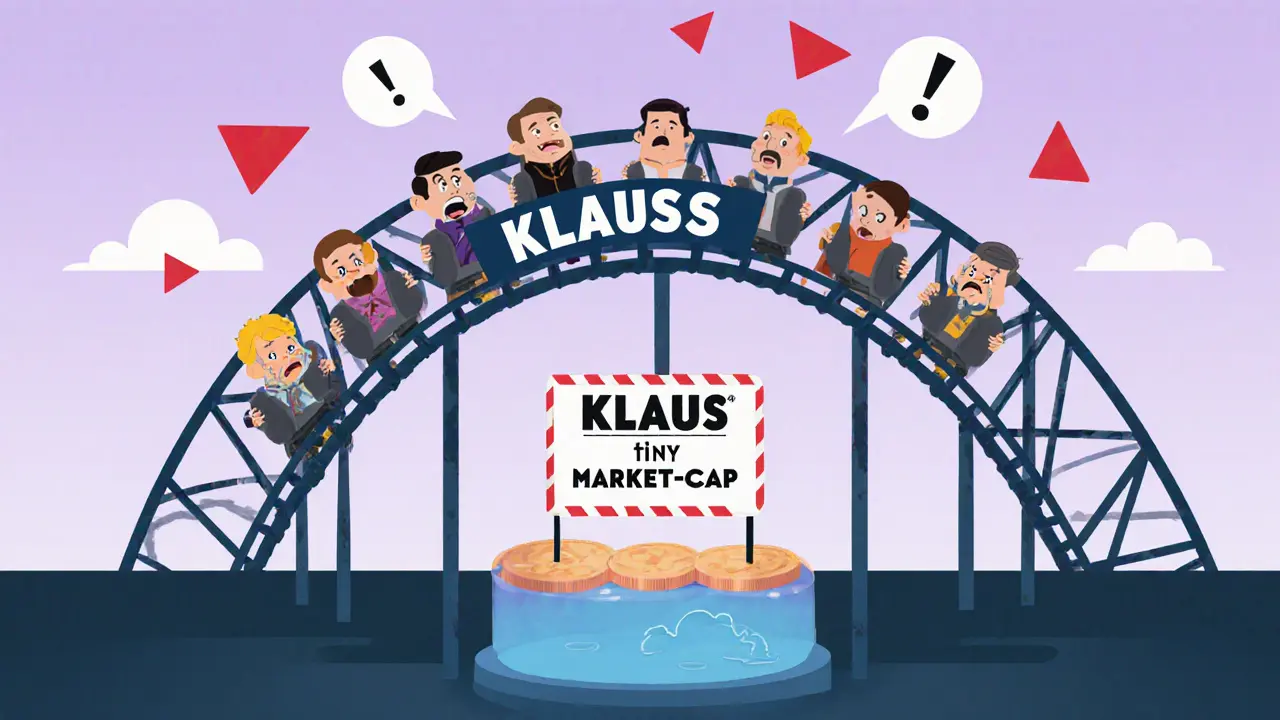
- Liquidity crunch - 24‑hour volume often under $100 k, making it hard to enter or exit positions without slippage.
- Platform ambiguity - conflicting reports on whether the token lives on Ethereum or Solana; this uncertainty can trap users on the wrong network.
- Utility vacuum - no documented AI integration, no dApp, no partner, no real‑world use case.
- Community vacuum - almost no discussion on Reddit, Twitter, or Discord, which limits organic growth.
- Regulatory exposure - the SEC has tightened scrutiny on AI‑related tokens lacking clear utility; KLAUS could be flagged as a speculative asset.
If any of these sound familiar, treat KLAUS as a high‑risk speculative token rather than a long‑term investment.
How to actually buy KLAUS (if you decide to)
Because the token isn’t listed on major centralized exchanges, you’ll need a decentralized route:
- Identify the correct blockchain (Ethereum or Solana). Check the token contract address on the platform you trust - a mismatch could send your funds to a dead address.
- Set up a compatible wallet: MetaMask for Ethereum, Phantom for Solana.
- Find a DEX that lists KLAUS. Uniswap V2 shows up on some aggregators for the Ethereum version; Raydium or Serum may list a Solana version.
- Swap a stablecoin (USDC, USDT) for KLAUS. Expect high slippage due to low depth.
- Store the tokens securely and keep the contract address bookmarked - many explorers show a “token not verified” warning.
Remember, buying a token with unclear fundamentals can lead to a total loss. Only allocate money you can afford to lose.
What do analysts say?
Prediction engines are split:
- WalletInvestor projects a modest rise to $0.000168 (about 50% upside from current low‑end prices).
- PricePrediction.net sees a short‑term target of $0.000375.
- TradingBeast is bullish for 2026, forecasting $0.000767.
- Coinlore’s long‑term model wildly jumps to $0.3916 in ten years - a figure that assumes a massive shift in adoption that has no current evidence.
All these models share a common caveat: they assume liquidity and demand will improve, which historically hasn’t happened for tokens under $500 k market cap. Treat forecasts as speculative at best.
Bottom line - should you consider KLAUS?
If you love chasing meme coins and can handle losing the entire stake, KLAUS might be a cheap experiment. If you prefer assets with real tech, active communities, and transparent roadmaps, there are far better options. The safest takeaway: do thorough due diligence, verify the contract address, and never invest more than you’re prepared to lose.
Is Klaus (KLAUS) built on Ethereum or Solana?
Data sources disagree. Liquidity Finder lists an ERC‑20 contract on Ethereum, while Coinswitch describes it as an SPL token on Solana. Until the project publishes an official contract address, you’ll need to verify the network before transacting.
What is the total supply of KLAUS?
The token has a fixed total and circulating supply of 1 billion KLAUS tokens.
Where can I buy KLAUS?
KLAUS is not on major centralized exchanges. You’ll need a decentralized exchange (Uniswap for Ethereum version, Raydium or Serum for Solana version) and a compatible wallet (MetaMask or Phantom).
Is KLAUS a good long‑term investment?
Given its tiny market cap, low liquidity, unclear blockchain, and no proven utility, most analysts advise treating it as a high‑risk speculative token rather than a long‑term hold.
How does KLAUS compare to other AI‑themed tokens?
Projects like Fetch.ai and Dogwifhat have market caps in the billions, functional AI platforms, and active communities. KLAUS sits at around $112 k with no verifiable AI product, making it a far riskier bet.




Comments (18)