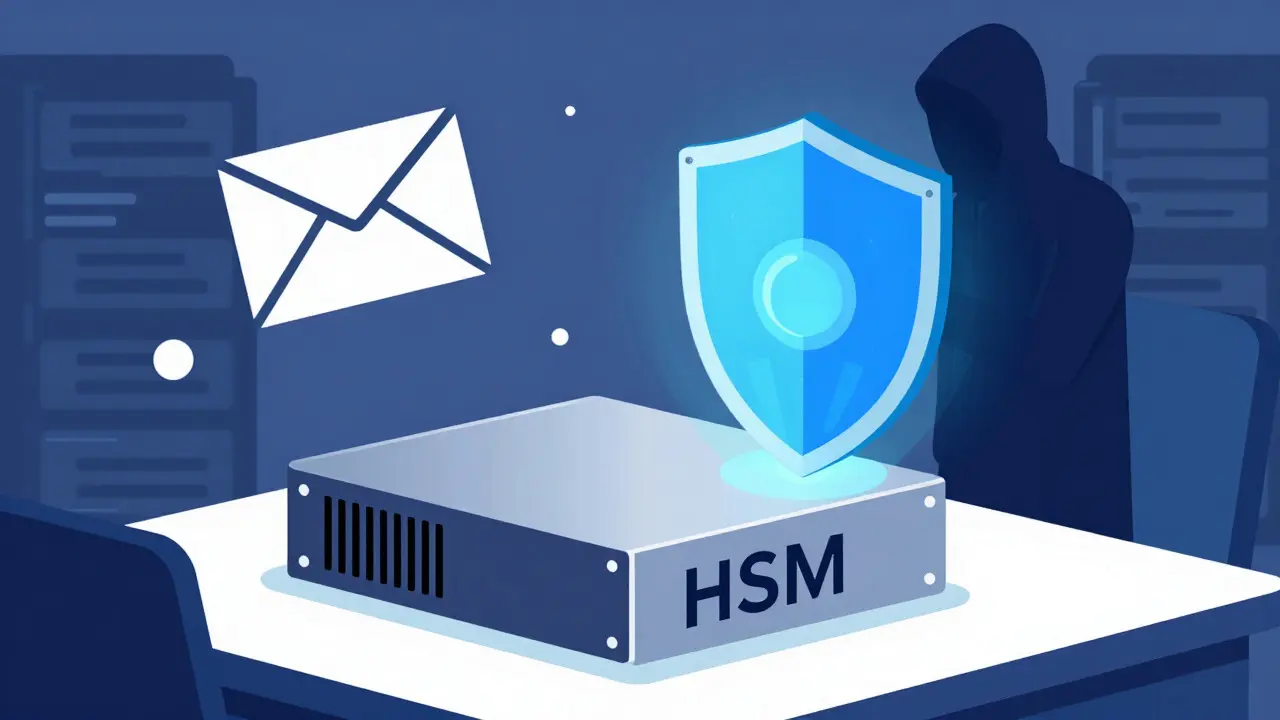
Imagine losing $8.7 million in a single phishing attack because your private keys were stored on a server instead of a secure chip. That’s not a hypothetical scenario; it happened to a mid-sized exchange last year. The difference? They had a Hardware Security Module (HSM) installed. But here is the catch: setting one up isn't just about buying a box. It’s a complex financial decision that can range from a few thousand dollars to over $100,000, depending on how you deploy it.
If you are running a crypto wallet, an exchange, or even a DeFi protocol, understanding the true HSM cost is critical. You aren't just paying for hardware; you're paying for peace of mind, regulatory compliance, and protection against catastrophic loss. Let's break down exactly what goes into that price tag so you can budget without surprises.
The Core Price Tags: What You Pay Upfront
First, let's look at the sticker price. An HSM is a tamper-resistant physical device that stores cryptographic keys. In the crypto world, this means your private keys never leave the device in plain text. But prices vary wildly based on the vendor and the certification level.
For smaller startups or teams looking for a cost-effective entry point, Yubico YubiHSM 2 is a popular choice. It’s designed for organizations of all sizes and focuses on secure key generation and storage. While exact pricing isn't always public, it sits at the lower end of the market, making it accessible for early-stage projects.
On the enterprise side, things get expensive fast. The Entrust nShield 5c, certified to FIPS 140-3 Level 3 and Common Criteria EAL4+ standards, typically costs between $25,000 and $54,000 USD. If you need top-tier performance for high-volume trading, you might be looking at solutions from Thales or Futurex. The Futurex Excrypt SSP Enterprise v.2, for instance, runs around $38,000. These devices handle thousands of transactions per second with latency under 5 milliseconds, which is crucial if you’re processing massive volumes of Bitcoin or Ethereum signatures.
| Vendor/Model | Approx. Hardware Cost (USD) | Best For | Certification |
|---|---|---|---|
| Yubico YubiHSM 2 | $1,000 - $5,000 (Est.) | Startups, CA Root Keys | FIPS 140-2 Level 3 |
| Entrust nShield 5c | $25,000 - $54,000 | Mid-to-Large Exchanges | FIPS 140-3 Level 3, CC EAL4+ |
| Futurex Excrypt SSP | ~$38,000 | Enterprise Scalability | FIPS 140-2 Level 3 |
| Thales Luna Network HSM | Varies ($10k - $100k+) | High-Volume Trading | FIPS 140-2/3 |
Hardware vs. Cloud: The Deployment Dilemma
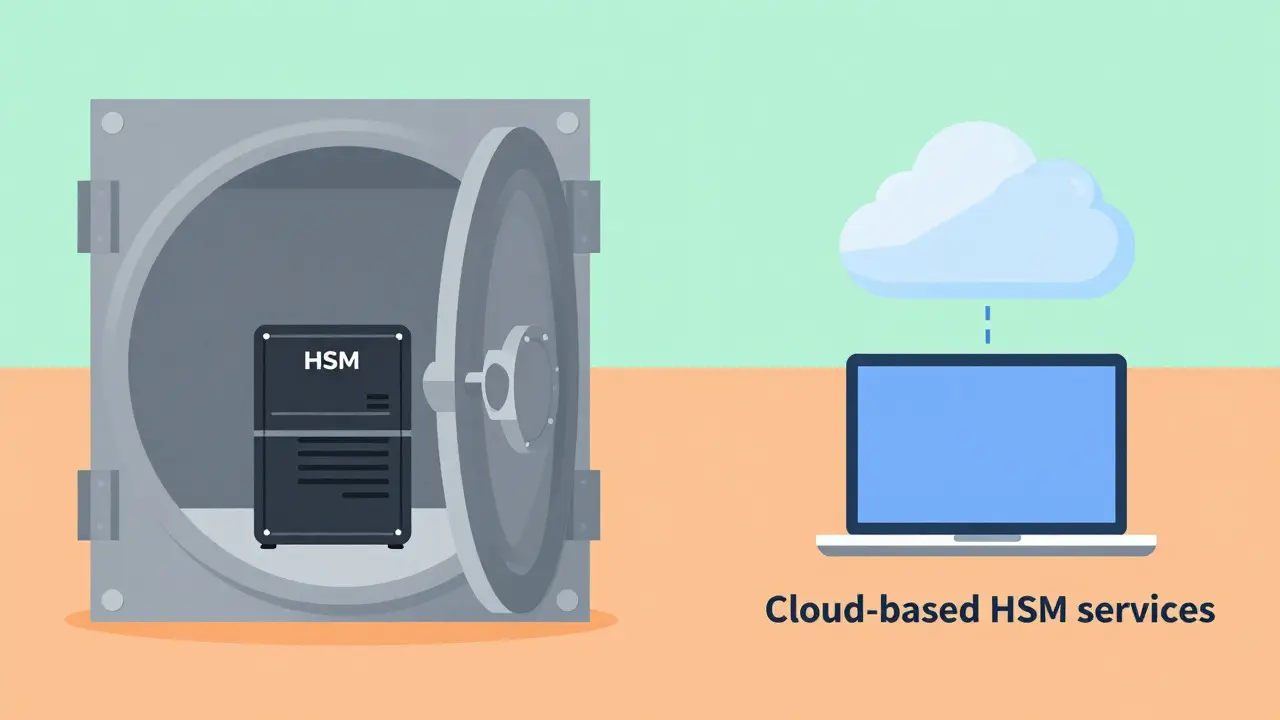
You have two main ways to get an HSM: buy the physical box (on-premise) or rent it as a service (cloud). This choice drastically changes your cash flow and total cost of ownership.
On-Premise: You buy the hardware once. It’s a capital expenditure (CapEx). The benefit is that you own the asset, and there are no monthly fees for the hardware itself. However, you need a secure location-often a data center or a vault-and you are responsible for power, cooling, and physical security. High-end on-premise setups can easily exceed $100,000 when you factor in the installation environment.
Cloud HSM (HSMaaS): Services like Thales Data Protection on Demand (DPoD) operate on a subscription model. Instead of a huge upfront bill, you pay a monthly fee ranging from several hundred to several thousand dollars. This converts your cost into an operational expense (OpEx), which many finance teams prefer. Gartner predicts that 65% of new crypto HSM implementations will be cloud-based by 2025, up from 38% in 2023, largely due to this flexibility and reduced maintenance burden.
Which is cheaper? For a small team handling low transaction volumes, cloud might win on initial outlay. For a large exchange doing millions of transactions daily, owning the hardware often becomes more cost-effective after two to three years, provided you have the technical staff to manage it.
The Hidden Costs Nobody Talks About
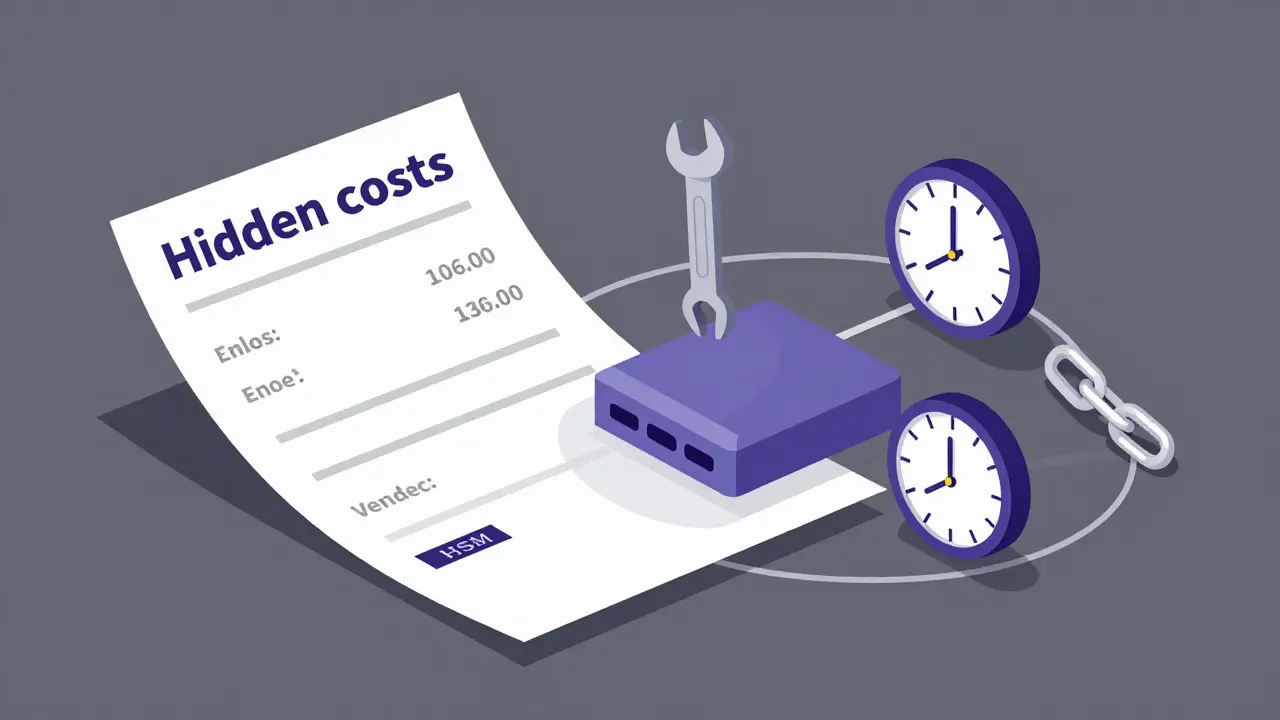
This is where budgets usually blow up. The hardware is only part of the story. Integration, labor, and maintenance add significant layers to the final bill.
Integration & Development Time: Connecting an HSM to your blockchain stack isn't plug-and-play. You need developers proficient in PKCS#11 or Cloud HSM APIs. One CTO on Hacker News reported spending 37 extra development hours just because the documentation lacked crypto-specific examples, costing them roughly $4,600 in developer time. If you hire professional services for help, rates can hit $120-$180 per hour. Expect integration costs to add 25-40% to your initial hardware budget.
Maintenance & Support: Ongoing maintenance typically adds 15-20% annually to the initial hardware investment. This covers security updates, firmware patches, and support contracts. If you ignore this, you risk compatibility issues with new blockchain protocols or security vulnerabilities.
Vendor Lock-In: Migrating between HSM vendors is painful. Analyst Heidi Shey noted that moving keys can cost more than 30% of the initial implementation due to proprietary formats. Choose your vendor carefully, knowing you’ll likely be stuck with them for years.
Is It Worth It? The ROI Calculation
Let’s look at the numbers from a real-world perspective. A senior security engineer shared on Reddit that his exchange spent $42,000 on an Entrust nShield HSM plus $18,000 in integration. Total spend: $60,000. During a sophisticated phishing attack in Q4 2022, they avoided an estimated $8.7 million in losses. That’s a return on investment that makes the HSM look like a bargain.
Consider also the regulatory angle. With the SEC and other bodies tightening custody rules, "secure storage" is becoming a legal requirement, not just a best practice. Jisasoftech’s analysis highlights that hidden costs of *not* using HSMs-like regulatory fines and reputational damage-can far exceed the initial investment. In 2022 alone, $1.9 billion in crypto was stolen, mostly due to poor key management. An HSM is your insurance policy against that statistic.
How to Budget for Your Implementation
If you’re planning to implement an HSM, follow these steps to keep your budget realistic:
- Define Your Throughput Needs: Do you need 100 transactions per second or 10,000? High-performance models cost more but save you from bottlenecks later.
- Choose Deployment Model: Decide between CapEx (buying) and OpEx (renting). Talk to your CFO about cash flow preferences.
- Budget for Integration Labor: Allocate at least 30% of the hardware cost for development and testing. Don’t underestimate the learning curve for PKCS#11 integration.
- Factor in Maintenance: Set aside 15-20% of the hardware cost annually for support and updates.
- Check Certification Requirements: Do you need FIPS 140-3? Post-quantum readiness? These features add a premium (around 15% for post-quantum support) but future-proof your setup.
Remember, the goal isn't just to buy a box; it’s to build a resilient security layer for your digital assets. Whether you go with a cost-effective YubiHSM for a startup or a heavy-duty Thales system for an exchange, the key is to account for the full lifecycle cost, not just the invoice.
What is the average cost of an HSM for cryptocurrency?
The average cost varies widely. Entry-level models like the Yubico YubiHSM 2 may cost under $5,000. Enterprise-grade systems like the Entrust nShield 5c range from $25,000 to $54,000. When including integration and maintenance, expect to multiply the hardware cost by 1.5 to 2 for the first year.
Is cloud HSM cheaper than on-premise?
Cloud HSMs have lower upfront costs but higher long-term expenses if usage is high. On-premise has high upfront costs but lower marginal costs per transaction. For high-volume exchanges, on-premise is often cheaper after 2-3 years. For startups or variable workloads, cloud is usually more economical initially.
Why are HSM integration costs so high?
Integration requires specialized knowledge of both blockchain protocols and cryptographic APIs like PKCS#11. Documentation is often generic, leading to trial-and-error development. Professional services cost $120-$180/hour, and unexpected challenges with specific chains like Solana or Ethereum can add weeks to the timeline.
Do I really need an HSM if I use a multi-sig wallet?
Multi-sig adds security, but it doesn't replace the need for secure key storage. If your multi-sig signers' keys are compromised, you still lose funds. An HSM ensures that even if a server is hacked, the private keys remain encrypted and inaccessible. For institutional custody, HSMs are increasingly mandatory.
What are the ongoing maintenance costs for an HSM?
Expect to pay 15-20% of the initial hardware investment annually for support contracts, firmware updates, and security patches. Cloud HSMs include maintenance in their subscription fee, while on-premise units require separate annual support agreements.