
Coinflare Leverage and Fee Calculator
Maximum leverage available based on your margin:
100× Leverage
50× Leverage
10× Leverage
If you’ve been hunting for a crypto exchange that specializes in high‑leverage perpetual swaps, you’ve probably hit the name Coinflare review on a few forums. But does the platform live up to its bold promises, or is it just another rebranded service trying to steal market share? This 2025 review pulls apart the fee schedule, security partnerships, trading tools, and the overall user experience so you can decide whether Coinflare deserves a spot in your trading toolbox.
What Is Coinflare?
Coinflare is a centralized cryptocurrency exchange that focuses on perpetual swap contracts with leverage up to 100×. Launched in September 2023 after rebranding from BITFLEX, the platform markets itself as a “world‑leading” venue for traders who want to trade BTC, ETH, XRP and a handful of other major assets on a margin basis.
Core Products and Trading Options
Coinflare offers three primary product lines:
- Spot trading - conventional buying and selling of crypto pairs.
- Derivatives - perpetual swap contracts with leverage ranging from 1× to 100×.
- Staking - passive earnings on supported assets.
The perpetual swaps are the star of the show. They settle in the underlying crypto (e.g., BTC‑USDT‑P) and never expire, so you can keep a position open indefinitely as long as you meet the margin requirements. Initial margin can be as low as 1 % for 100× leverage, but it climbs to 50 % for low‑leverage, high‑margin trades.
Fee Structure - How Much Does It Cost?
Fees are a critical factor for any trader. Coinflare uses a tiered model based on 30‑day trading volume (measured in USDT). Below is a snapshot of the fee schedule as of October 2025:
| Volume (30‑day USDT) | Spot Maker | Spot Taker | Derivatives Maker | Derivatives Taker |
|---|---|---|---|---|
| 0 - 100,000 | 0.0250 % | 0.0460 % | 0.0100 % | 0.0300 % |
| 100,001 - 1,000,000 | 0.0220 % | 0.0400 % | 0.0080 % | 0.0250 % |
| 1,000,001 - 10,000,000 | 0.0190 % | 0.0350 % | 0.0060 % | 0.0200 % |
| > 10,000,000 | 0.0150 % | 0.0300 % | 0.0040 % | 0.0150 % |
Compared with industry giants like Binance (0.01 %-0.1 % maker/taker) or Bybit (0.025 %-0.075 %), Coinflare’s fees sit in the middle ground - not the cheapest, but competitive given the high‑leverage options.
Security & Compliance
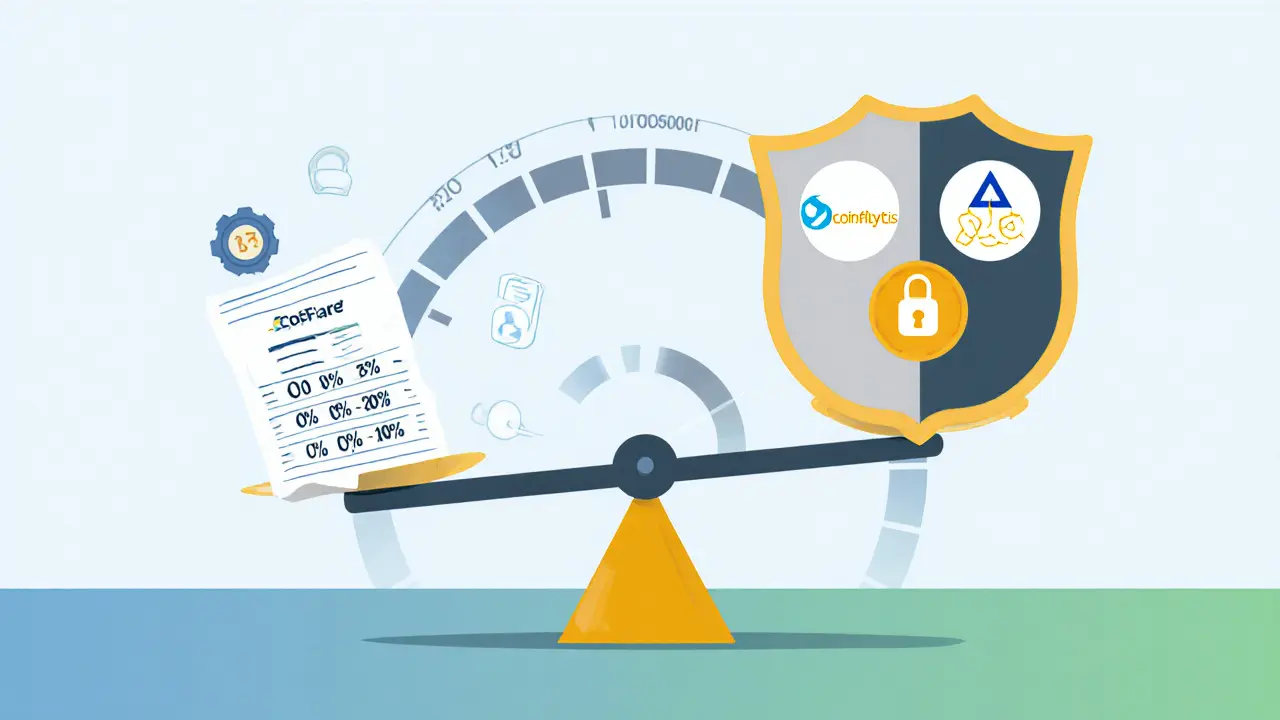
Security is where many new exchanges stumble. Coinflare has taken two visible steps:
- Chainalysis provides real‑time blockchain transaction monitoring, helping to flag suspicious activity.
- Coincover offers a fund‑protection insurance layer for assets held in the exchange’s custodial wallets.
All users must enable Two‑Factor Authentication (2FA) during signup. The KYC process follows the usual “ID, address, selfie” flow, with verification times ranging from minutes to a few days. Non‑KYC accounts are capped at 2 BTC (or equivalent) per day for withdrawals, which encourages full verification for higher‑volume traders.
Liquidity & Performance
Coinflare claims an average order execution time of 1.2 ms during peak periods, based on its proprietary matching engine. Independent data from CoinGecko suggests daily trading volume around $150 million - modest when stacked against Binance’s $30+ billion but respectable for a niche derivatives venue.
Liquidity concentrates on the big three (BTC, ETH, XRP). The platform has been pruning less‑liquid perpetual contracts (e.g., EOSUSDT‑P) since mid‑2023, which means you’ll rarely find exotic pairs on Coinflare. For traders who only need the heavyweights, this focus can actually improve depth and reduce slippage.
User Experience - UI, Mobile, and Support
The web UI is clean, with a dark‑mode layout that mirrors the style of Bybit and BitMEX. New users will find a “Quick Start” wizard that walks through deposit, margin allocation, and order placement. However, the platform currently lacks a native mobile app - a major drawback for on‑the‑go traders. Coinflare announced a mobile app “coming soon” in September 2023, but as of October 2025 the app is still in beta and not publicly released.
Customer support is available 24/7 via live chat, email ([email protected]), and social media. Response time metrics aren’t published, but community chatter on Reddit (r/CryptoCurrency) mentions average chat replies within 5‑10 minutes during trading hours.
How Coinflare Stacks Up Against the Competition
Below is a side‑by‑side comparison with three leading exchanges that also offer perpetual swaps.
| Feature | Coinflare | Binance | Bybit | BitMEX |
|---|---|---|---|---|
| Leverage (max) | 100× | 125× | 100× | 100× |
| Spot pairs | ~30 | ~500 | ~150 | ~30 |
| Derivatives pairs | ~20 perpetual | ~200 perpetual | ~120 perpetual | ~100 perpetual |
| Mobile app | No (beta only) | Yes | Yes | Yes |
| Security partners | Chainalysis, Coincover | Chainalysis, CertiK | Chainalysis, CipherTrace | None disclosed |
| Average fee (maker) | 0.015‑0.025 % | 0.010‑0.020 % | 0.015‑0.025 % | 0.025 % |
| KYC limit (non‑verified) | 2 BTC/day | 0.5 BTC/day | 1 BTC/day | 0 BTC (no trading) |
Key takeaways:
- Coinflare offers the highest leverage for most retail traders while keeping fees modest.
- It falls short on asset variety and mobile accessibility.
- Security partnerships are solid, though the platform lacks third‑party audit reports.
Who Should Consider Coinflare?
Because the exchange zeroes in on perpetual contracts, it makes the most sense for:
- Experienced traders comfortable with margin calls and liquidation mechanics.
- Users who trade mainly BTC, ETH, or XRP and don’t need a sprawling list of altcoins.
- People who prioritize high‑leverage opportunities over a broad suite of DeFi tools.
If you’re a beginner looking for a one‑stop shop with tutorials, staking pools, and a mobile app, Binance or Coinbase might be a better fit.
Potential Risks & Red Flags
Every platform has pitfalls. Here are the ones you should watch on Coinflare:
- Liquidity depth: Lower volume can cause price slippage on large orders.
- Regulatory exposure: The exchange recently blocked users from several jurisdictions to comply with the EU’s MiCA framework. Future restrictions could affect your ability to deposit or withdraw.
- Limited third‑party audits: While Chainalysis and Coincover are reputable, the lack of an independent security audit means you’re largely trusting the platform’s self‑reported safeguards.
Bottom Line - Is Coinflare Worth Your Time?
Coinflare delivers exactly what it promises: a high‑leverage, perpetual‑swap‑centric marketplace with competitive fees and decent security partnerships. The trade‑off is a narrower asset roster, no full‑featured mobile app, and a relatively modest liquidity pool. If you’re focused on short‑term leveraged trades of the big three cryptos and you can tolerate the occasional liquidity hiccup, Coinflare can be a solid addition to your trading arsenal.

What is the maximum leverage offered by Coinflare?
Coinflare allows up to 100× leverage on its perpetual swap contracts, with margin requirements as low as 1 % for the highest leverage tier.
How does Coinflare’s fee structure compare to Binance?
Coinflare’s maker fees start at 0.015 % for high‑volume traders, while Binance’s maker fees can be as low as 0.010 % for VIP users. Overall, Coinflare’s fees are slightly higher but still competitive for the leverage it provides.
Is there a mobile app for Coinflare?
As of October 2025, Coinflare does not have a public mobile app. A beta version is in testing, but traders must use the web interface on mobile browsers.
What security measures protect my funds?
Coinflare mandates 2FA, partners with Chainalysis for transaction monitoring, and uses Coincover’s insurance for custodial assets. Full‑scale audits have not been published.
Can I trade without completing KYC?
Yes, but non‑KYC accounts are limited to withdrawing the equivalent of 2 BTC per day, and higher‑volume traders need full verification to unlock larger limits.





Comments (17)