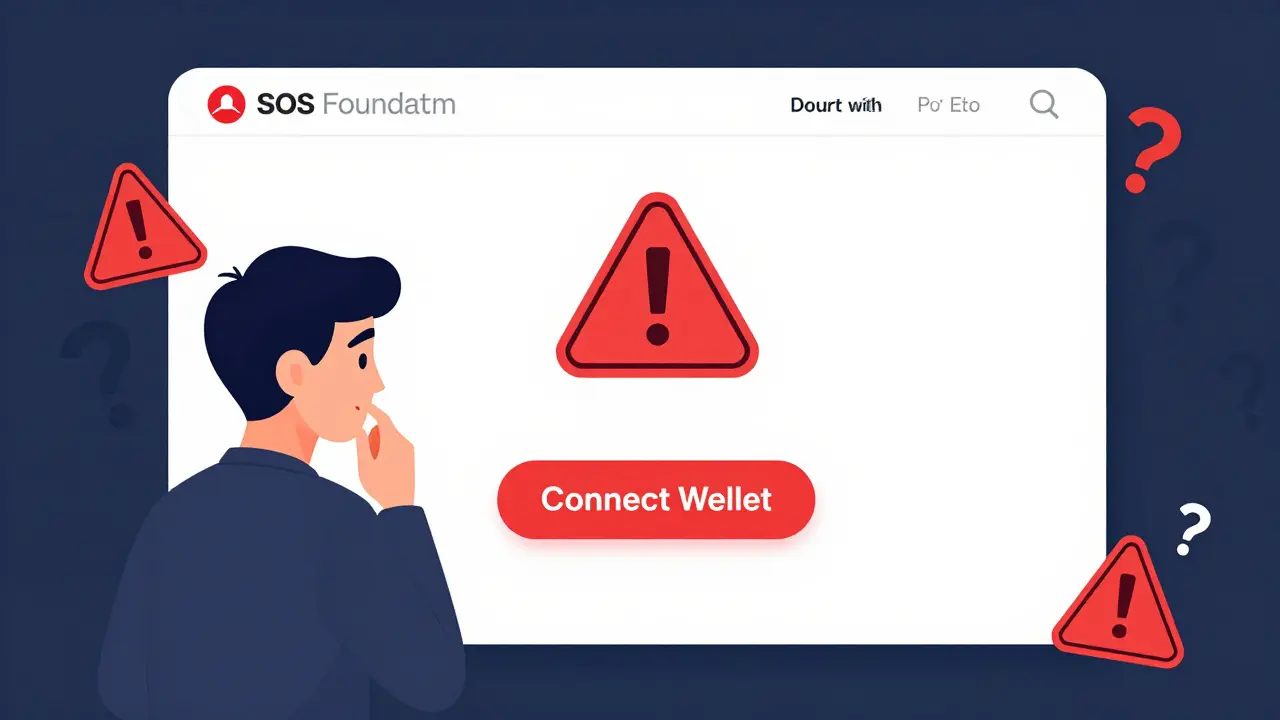
Something feels off about the SOS Foundation IDO Launch Celebration you saw advertised. You clicked the link expecting free tokens, but now you're staring at a request to connect your wallet or sign a suspicious transaction. This hesitation is your best defense. The SOS Foundation airdrop circulating online right now exhibits every hallmark of a sophisticated cryptocurrency scam designed to drain user funds.
As of late May 2026, there is no credible evidence that an entity known as "SOS Foundation" has launched a legitimate Initial D Offering (IDO) or associated airdrop. Major blockchain explorers, reputable news outlets, and security databases have not recorded this project. When a project promises high returns with zero risk, it is almost certainly a trap. This article breaks down why this specific offer is dangerous, how these scams operate, and exactly what steps you need to take to protect your digital assets.
The Red Flags of the SOS Foundation Airdrop
Scammers rely on urgency and greed. They create a sense of FOMO (Fear Of Missing Out) so you stop thinking critically. Let's look at the specific red flags present in the SOS Foundation promotion.
- Lack of Verified Information: Legitimate projects publish whitepapers, team details, and audit reports. The SOS Foundation website lacks verifiable team members, GitHub repositories, or smart contract audits from firms like CertiK or Hacken.
- Unofficial Communication Channels: The announcement likely came via unsolicited Telegram messages, Twitter DMs, or spam emails. Real foundations do not distribute high-value assets through random direct messages.
- Generic Branding: "SOS Foundation" is a generic name often used by scammers to sound charitable or authoritative. It mimics real-world humanitarian organizations to lower your guard.
- High Yield Promises: If the airdrop promises significant token value for minimal action, it violates basic economic principles. No legitimate business gives away valuable equity for free without clear utility or marketing strategy.
These elements combine to create a perfect storm for victimization. The goal isn't to build a community; it's to extract value from wallets as quickly as possible.
How the "Connect Wallet" Trap Works
The core mechanism of this scam is the malicious smart contract interaction. Here is the step-by-step process of how the SOS Foundation airdrop attempts to steal your funds.
- The Lure: You land on a phishing site claiming to be the official SOS Foundation distribution portal.
- Connection Request: The site asks you to connect your Web3 wallet (like MetaMask, Trust Wallet, or Phantom). Connecting alone doesn't steal funds, but it exposes your public address to the attacker.
- The Approval Transaction: To "claim" your airdrop, you are asked to sign a transaction. This is often disguised as a gas fee payment or a verification step. In reality, this transaction grants the scammer's contract unlimited approval to spend your tokens.
- The Drain: Once approved, the scammer can instantly transfer all supported tokens (USDT, ETH, SOL, etc.) from your wallet to their address. This happens in seconds, and reversing it is nearly impossible.
This method exploits the complexity of blockchain transactions. Most users don't read the raw data of the transaction they are signing. They see "Sign" and click, trusting the interface. That trust is what the scammer sells.
Verifying Crypto Projects: A Safety Checklist
To avoid falling for traps like the SOS Foundation IDO, you must adopt a verification routine before interacting with any new project. Use this checklist for every airdrop or IDO opportunity.
| Check Item | What to Look For | Red Flag Indicator |
|---|---|---|
| Official Website Domain | Registered for months/years, HTTPS secure | Newly registered domain (<1 month), misspelled URLs |
| Social Media Presence | Verified badges, long history, active community | Fake followers, bot comments, no verified links |
| Smart Contract Audit | Audit report from reputable firm (CertiK, PeckShield) | No audit, or audit from unknown/unverified source |
| Team Transparency | LinkedIn profiles, real names, past experience | Anonymous team, stock photos, no professional history |
| Community Engagement | Active Discord/Telegram with real discussions | Read-only channels, banned questions, aggressive mods |
If a project fails even one of these checks, especially the social media and audit requirements, assume it is fraudulent until proven otherwise. The burden of proof lies with the project, not you.
Immediate Steps if You Interacted with the Scam
If you already connected your wallet or signed a transaction related to the SOS Foundation airdrop, time is critical. Do not panic, but act immediately.
- Revoke Approvals: Use tools like Revoke.cash or Etherscan's Token Approval feature to revoke any permissions granted to unknown contracts. This stops future drains.
- Transfer Assets: Move remaining funds from the compromised wallet to a new, clean wallet address. Generate a new seed phrase for this new wallet.
- Monitor Transactions: Check your transaction history on block explorers (Etherscan, Solscan) for any outgoing transfers you didn't initiate.
- Change Passwords: If you reused passwords across platforms, change them immediately. Enable two-factor authentication (2FA) using an authenticator app, not SMS.
Remember, once crypto leaves your wallet, it cannot be recovered. There is no customer support for blockchain transactions. Prevention is the only viable strategy.
Understanding Legitimate IDOs vs. Scams
Initial D Offerings (IDOs) are legitimate fundraising methods for early-stage blockchain projects. However, they differ significantly from airdrop scams in structure and transparency.
Legitimate IDOs occur on established launchpads like DAO Maker, Polkastarter, or Seedify. These platforms perform due diligence on projects before listing them. Participants usually need to hold specific platform tokens to qualify, ensuring serious interest rather than casual clicking. The terms are clearly defined, including vesting schedules, lock-up periods, and token distribution mechanics.
In contrast, the SOS Foundation airdrop operates outside these ecosystems. It bypasses launchpad vetting, offers immediate rewards, and requires no prior engagement with the project. This disconnect between effort and reward is the primary indicator of fraud. Real projects build communities over time; scams harvest wallets in minutes.
Protecting Your Digital Identity
Beyond financial loss, interacting with scam sites can compromise your personal data. Phishing sites often collect email addresses, phone numbers, and sometimes even private keys if you are tricked into entering them.
Always use burner wallets for exploring new or unverified projects. Keep your main holdings in a hardware wallet (like Ledger or Trezor) that never connects directly to potentially malicious websites. Never share your seed phrase under any circumstances. No legitimate service will ever ask for your recovery phrase.
Educate yourself on common scam tactics. Familiarize yourself with terms like "honeypot," "rug pull," and "drainer." Understanding these concepts helps you recognize patterns when they appear. The crypto space evolves rapidly, but the fundamental principles of security remain constant: verify, verify, and verify again.
Reporting Fraudulent Activities
If you encounter the SOS Foundation airdrop or similar scams, report them. While reporting won't recover your funds, it helps protect others. Submit reports to relevant authorities such as the FBI's Internet Crime Complaint Center (IC3) or local cybercrime units. Additionally, flag the content on social media platforms and warn communities on Reddit, Twitter, and Discord.
Blockchain analysis firms also track scam addresses. By providing transaction hashes and wallet addresses involved in the scam, you contribute to a broader database that can blacklist these entities across exchanges and services.
The internet is full of opportunities, but also dangers. Stay skeptical, stay informed, and prioritize security over shortcuts. Your digital assets are worth protecting.
Is the SOS Foundation IDO airdrop real?
No, the SOS Foundation IDO airdrop is widely considered a scam. There is no verified information about a legitimate project by this name launching an IDO. It exhibits all the signs of a phishing attempt designed to steal cryptocurrency from users' wallets.
How can I tell if a crypto airdrop is legitimate?
Legitimate airdrops come from well-known projects with transparent teams, audited smart contracts, and active, verified social media presence. They rarely require you to connect your wallet to claim tokens unless it's through a trusted launchpad. Always check for recent negative reviews or scam warnings before participating.
What should I do if I connected my wallet to the SOS Foundation site?
Immediately revoke any token approvals granted to the site using tools like Revoke.cash. Transfer all remaining funds from that wallet to a new, secure wallet with a fresh seed phrase. Monitor your transaction history for unauthorized transfers and change any associated passwords.
Can I recover funds lost to the SOS Foundation scam?
Unfortunately, cryptocurrency transactions are irreversible. Once funds are sent to a scammer's wallet, they cannot be retrieved through standard means. Reporting the incident to authorities is important for tracking criminal activity, but recovery is extremely rare.
Why do scammers use names like "Foundation" or "Global"?
Scammers use authoritative-sounding names to create a false sense of trust and legitimacy. Words like "Foundation," "Global," or "International" imply stability and official status, which lowers victims' guard and makes them less likely to question the validity of the offer.