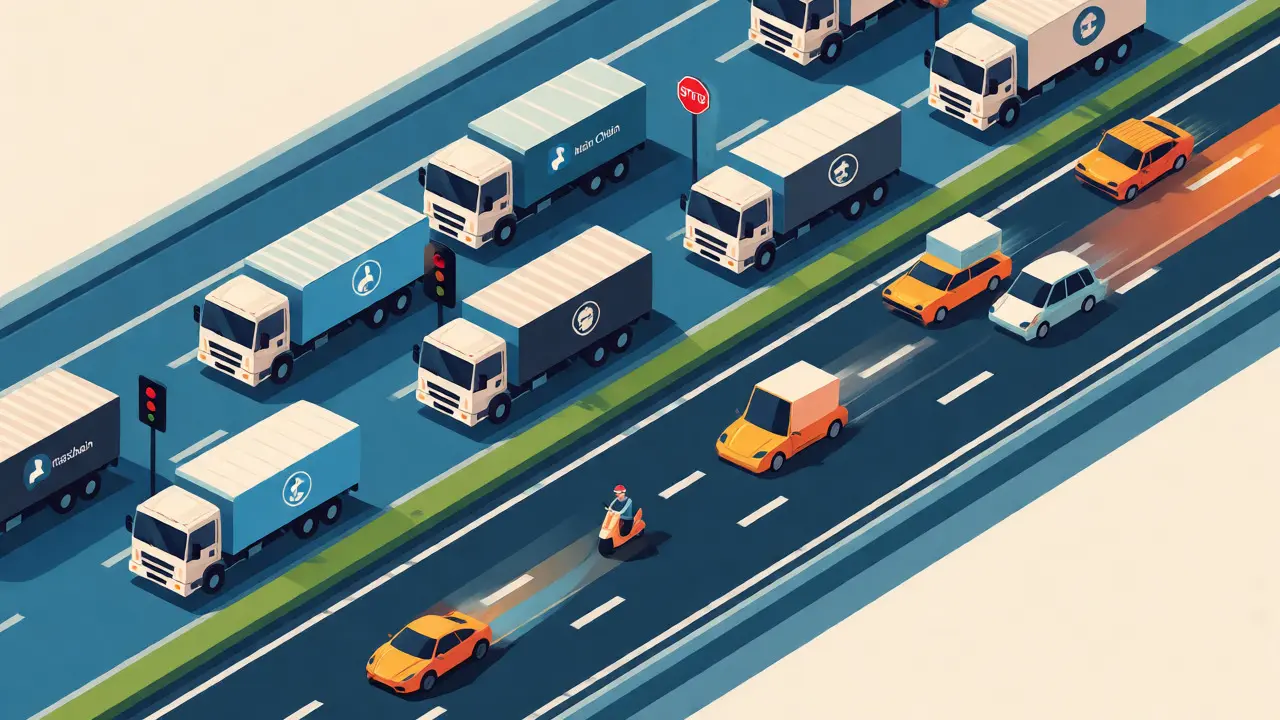
You've probably heard the term sidechain thrown around in crypto circles. It sounds technical, maybe a bit intimidating. But at its core, it's just a separate blockchain running parallel to a main one, like Ethereum or Bitcoin. Think of it as a dedicated lane on a highway that lets specific types of traffic move faster without clogging up the main road. The big question isn't what it is, but why you should care about its ability to scale networks and enable new features without risking the main chain's security.
If you're building an app, trading assets, or just trying to understand where your transaction fees are going, understanding sidechains changes the game. They aren't magic bullets-they have trade-offs-but they solve real problems. Let's break down exactly how they work, where they shine, and when you might want to avoid them.
What Exactly Is a Sidechain?
A sidechain is an independent blockchain that connects to a parent chain (the mainnet) through a mechanism called a two-way peg. This peg allows digital assets to move securely between the main chain and the sidechain. When you send Bitcoin to the Liquid Network, for example, it gets locked on the Bitcoin mainnet and released on Liquid. Send it back, and the process reverses.
The key difference between a sidechain and other scaling solutions, like Layer-2 rollups, is independence. A sidechain has its own consensus mechanism. It doesn't inherit the full security of the main chain. If the main chain is Bitcoin using Proof-of-Work, the sidechain might use Proof-of-Stake or a federated model. This independence gives developers freedom to experiment with speed and features that would be impossible or too risky on the main chain.
| Feature | Main Chain (e.g., Ethereum) | Sidechain (e.g., Polygon PoS) | Layer-2 (e.g., Arbitrum) |
|---|---|---|---|
| Security Source | Native Consensus | Own Consensus (Independent) | Inherits Main Chain Security |
| Transaction Speed | Slow (13-15s finality) | Fast (2.1s finality) | Medium-Fast |
| Cost per Tx | High ($1.50+ avg) | Very Low ($0.0001) | Low |
| Flexibility | Low (Hard Forks required) | High (Custom Rules) | Medium (Constrained by L1) |
Why Do We Need Sidechains? The Scalability Problem
Here's the harsh reality: main chains are slow and expensive. Ethereum processes about 15-30 transactions per second (TPS). During peak times, gas fees skyrocket because everyone is fighting for block space. Imagine trying to buy a coffee with $50 worth of ETH in fees. Not practical, right?
Sidechains step in to handle this overflow. They can process thousands of transactions per second. Polygon PoS, one of the most popular sidechains, achieves over 6,700 active dApps and handles massive volume at fractions of a cent. By moving activity off the main chain, sidechains keep the mainnet secure and stable while letting users interact cheaply and quickly.
This isn't just about saving money. It's about usability. For gaming apps or social platforms, waiting 15 seconds for a transaction to confirm kills the user experience. Sidechains offer near-instant feedback, which is critical for mass adoption.
Top Use Cases Where Sidechains Shine
Not every project needs a sidechain. But for specific scenarios, they are the best tool for the job. Here are the areas where they deliver tangible value.
Gaming and NFTs
Games need speed. Players don't want to wait for blockchain confirmations to loot a chest or trade an item. Immutable X, a sidechain focused on non-fungible tokens (NFTs), processes 9,000 TPS with zero gas fees for minting and trading. This makes it ideal for games like Gods Unchained or Illuvium, where millions of micro-transactions happen daily.
The benefit here is clear: low friction. Users can buy, sell, and create NFTs without worrying about complex wallet interactions or high costs. The sidechain handles the heavy lifting, settling batches of transactions back to the main chain periodically.
Enterprise Supply Chain Management
Companies like Walmart or Maersk track goods across borders. Recording every single movement on Ethereum would be prohibitively expensive and slow. Sidechains allow these enterprises to run private or semi-private ledgers with custom rules. They can share data with partners securely without exposing proprietary info to the public mainnet.
According to Deloitte's 2023 survey, 48% of Fortune 500 companies testing blockchain use sidechain-like architectures for supply chain tracking. Why? Because they need control over who validates transactions and how fast blocks are produced. Public mainnets can't always offer that level of customization.
Decentralized Finance (DeFi) Yield Farming
Yield farming often involves frequent rebalancing of positions. On Ethereum, doing this five times a day could eat all your profits in gas fees. On a sidechain like Polygon or BNB Chain (which operates similarly), those same actions cost pennies. This accessibility brings DeFi to smaller investors who can't afford $50 fees for a $100 deposit.
The Benefits You Can Actually Feel
Let's cut through the jargon. What do you actually get from using a sidechain?
- Lower Costs: Transaction fees drop from dollars to cents or less. This is the biggest driver for retail users.
- Faster Confirmations: Blocks are produced faster. Finality happens in seconds, not minutes.
- Experimentation Freedom: Developers can try new consensus mechanisms or smart contract languages without breaking the main chain. If a sidechain fails, the main chain remains untouched.
- Interoperability: The two-way peg lets you move assets back and forth. You're not trapped; you can return to the main chain whenever you want.
Vitalik Buterin, co-founder of Ethereum, noted in 2023 that sidechains are useful for specific applications but don't offer the same security guarantees as true Layer-2 solutions. That's a fair point. But for many users, "good enough" security combined with great performance is a worthwhile trade-off.
Risks and Limitations You Should Know
It's not all sunshine. Sidechains have a major weakness: security fragmentation. Since they run their own validators, they don't inherit the full hash power or stake of the main chain. If the sidechain's validators are compromised, funds can be stolen even if the main chain is safe.
Remember the Ronin Network hack in 2022? Axie Infinity's sidechain lost $625 million because only 5 out of 9 validators were needed to approve transactions, and several were hacked. This highlighted the risk of centralized validator sets. Unlike Ethereum, where attacking the network requires billions in hardware, attacking a small sidechain might require much less.
Also, bridging assets can be tricky. Moving funds from Ethereum to a sidechain takes time-sometimes hours-and involves smart contract risks. Always double-check the bridge you're using. Stick to established ones like the official Polygon Bridge or Wormhole rather than obscure, unaudited alternatives.

How to Choose the Right Sidechain
With dozens of options out there, how do you pick? Ask yourself these three questions:
- Do I need maximum security? If yes, stick to the main chain or a secure Layer-2. If no, a sidechain is fine.
- Is my application high-frequency? Gaming, social media, and micropayments benefit hugely from sidechains. Large, infrequent transfers might not justify the bridging hassle.
- Who are the validators? Check how decentralized the sidechain is. More validators generally mean better security. Polygon PoS has hundreds of validators, making it more robust than newer, smaller chains.
For beginners, Polygon is often the safest entry point due to its large ecosystem and mature tooling. For Bitcoin users, Liquid Network offers privacy and speed for BTC transfers. For enterprise, look at Hyperledger Fabric-based sidechains or Rootstock for Bitcoin smart contracts.
The Future of Sidechains
The landscape is shifting. Some projects, like Polygon, are transitioning toward Layer-2 zk-Rollup models to boost security. Others are adopting shared security models, like Cosmos' Inter-Blockchain Communication (IBC), which allows multiple chains to pool their economic security.
Gartner predicts sidechain adoption will grow at 34% annually through 2026, especially in enterprise sectors. However, competition from Layer-2 solutions is fierce. The winners will be those that balance flexibility with sufficient decentralization. As interoperability standards improve, moving assets between chains will become seamless, making sidechains an invisible layer of infrastructure rather than a conscious choice.
For now, if you're tired of high fees and slow speeds, exploring a sidechain is a smart move. Just remember: you're trading some security for performance. Keep your long-term holdings on the main chain, and use sidechains for active trading, gaming, and everyday payments.
Are sidechains safer than the main blockchain?
No, sidechains are generally less secure than the main blockchain. While the main chain (like Ethereum or Bitcoin) has thousands of validators securing it with massive economic weight, a sidechain relies on its own set of validators. If the sidechain has fewer validators or lower staked capital, it is easier to attack. However, for most everyday transactions, the risk is considered acceptable compared to the benefits of lower fees and higher speed.
Can I lose my funds when moving assets to a sidechain?
Yes, there are risks involved in bridging assets. Funds are locked in a smart contract on the main chain and minted on the sidechain. If the sidechain suffers a consensus failure or a hack (like the Ronin Network incident), you could lose your funds. Additionally, bugs in the bridge smart contracts themselves can lead to losses. Always use reputable bridges and start with small amounts when testing.
What is the difference between a sidechain and a Layer-2 solution?
The main difference is security inheritance. Layer-2 solutions (like Optimistic Rollups) post transaction data back to the main chain and inherit its security guarantees. Sidechains operate independently with their own consensus mechanism and do not inherit the main chain's security. Sidechains offer more flexibility in design but typically provide lower security assurance than Layer-2s.
Which sidechains are most popular in 2026?
As of 2026, Polygon PoS remains a dominant player for Ethereum compatibility, though it is evolving into a Layer-2 architecture. Other notable sidechains include Liquid Network for Bitcoin users seeking faster BTC settlements, Rootstock for bringing smart contracts to Bitcoin, and various Cosmos SDK-based chains that utilize the Inter-Blockchain Communication (IBC) protocol for interoperability.
Do I need special wallets to use sidechains?
Most modern multi-chain wallets like MetaMask, Trust Wallet, and Rabby support popular sidechains like Polygon and Binance Smart Chain automatically. You usually just need to add the network details manually if they aren't pre-loaded. For specialized sidechains like Liquid Network, you may need a dedicated wallet such as Blockstream Green or Ledger Live with specific plugins enabled.