
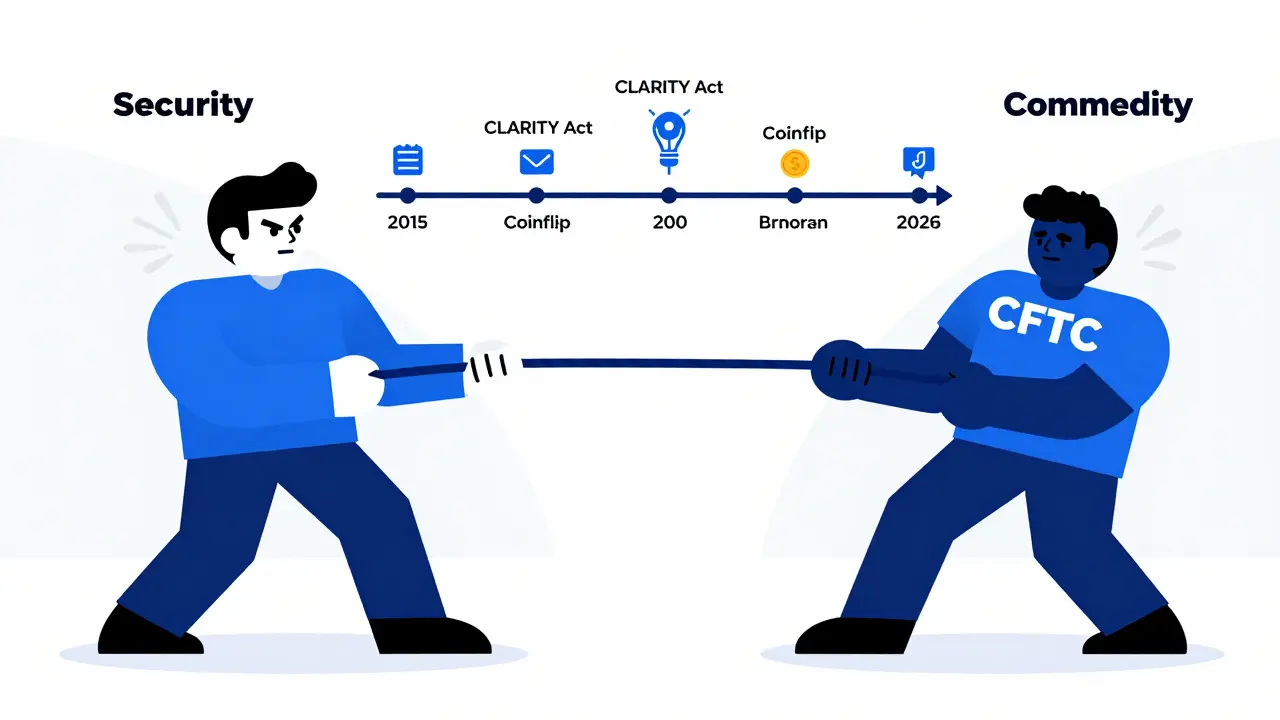
Imagine trying to build a house where the architect says one thing, the builder says another, and the inspector changes the rules every Tuesday. That is exactly what running a cryptocurrency business in the United States felt like for most of the last decade. At the heart of this chaos is a turf war between two federal agencies: the Securities and Exchange Commission (SEC), which regulates stocks and bonds, and the Commodity Futures Trading Commission (CFTC), which oversees commodities like corn, oil, and gold.
The question isn't just academic. It determines whether your token is treated like a stock or a commodity, which agency can fine you, and whether investors can actually buy what you're selling. By 2026, the dust has started to settle, but understanding how we got here-and where things stand now-is crucial for anyone holding, building with, or investing in digital assets.
The Core Conflict: Securities vs. Commodities
To understand the battle, you have to look at the definitions each agency uses. The SEC relies on the Howey Test, a legal framework from 1946. If an asset involves an investment of money in a common enterprise with profits expected from the efforts of others, it’s a security. The SEC argues that many tokens sold in Initial Coin Offerings (ICOs) fit this description because early buyers relied on the development team’s work to make the token valuable.
On the other side, the CFTC views cryptocurrencies through the lens of the Commodity Exchange Act. In 2015, during the Coinflip case, the CFTC declared Bitcoin a commodity. They argue that once a blockchain network is decentralized and functioning, the underlying asset acts like a commodity-something traded for its intrinsic value rather than as an equity stake in a company.
This creates a gray area. Is Ethereum a security because people bought ETH to support the network’s growth? Or is it a commodity because it’s now used globally as fuel for smart contracts? For years, both agencies said "yes" to their own interpretation, leaving companies stuck in the middle.
Key Legal Milestones That Shaped the Fight
The jurisdictional tug-of-war wasn't sudden; it was built on specific court rulings and enforcement actions.
- 2015: The CFTC establishes Bitcoin as a commodity in the Coinflip proceeding.
- 2018: A federal court confirms the CFTC's authority over virtual currencies as "goods" under the Commodity Exchange Act in CFTC v. McDonnell.
- 2019: Former CFTC Chairman Heath Tarbert explicitly states that Ether is a commodity.
- 2023: The SEC sues Coinbase, alleging it operates as an unregistered securities exchange. This was a major escalation, claiming that dozens of tokens on the platform were unregistered securities.
- 2024: Judge Katherine Polk Failla denies Coinbase’s motion to dismiss, agreeing the SEC had a plausible case that some assets were securities.
- 2025: A dramatic shift occurs. The SEC and Coinbase agree to dismiss the lawsuit entirely. This signaled a change in strategy, likely due to new leadership and political pressure.
These dates matter because they show the pendulum swinging. The SEC pushed hard in 2023-2024, using enforcement to create rules. But by early 2025, the momentum shifted toward legislative solutions and de-escalation.
The Legislative Solution: The CLARITY Act
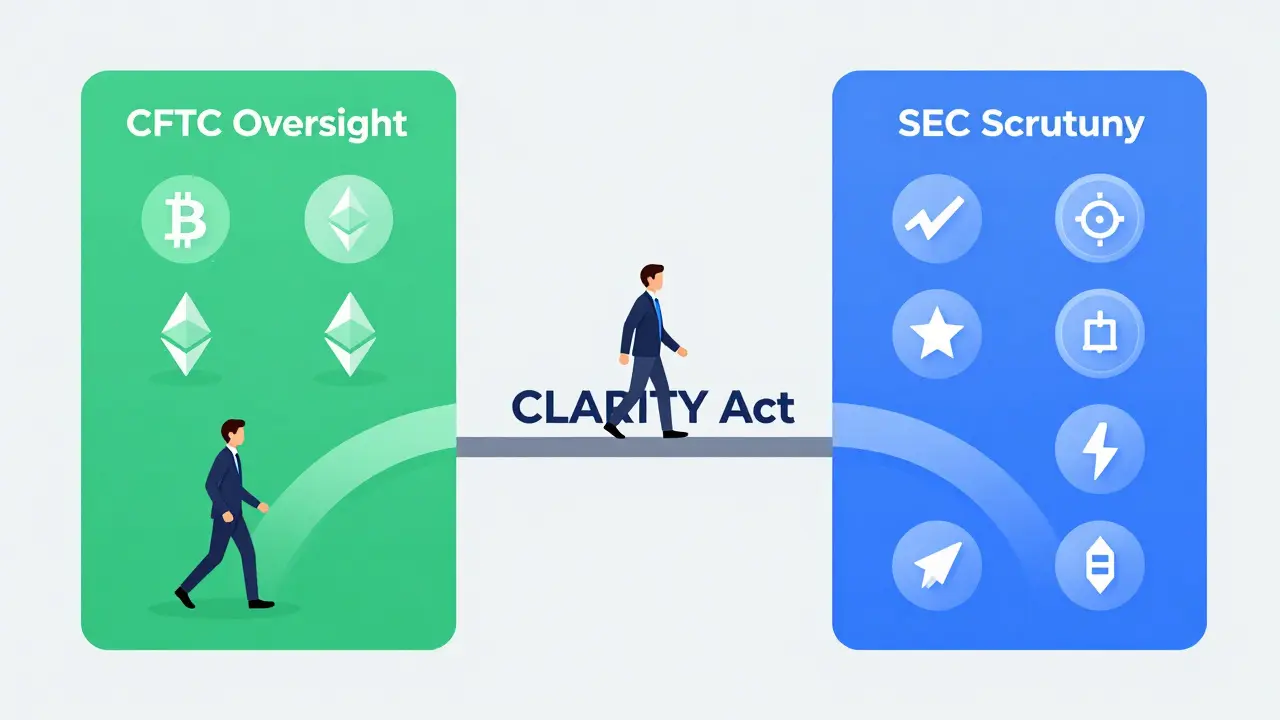
Regulation by enforcement is messy. That’s why Congress stepped in. The CLARITY Act (Clarity for Digital Assets Through Technology Innovation), passed by the House in April 2024, offers a roadmap out of the confusion. It doesn’t eliminate the agencies but draws a clear line between them.
Under the CLARITY Act, the CFTC would regulate "digital commodities." To qualify, an asset must meet three criteria:
- It is intrinsically linked to a mature blockchain system.
- It is sufficiently decentralized (no single entity controls it).
- It does not confer ownership rights or voting power in a company.
If a token fails these tests-for example, if it represents shares in a startup or gives holders voting rights-it remains a security under SEC jurisdiction. This distinction protects investors while allowing decentralized networks like Bitcoin and Ethereum to operate under commodity rules.
The Senate Banking Committee also released a discussion draft in March 2024, proposing a similar framework but with a formal "digital asset determination" process. While reconciliation between the House and Senate versions takes time, the bipartisan support suggests that a hybrid model is the future. As of mid-2026, industry experts estimate a 68% probability of a compromise bill passing before the next midterm elections.
Impact on Businesses and Investors
You might wonder why this matters if you’re not a CEO of a crypto exchange. The uncertainty has real economic costs. According to a 2024 Deloitte survey, U.S. crypto firms spend an average of $2.7 million annually on compliance, with nearly half of that cost going directly to navigating the SEC-CFTC divide.
For businesses, the lack of clarity forced many to adopt a "dual compliance" approach. Exchanges like Kraken and Gemini implemented regulations for both securities and commodities for all tokens, increasing operational costs by roughly 35%. Many startups delayed product launches. The Blockchain Association estimated that regulatory limbo cost the U.S. economy $4.2 billion in lost investment in 2023 alone.
For investors, the impact is equally significant. Institutional investors-pension funds, endowments-are risk-averse. They cannot invest in assets that might be deemed illegal securities tomorrow. The dismissal of the Coinbase lawsuit in 2025 helped restore some confidence, but until legislation is final, many large players remain on the sidelines.
| Feature | SEC (Securities) | CFTC (Commodities) |
|---|---|---|
| Primary Focus | Investor protection, disclosure, anti-fraud in securities markets | Market integrity, preventing manipulation in derivatives and spot commodities |
| Key Legal Test | Howey Test (investment contract) | Commodity Exchange Act definition |
| Typical Assets | ICO tokens, governance tokens with voting rights, stablecoins tied to central entities | Bitcoin, Ether, Litecoin, Tether (as a commodity) |
| Enforcement Style | Heavy reliance on lawsuits and registration requirements | Focus on fraud/manipulation in trading; more permissive for innovation |
| 2023-2024 Actions | 23 enforcement actions against platforms | 15 enforcement actions, mostly regarding unregistered futures merchants |
Global Context: Why the U.S. Falls Behind
While the U.S. debated jurisdiction, other regions moved forward. The European Union implemented the Markets in Crypto-Assets (MiCA) regulation in June 2024. MiCA provides a unified framework across 27 member states, giving businesses legal certainty. Meanwhile, the U.S. struggled with inter-agency conflict.
The result? Market share loss. In 2020, U.S. firms captured 32% of the global crypto market. By 2024, that dropped to 14%. Boston Consulting Group estimates that without clear resolution, U.S. firms could lose another 10-15% to offshore competitors. Regulatory clarity isn’t just about fairness; it’s about national competitiveness. The Center for Strategic and International Studies (CSIS) projects that resolving this conflict could unlock $500 billion in additional U.S. crypto investment by 2027.
What Comes Next?
We are entering a period of transition. The dismissal of the Coinbase case in February 2025 marked a turning point. It suggested that the SEC, under new leadership, is willing to step back from aggressive litigation in favor of working with Congress. The approval of spot Ethereum ETFs by the CFTC in April 2025 further solidified the status of major cryptos as commodities.
However, vigilance is needed. State regulators are stepping in to fill the void. In April 2025, the Oregon Attorney General sued Coinbase using theories similar to the SEC’s previous arguments. This means even if federal agencies agree, local laws may still pose challenges.
For now, the path forward seems clear: established, decentralized coins like Bitcoin and Ether will likely fall under CFTC oversight. Newer, centralized tokens will remain under SEC scrutiny. The key is waiting for the final legislative text to codify these boundaries. Until then, the best strategy is transparency, decentralization, and avoiding promises of returns based on third-party efforts.
Is Bitcoin considered a security or a commodity?
Bitcoin is widely recognized as a commodity. Both the CFTC and federal courts have affirmed this status since 2015. It is highly decentralized, has no central management team, and does not offer investment returns derived from the efforts of others, so it fails the Howey Test for securities.
What is the Howey Test?
The Howey Test is a legal standard from a 1946 Supreme Court case used to determine if an asset is an "investment contract" (security). An asset is a security if it involves: 1) an investment of money, 2) in a common enterprise, 3) with a reasonable expectation of profit, 4) derived from the efforts of others. The SEC uses this test to classify many crypto tokens as securities.
Did the SEC drop the case against Coinbase?
Yes. In February 2025, the SEC and Coinbase filed a joint stipulation to dismiss the action entirely. This was seen as a significant shift in the SEC's enforcement strategy, moving away from broad litigation toward a more collaborative approach pending legislative clarity.
What does the CLARITY Act do?
The CLARITY Act proposes a clear division of regulatory authority. It assigns jurisdiction over "digital commodities" (decentralized assets like Bitcoin and Ether) to the CFTC, while keeping securities (assets with central management or profit-sharing features) under SEC control. It aims to reduce regulatory overlap and provide legal certainty for businesses.
Why does the SEC vs CFTC battle matter to retail investors?
It affects the availability and safety of products. Clear regulations encourage institutional investment, which stabilizes markets and brings better infrastructure. Uncertainty leads to higher fees, fewer products, and potential legal risks for exchanges, which can ultimately impact the value and accessibility of your crypto holdings.