
You deposit money into a decentralized finance (DeFi) pool. You watch the annual percentage yield (APY) climb to 500%. Then, overnight, the rewards drop by 80%. What do you do? Most people pull their money out immediately and chase the next high-yield opportunity. This behavior defines mercenary capital, a phenomenon where investors treat protocols like temporary ATMs rather than long-term ecosystems. It is the driving force behind the boom-and-bust cycles that have characterized blockchain knowledge since 2020.
Mercenary capital isn't just about greed; it is a rational response to how early DeFi incentives were structured. Protocols needed liquidity to function, so they paid users with native tokens. Investors provided that liquidity, harvested the tokens, and sold them for profit. The result? A cycle of massive growth followed by rapid collapse. Understanding this dynamic is crucial if you want to navigate the current landscape of liquidity mining without losing your principal to impermanent loss or token dilution.
The Mechanics of Mercenary Behavior
To understand why mercenary capital dominates, we need to look at how liquidity mining works. In simple terms, liquidity mining is the practice of distributing rewards-often in the protocol's native governance token-to users who provide liquidity to the protocol. When you deposit assets like ETH and USDC into an automated market maker (AMM) such as Uniswap or Curve, you receive LP tokens. You then stake these LP tokens in a yield farming contract to earn additional rewards.
The problem arises from the speed at which capital moves. Brian Flynn of Variant Fund analyzed 12,000 liquidity providers across 47 protocols and found that the average miner stays in a protocol for only 14.7 days before moving to the next highest yield opportunity. These investors use tools like DeFiLlama and Zapper to scan for new launches offering initial APYs exceeding 100%.
This creates a specific behavioral pattern:
- Entry: Investors deposit capital into a new protocol during its launch phase when rewards are highest.
- Harvesting: They accumulate the protocol’s native governance tokens.
- Exit: Once the hype fades or a better opportunity appears, they withdraw their liquidity and sell the earned tokens on secondary markets.
This exit strategy creates significant downward pressure on the token price. As IronKey Capital noted in their October 2023 report, if a protocol keeps rewarding liquidity mining with large quantities of its token, the value of those tokens will surely be diluted. Mercenary investors are highly incentivized to dump these rewards, exacerbating the price drop.
Case Study: The Big Data Protocol Collapse
No example illustrates the danger of mercenary capital better than the Big Data Protocol incident in September 2021. Over a single weekend, the protocol amassed approximately 10% of the total value locked (TVL) in the entire DeFi ecosystem, reaching roughly $1.2 billion. How did this happen? The protocol offered unsustainable yields that attracted opportunistic capital from across the industry.
Within days, the reality set in. The rewards were not backed by real revenue or sustainable tokenomics. As Two Sigma documented in their October 2021 research report, the TVL collapsed to near-zero levels almost as quickly as it had risen. This wasn't an isolated incident. SushiSwap saw its TVL drop from $1.8 billion to $300 million within six months of its launch in 2020 as mercenary capital fled for greener pastures.
These collapses highlight a critical risk: when your returns depend entirely on new investors entering the system, you are running a Ponzi-like structure. Once the flow of new mercenary capital slows down, the house of cards falls.

The Hidden Cost: Impermanent Loss
While chasing high APYs, many investors overlook a critical technical constraint known as impermanent loss. This occurs when the relative price of the deposited tokens changes. If one token in your pair increases in value significantly compared to the other, the AMM rebalances the pool, leaving you with fewer of the appreciating asset than if you had simply held the tokens in your wallet.
During periods of high volatility, losses can exceed 50%. For example, a user on Reddit reported losing $28,000 in impermanent loss on a SushiSwap position during the May 2021 market crash, despite earning $12,000 in SUSHI rewards. The net result was a substantial loss.
Understanding the difference between APR and APY is also vital here. APR reflects nominal annualized rewards without compounding, while APY includes compounding effects. Many platforms advertise APY to make returns look more attractive, but if impermanent loss erodes your principal, the advertised yield becomes meaningless.
How Protocols Are Fighting Back: DeFi 2.0 Solutions
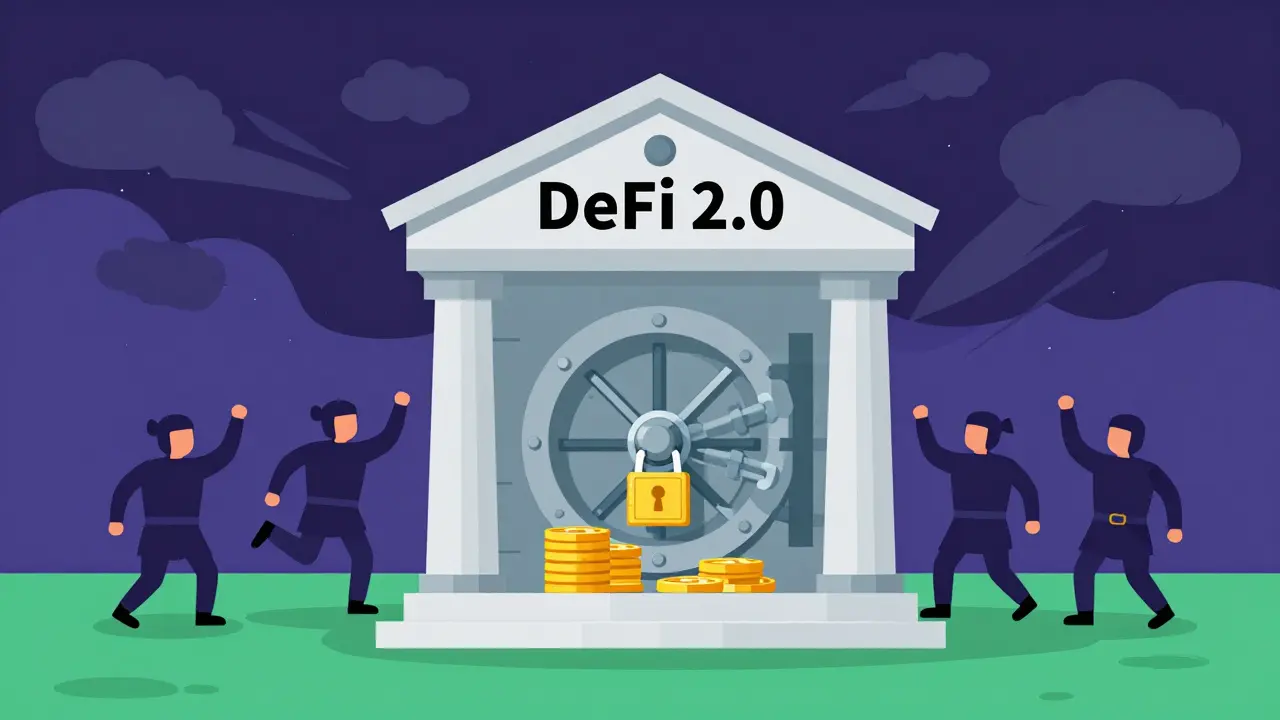
Recognizing the unsustainability of pure mercenary capital, the industry has shifted toward "DeFi 2.0" solutions designed to create sticky, loyal liquidity. These models aim to align the interests of investors with the long-term health of the protocol.
| Model | Key Mechanism | Example Protocol | Impact on Mercenary Capital |
|---|---|---|---|
| Traditional Liquidity Mining | High APY rewards for short-term deposits | SushiSwap (2020) | Encourages rapid entry and exit |
| Vote-Escrowed Tokens (veToken) | Lock tokens for up to 4 years to maximize rewards | Curve Finance | Reduces turnover; 65% of CRV supply locked |
| Protocol-Owned Liquidity (POL) | Protocol buys back liquidity using discounted bonds | Olympus DAO | Removes reliance on external LPs |
| Anti-Withdrawal Penalties | Fees for early withdrawals (e.g., 1% same-day) | Bancor v2.1 | Reduced mercenary behavior by 47% |
Curve Finance’s veCRV model is a standout example. By requiring users to lock CRV tokens for up to four years to vote on reward distribution, Curve created a community of long-term stakeholders. As of October 2023, 65% of the total CRV supply was locked, demonstrating the effectiveness of this approach in reducing churn.
Olympus DAO pioneered the POL model, allowing protocols to purchase liquidity directly using discounted token bonds. While the OHM token itself has declined 99% from its all-time high, the underlying concept of protocol-owned liquidity has been adopted by 34 other protocols, controlling over $482 million in assets. This shift reduces the protocol's vulnerability to sudden withdrawals by mercenary capital.
Risks and Realities for Retail Investors
If you are considering participating in liquidity mining, it is essential to understand the risks. A survey by IntoTheBlock of 1,243 DeFi users found that 68.3% had engaged in liquidity mining, but 76.8% admitted they would immediately withdraw if a better APY appeared elsewhere. This confirms that the majority of participants are still acting as mercenaries.
Common challenges include:
- Smart Contract Risk: In 2022 alone, $2.8 billion was lost to DeFi hacks according to Chainalysis.
- Reward Token Volatility: 73.2% of users experienced price drops exceeding 30% within 72 hours of earning rewards.
- Complexity: Beginners typically require 20-30 hours of study to safely navigate liquidity mining, with 67% making critical errors in their first attempts.
Regulatory scrutiny is also increasing. Following the SEC’s enforcement action against Uniswap Labs in February 2023, 17 countries have issued specific guidance on liquidity mining taxation. This adds another layer of complexity for retail investors who must now consider tax implications alongside financial risks.
Practical Steps for Safer Participation
If you decide to engage with liquidity mining, adopt a cautious and informed approach. First, diversify your exposure. Do not put all your capital into a single protocol chasing the highest APY. Second, use tools to monitor impermanent loss. Platforms like Tokenomik offer calculators that help you estimate potential losses based on price volatility.
Third, focus on protocols with sustainable tokenomics. Look for models that incorporate lock-up periods, vote-escrowed mechanisms, or protocol-owned liquidity. These structures indicate a commitment to long-term stability rather than short-term hype. Finally, keep your gas fees in mind. On networks like Ethereum, frequent transactions can eat into your profits, especially if you are constantly moving capital between pools.
The future of DeFi likely lies in hybrid models that balance short-term growth incentives with sustainable tokenomics. As Haseeb Qureshi of Dragonfly Capital predicted, protocols that separate governance, utility, and reward tokens will capture the majority of market share. Until then, mercenary capital will remain a dominant force, shaping the rise and fall of countless projects.
What is mercenary capital in DeFi?
Mercenary capital refers to opportunistic funds provided by investors who move rapidly between DeFi protocols to chase the highest short-term yields. These investors lack loyalty to any single protocol and often withdraw their liquidity and sell reward tokens once incentives decrease, causing volatility and instability.
How does impermanent loss affect liquidity miners?
Impermanent loss occurs when the price ratio of the tokens in a liquidity pool changes compared to when they were deposited. If one token appreciates significantly, the miner ends up with less value than if they had simply held the tokens. During high volatility, this loss can exceed 50%, potentially wiping out yield rewards.
What is Protocol-Owned Liquidity (POL)?
Protocol-Owned Liquidity is a model where the DeFi protocol itself owns the liquidity in its trading pools, rather than relying on external users. This is often achieved by issuing discounted bonds that allow the protocol to buy back its own tokens and add them to liquidity pools, reducing dependence on mercenary capital.
Why did Big Data Protocol collapse?
Big Data Protocol collapsed because it relied entirely on unsustainable high yields to attract mercenary capital. It amassed $1.2 billion in TVL in one weekend, but once the rewards proved unbacked by real value, investors withdrew en masse, causing the TVL to drop to near zero within days.
Is liquidity mining safe for beginners?
Liquidity mining carries significant risks for beginners, including smart contract vulnerabilities, impermanent loss, and token volatility. Surveys show that 67% of novice users make critical errors in their first attempts. It requires understanding of gas fees, slippage, and tokenomics, making it unsuitable for those without prior experience or education in DeFi.