
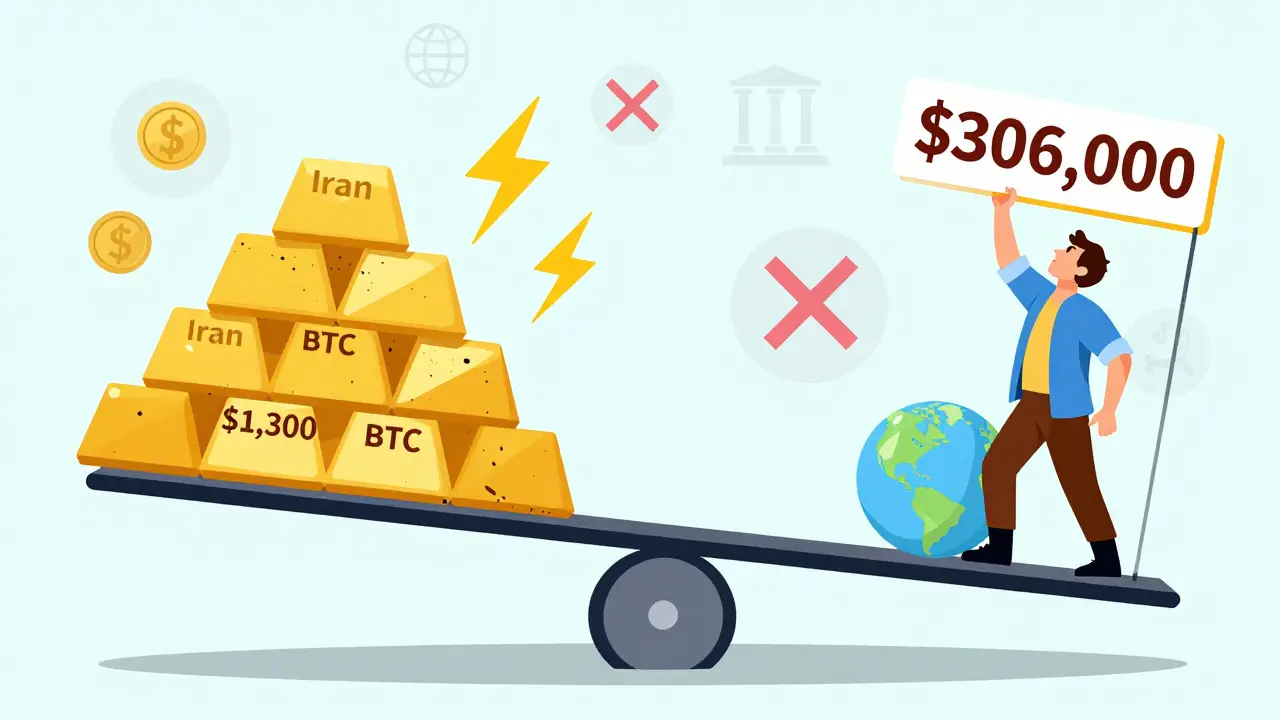
You might have heard that Bitcoin is expensive to mine. In most parts of the world, it’s a high-cost, low-margin business. But in Iran, the math looks completely different. Here, miners can produce a single Bitcoin for roughly $1,300, while the global market price hovers between $30,000 and $40,000. That is a profit margin that would make any investor jealous. So, why does this matter to you? Because this massive profit isn’t coming from efficiency or technology alone. It’s coming from subsidized electricity that ordinary Iranians are desperately short on.
The story of Iranian energy subsidies for crypto mining is not just about digital currency. It is a tale of economic survival, political control, and a power grid pushed to its breaking point. As of mid-2026, the situation has become increasingly complex. The government wants the foreign exchange generated by crypto to bypass international sanctions, but the people want their lights to stay on during the scorching summer heat. This clash creates a volatile environment where regulations change overnight, and blackouts become a daily reality for millions.
How the Subsidy System Works
To understand the scale of this operation, you need to look at the numbers. Electricity in Iran is heavily subsidized. For industrial users involved in cryptocurrency mining, rates can drop as low as $0.01 to $0.05 per kilowatt-hour (kWh). Compare that to Italy, where mining costs can reach $306,000 per Bitcoin due to higher energy prices. That is a 235-fold difference. No wonder Iran has become a global hub for mining activity.
However, it’s not quite that simple. While household electricity is even cheaper (around $0.01-$0.02/kWh), the government officially requires miners to pay industrial tariffs. In practice, many operations run illegally using household connections. This loophole allows them to access the cheapest power possible, but it also means they are stealing from the public grid. The result is a system where the cost of production is artificially low, but the social cost is incredibly high.
- Licensed Miners: Pay industrial rates ($0.04-$0.07/kWh) but face strict quotas and frequent shutdowns.
- Illegal Miners: Use residential rates ($0.01-$0.02/kWh) by hiding equipment in homes or basements, causing localized blackouts.
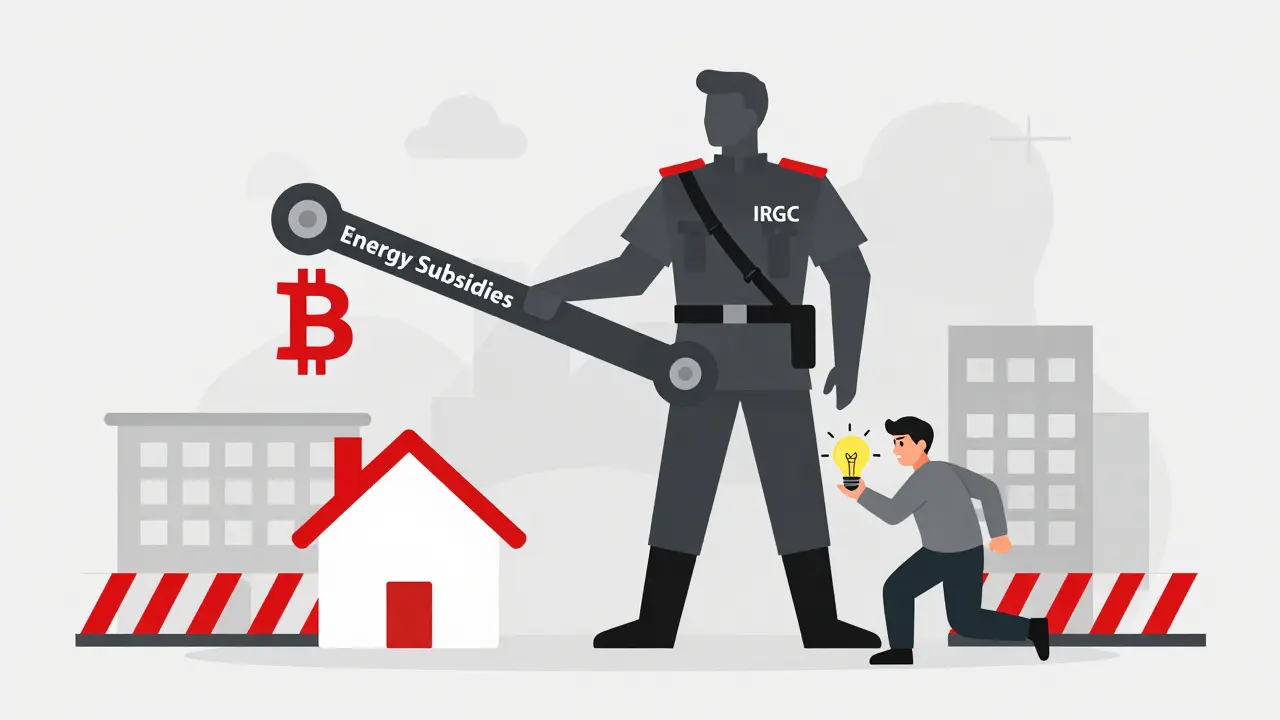
- State-Backed Operations: Often linked to powerful entities like the IRGC, operating with minimal oversight and maximum capacity.
The Human Cost: Blackouts and Frustration
Behind every megawatt used by a mining rig is a family without air conditioning. During the summer months, when temperatures soar above 45°C (113°F), electricity demand in Iran spikes by 30-40%. This is exactly when the grid struggles the most. According to data from Tavanir, Iran’s power company, cryptocurrency mining consumes nearly 2,000 megawatts (MW) of electricity. That represents about 5% of the country’s total consumption but accounts for 15-20% of the electricity imbalance.
What does that mean for you if you were living there? It means blackouts. In June and July 2025, residents reported average daily blackouts of 8-12 hours. On social media platforms like X (formerly Twitter) and Telegram, frustration boiled over. One user noted, "21 hours of blackouts this week while the IRGC's mining farms run 24/7." Another resident in Tehran shared, "They only mine cryptocurrency, but we are deprived of electricity." These aren't isolated complaints; they reflect a widespread sentiment that the government prioritizes digital gold over human comfort.
| Metric | Value | Context |
|---|---|---|
| Total Mining Consumption | ~2,000 MW | Equivalent to powering a major city |
| Share of Total Usage | 5% | Seems small, but hits peak demand hard |
| Grid Imbalance Contribution | 15-20% | Major factor in seasonal shortages |
| Bitcoin Energy Cost | 300 MWh | Power for ~35,000 households for one day |
Who Controls the Mines?
If you think crypto mining is a decentralized revolution, Iran offers a stark counterexample. A significant portion of the mining industry is controlled by state-affiliated groups. Reports indicate that the Islamic Revolutionary Guard Corps (IRGC) controls approximately 60% of illegal mining operations. They set up large-scale facilities in hidden locations, such as the tunnels under Ahvaz Stadium, discovered in April 2025.
This concentration of power creates a parallel economy. Dr. Saeed Laylaz, an economic advisor, criticized this setup, stating, "The government has created a parallel economy where the IRGC controls both the energy supply and the cryptocurrency output, bypassing central bank oversight." This isn't just about making money; it's about maintaining financial independence from the global banking system, which has sanctioned Iran for years.
The Central Bank of Iran (CBI) plays a tricky role here. They prohibit domestic payments in cryptocurrency to prevent capital flight and inflation. However, they allow licensed miners to sell their mined coins for cross-border trade settlements. This dual approach lets the government earn foreign currency without destabilizing the local rial entirely. It’s a delicate balancing act that often tips toward chaos.
Regulations and Crackdowns
The government knows the problem. That’s why you see periodic bans and crackdowns. In 2021, 2022, and 2023, authorities shut down legal mining operations during peak summer months to save power for hospitals and homes. But these bans are temporary. Once the heat wave passes, the rigs come back online.
In 2025, the rules tightened further. All mining operations must now register with industrial-scale facilities and install smart meters to monitor usage in real-time. The goal is to eliminate the shadow market of illegal miners. To encourage compliance, the government launched a reward program: citizens who report illegal mining operations receive 10% of the recovered electricity costs. In the first six months of 2025, this led to 8,432 reports and 2,157 shutdowns.
Despite these efforts, enforcement is spotty. Illegal miners adapt quickly. When internet outages occurred in mid-2025 due to regional conflicts, power consumption dropped by 2,400 MW almost instantly. This proved that a huge chunk of the load was indeed crypto-related, yet the infrastructure to stop it permanently remains lacking.
Economic Impact vs. Infrastructure Strain
Why does the government continue to tolerate this? The answer is money. Iran’s cryptocurrency sector is projected to generate $1.5 billion annually by 2025, growing at a rate of 23.7% per year. This revenue helps offset the losses from international sanctions. Energy Minister Ali Akbar Mehrabian defended the policy in June 2025, arguing that regulated mining generates $800 million in foreign exchange through trade settlement, which he claims offsets the energy costs.
But critics argue this is short-sighted. The power grid is already operating at 60-70% of required capacity due to decades of underinvestment. Using precious electricity to mine speculative assets exacerbates long-term instability. The International Energy Agency predicts that without significant grid upgrades, power shortages could increase by 25-30% by 2027. You are trading immediate cash flow for future reliability. Is that a fair deal? Most engineers say no.
What Does This Mean for Global Crypto?
For the rest of the world, Iran’s mining boom distorts the market. When a significant portion of new Bitcoins is produced at $1,300 each, it puts downward pressure on prices globally. Miners in countries with higher energy costs struggle to compete. This creates an uneven playing field where geopolitical factors dictate profitability more than technological innovation.
Furthermore, the association of crypto with state-controlled entities in Iran raises concerns about transparency. If a large percentage of the hash rate is controlled by a single authoritarian regime, does that undermine the decentralization ethos of Bitcoin? These are questions regulators worldwide are starting to ask. As Iran continues to walk the fine line between harnessing crypto’s potential and addressing grid instability, the global community watches closely.
Is cryptocurrency mining legal in Iran?
Yes, but with strict conditions. Mining itself was legalized in 2018, but operators must obtain licenses from multiple government bodies, including the Ministry of Industry and the Central Bank of Iran. Unlicensed mining is illegal and subject to severe penalties, including device confiscation and arrest.
How much electricity does one Bitcoin consume in Iran?
Mining a single Bitcoin requires over 300 megawatt-hours (MWh) of electricity. This is equivalent to the daily power consumption of approximately 35,000 Iranian households. Given the subsidized rates, this makes production extremely cheap compared to global averages.
Why does the Iranian government support crypto mining despite blackouts?
The primary reason is economic survival under sanctions. Crypto mining generates significant foreign exchange revenue, estimated at $1.5 billion annually. This money is used for cross-border trade settlements, allowing Iran to import essential goods despite being cut off from traditional international banking systems.
Who controls the majority of mining operations in Iran?
Reports suggest that the Islamic Revolutionary Guard Corps (IRGC) controls approximately 60% of illegal mining operations and a significant share of legal ones. This concentration of power allows the military wing to bypass central bank oversight and generate independent revenue streams.
Can regular citizens participate in crypto mining in Iran?
Technically yes, but it is risky. Small-scale miners make up 60-70% of participants, but they often operate illegally to access cheaper residential electricity. The government actively cracks down on these operations, seizing devices and imposing fines. Licensed participation requires navigating a complex bureaucratic process with low approval rates.