If you live in Perth or anywhere else in Australia, you’ve probably noticed that buying Bitcoin isn’t as simple as walking into a bank. You need an exchange that speaks your language-literally and financially. Enter Independent Reserve, one of Australia’s oldest and most trusted cryptocurrency exchanges, founded in Sydney in 2013. But is it still the best choice for you in 2026? Or are you better off with a global giant like Binance?
This review cuts through the marketing noise. We’ll look at the real costs, the security features that actually matter, and whether their limited coin selection is a dealbreaker for you. If you’re looking for a platform that plays by Australian rules, keeps your money safe, and doesn’t hide fees in the fine print, keep reading.
Quick Summary: The Good, The Bad, and The Ugly
- Best For: Australians and New Zealanders who prioritize regulatory safety and local banking integration over having 500 different altcoins.
- Biggest Strength: Full regulation by ASIC and AUSTRAC, plus insurance coverage-a rarity in the crypto world.
- Main Drawback: Only supports 32 cryptocurrencies. If you want to trade obscure meme coins, look elsewhere.
- Fee Reality: Starts high at 0.50% but drops significantly for active traders. AUD deposits are mostly free.
Who Is Independent Reserve Actually For?
Let’s be honest: not every exchange fits everyone. Independent Reserve isn’t trying to be the next Binance. They aren’t chasing the hype cycle of listing ten new tokens a week. Instead, they focus on stability. Since its launch, the platform has served over 200,000 customers across Australia, New Zealand, and Singapore. Their model works best if you fall into one of these categories:
- The Conservative Investor: You care more about your funds being insured and segregated than trading at 3 AM.
- The Local Trader: You want instant PayID transfers in AUD without waiting days for international wire settlements.
- The High-Net-Worth Individual: You need access to an Over-The-Counter (OTC) desk for large trades where slippage matters.
If you’re a day trader hunting for leverage up to 100x or futures contracts, you might find Independent Reserve a bit too tame. They offer up to 5x leverage, which is safer but less exciting for aggressive speculators.
Fees and Funding: Where Does Your Money Go?
Fees are where many exchanges try to trick you. Independent Reserve is relatively transparent, but you need to understand the tiered structure. Here is how the numbers stack up in 2026:
| Transaction Type | Cost / Fee | Notes |
|---|---|---|
| AUD Deposit (EFT) | Free (for > A$100) | A$0.99 fee for deposits under A$100. |
| AUD Withdrawal (EFT) | Free | Standard processing time. |
| Instant AUD Withdrawal | A$1.50 | Fast access to cash. |
| Card/PayPal Deposit | 1% | Convenient but expensive compared to EFT. |
| Trading Fees (Maker/Taker) | 0.50% down to 0.02% | Tiered based on monthly volume. |
| BTC Withdrawal | 0.0002 BTC | Network dependent. |
The key takeaway here? Use Electronic Funds Transfer (EFT) or PayID for your fiat currency. Avoid credit cards unless you’re in a rush, because that 1% fee eats into your gains immediately. For trading, if you move more than A$100,000 a month, your fees drop to competitive levels (around 0.02%-0.05%). If you’re just starting out, that initial 0.50% maker/taker fee feels steep, but it buys you peace of mind knowing the platform is fully compliant.
Security and Regulation: The Real Differentiator
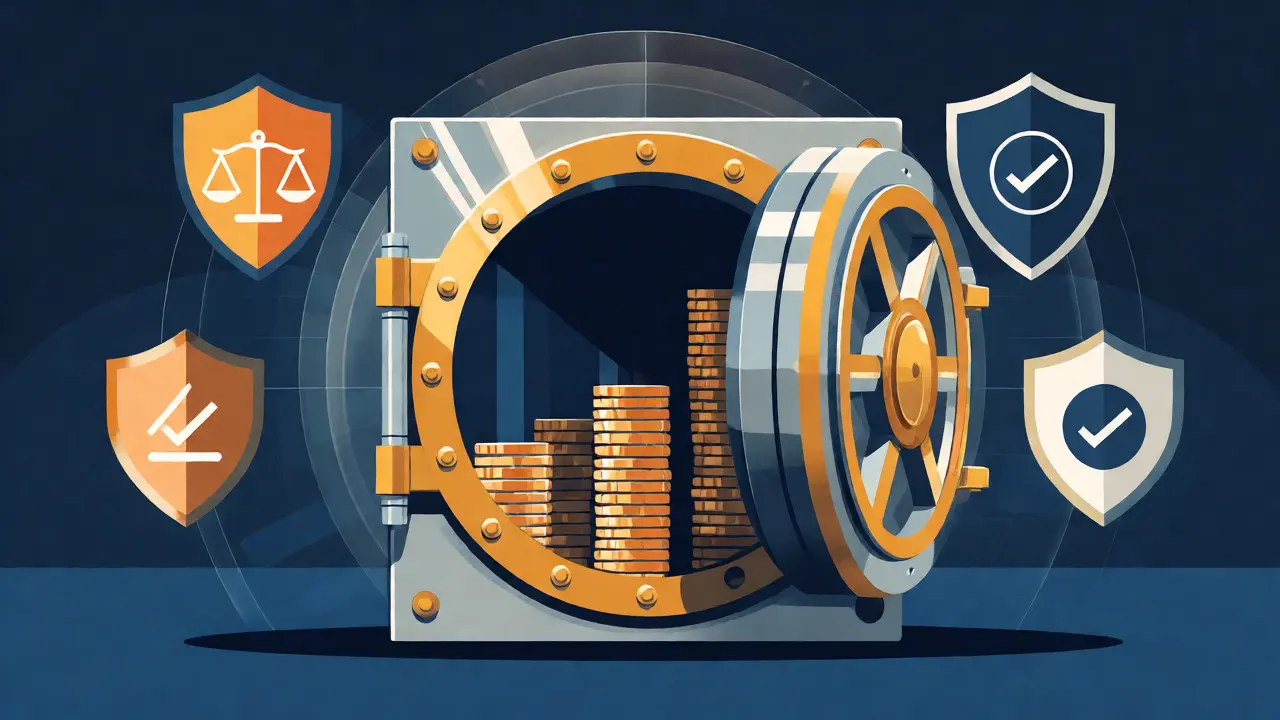
In the post-FTX era, "not your keys, not your coins" is the mantra. But if you do leave coins on an exchange, you want them on one that won’t disappear overnight. Independent Reserve holds gold membership in Blockchain Australia and was the first Australian exchange to secure cryptocurrency insurance coverage.
Here is what protects your assets:
- AUSTRAC Registration: This means they report suspicious transactions to the government. It’s annoying for privacy purists, but it proves legitimacy.
- Cold Storage: Most customer funds are kept offline, away from hackers targeting hot wallets.
- ISO 27001 Certification: This is an international standard for information security management. Not many crypto platforms bother with this level of formal auditing.
- Segregated Accounts: Customer money is held separately from company operating funds. If the business fails, your money isn’t used to pay their office rent.
They also use multi-layer encryption for private keys and allow browser whitelisting. This means you can restrict logins to specific devices, adding a layer of defense against phishing attacks.
Trading Features and User Experience
The interface is clean, functional, and lacks the clutter of some Asian-based exchanges. You won’t find complex derivatives charts everywhere, but for spot trading, it works well. The mobile app for iOS and Android gets high marks from users for ease of use. One user noted, "The security to access it is very good (much stronger than the banking apps!)."
However, don’t expect advanced tools. There are no futures, no options, and no perpetual swaps. You get limit orders, market orders, and stop-losses. That’s it. For most long-term holders, this is plenty. For scalpers, it’s restrictive.
One standout feature is the AutoTrader system. This allows you to set up automated buying strategies, such as Dollar Cost Averaging (DCA). If you want to buy $100 worth of Bitcoin every Friday regardless of price, this tool handles it for you. It’s a simple feature that saves significant mental energy.
The OTC Desk: For Big Players
If you’re moving serious money, say between A$50,000 and A$50 million, the retail order book might cause slippage. Independent Reserve offers an institutional-grade Over-The-Counter (OTC) desk. You get a personal broker who negotiates the price directly with you. Settlements happen same-day, which is crucial when markets are volatile. This service alone makes them a top contender for wealth managers and high-net-worth individuals in Australia.

Comparison: How Does It Stack Up Against Rivals?
You’re likely comparing Independent Reserve against other major players. Here is a realistic look at the landscape:
| Feature | Independent Reserve | Coinbase | Swyftx | Binance Australia |
|---|---|---|---|---|
| Regulation | ASIC & AUSTRAC (Strict) | Varies by region | ASIC & AUSTRAC | ASIC & AUSTRAC |
| Coin Selection | ~32 Coins | ~200+ Coins | ~300+ Coins | Hundreds |
| Local Banking | Excellent (PayID/EFT) | Good | Excellent | Good |
| Beginner Friendly | High | Very High | High | Moderate |
| Advanced Tools | Limited | Basic | Good | Extensive |
Notice the pattern? Coinbase is easier for absolute beginners but often has higher hidden spreads. Swyftx offers more coins and similar local banking benefits. Binance has the lowest fees and most coins but can feel overwhelming and has faced stricter regulatory scrutiny globally. Independent Reserve sits in the middle: safer than Binance, more professional than Coinbase, but less feature-rich than Swyftx.
Customer Support and Reputation
Support quality is often ignored until you have a problem. Independent Reserve offers 24/7 support via email and ticketing. Users frequently praise the response times, even on weekends. In a market that never sleeps, having humans who answer quickly is valuable.
Their reputation is bolstered by consistent industry recognition, including spots on the Deloitte Tech Fast 50 and Financial Times High Growth Companies lists. While these awards sound corporate, they signal financial health and operational stability. When you trust an exchange with your life savings, stability beats flashiness.
Final Verdict: Should You Sign Up?
Independent Reserve is not for everyone. If you want to trade the latest AI token launched yesterday, go to a decentralized exchange or a broader platform like Binance. But if you are an Australian investor who wants to sleep well at night, knowing your assets are protected by strict local laws, this is a top-tier choice.
The combination of insurance, cold storage, and direct AUD banking integration creates a frictionless experience for locals. The fees are fair for the level of security provided, especially if you avoid card deposits. For the average Aussie wanting to build a Bitcoin portfolio without worrying about offshore jurisdiction risks, Independent Reserve remains a solid, reliable partner in 2026.
Is Independent Reserve safe to use?
Yes, it is considered one of the safest exchanges in Australia. It is registered with AUSTRAC, regulated by ASIC, uses cold storage for most funds, and was the first Australian exchange to obtain cryptocurrency insurance coverage. It also holds ISO 27001 certification for information security.
What are the minimum deposit requirements?
You can start with as little as $1. However, note that AUD deposits under A$100 incur a small fee of A$0.99. Deposits above this amount via EFT are free.
Does Independent Reserve support PayPal?
Yes, you can fund your account using PayPal, but be aware that this method incurs a 1% transaction fee. It is generally cheaper to use EFT or PayID for larger amounts.
How many cryptocurrencies can I trade?
As of 2026, Independent Reserve supports approximately 32 cryptocurrencies. This includes major assets like Bitcoin, Ethereum, and Litecoin, but it does not have the extensive library of smaller altcoins found on global exchanges like Binance.
Can I withdraw my profits instantly?
Yes, but there is a cost. Standard EFT withdrawals are free but take longer. Instant withdrawals cost A$1.50 and provide faster access to your AUD balance.
Is KYC verification required?
Yes, absolutely. Because Independent Reserve is strictly regulated by ASIC and AUSTRAC, you must complete Know Your Customer (KYC) checks, including providing ID and proof of address, before you can trade or withdraw funds.