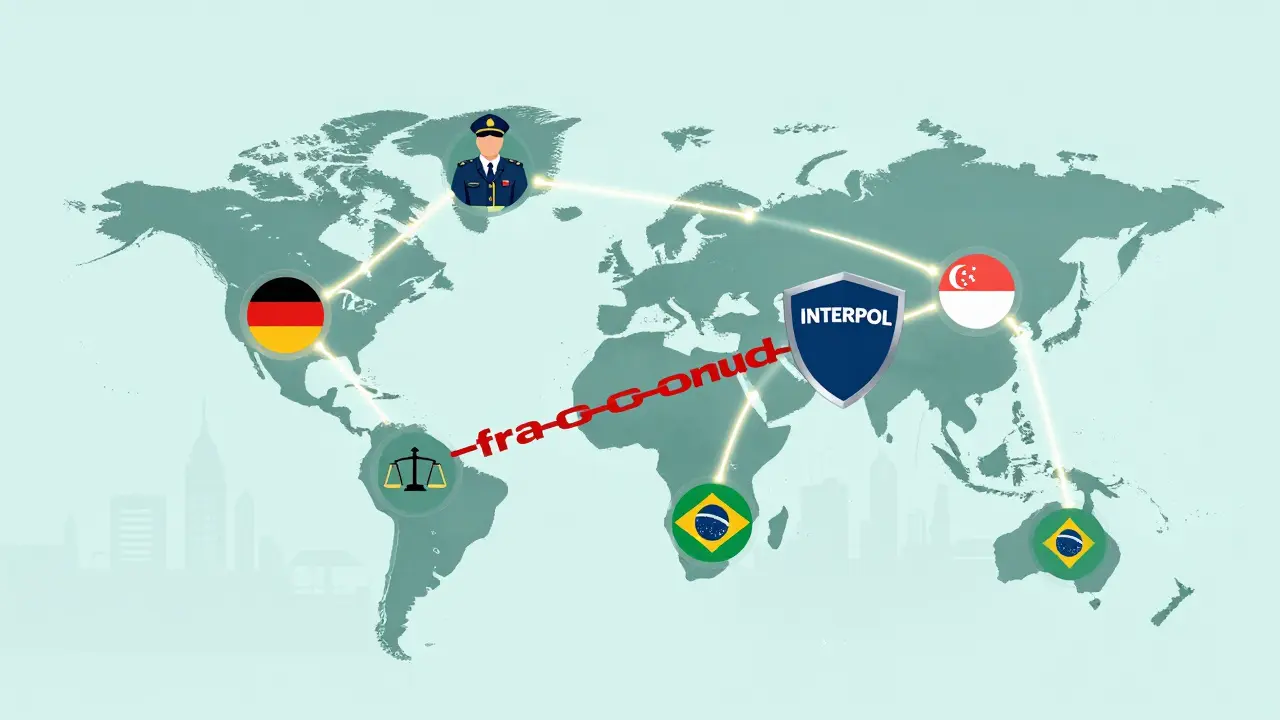
When someone loses $50,000 to a fake crypto investment scheme, the criminals aren’t just hiding in one country-they’re scattered across continents. A scammer in Nigeria might use a server in Germany, launder money through a decentralized exchange in Singapore, and cash out via a wallet in Brazil. Without global coordination, that money is gone forever. But in 2025, that’s changing. International cooperation on crypto crime enforcement is no longer optional-it’s the only way to stop the flood of digital fraud. In August 2025, Operation Serengeti took down 25 illegal crypto mining centers in Angola. But that wasn’t just an African operation. It was coordinated by INTERPOL, with intelligence shared from law enforcement in Germany, South Korea, and Zambia. The same operation led to arrests in Côte d’Ivoire for crimes that started in Europe. This isn’t a one-off. It’s the new normal. The old model-where each country chased its own cases in isolation-was doomed from the start. Crypto moves faster than borders. If you can’t track transactions across chains, jurisdictions, and exchanges, you’re fighting shadows. Today, countries are finally connecting the dots. INTERPOL’s Global Rapid Intervention of Payments (I-GRIP) is the backbone of this shift. Launched in 2022, it lets financial intelligence units in 195 countries freeze suspicious crypto transfers in real time. In Operation HAECHI VI (April-August 2025), this system helped recover $439 million from scams, phishing rings, and romance frauds across 40 nations. That’s not just a number-it’s 65,000 victims in Zambia who got their money back. It’s a Korean steel company that recovered $3.91 million after fake shipping documents drained its account. It’s proof that stolen crypto isn’t always lost. Private companies are playing a crucial role too. Firms like Chainalysis, Elliptic, and TRM Labs provide the tools that make this possible. Their blockchain analytics platforms trace transactions across Bitcoin, Ethereum, and dozens of lesser-known chains. In 2025, Bitcoin still makes up 75% of all illicit crypto holdings, but criminals are shifting to privacy coins and cross-chain bridges to hide their tracks. Elliptic found that over $21.8 billion in illegal crypto has been laundered using cross-chain methods since 2023. That’s why tools that automatically track movement between blockchains are now essential. One click can replace hours of manual tracing. The U.S. and Europe are taking different approaches. The Department of Justice focuses on prosecuting individuals-like the 17 people charged in Massachusetts in October 2024 for manipulating meme coins with bots. The SEC, meanwhile, goes after companies with civil penalties. In Europe, Europol prioritizes crypto-enabled money laundering linked to child exploitation and human trafficking. But only INTERPOL can pull all these efforts together. Its strength isn’t just in coordination-it’s in speed. While a single country might take months to trace a transaction across borders, INTERPOL’s network can do it in days. Training is now a core part of the fight. Officers in Operation Serengeti 2025 spent 120 hours learning how to use blockchain explorers, interpret wallet patterns, and understand decentralized finance protocols. In 2022, only 62% of INTERPOL member countries had dedicated crypto investigation units. Today, that number is 87%. Countries that didn’t invest in training are falling behind. But challenges remain. Criminals are adapting faster than laws. Illicit actors now use no-KYC coin swap services, mixers, and decentralized exchanges to break the trail. They create wallets that live for only a few hours before disappearing. Chainalysis found that direct transfers from illicit wallets to exchanges dropped from 40% in 2021 to just 15% in 2025. That means law enforcement has to get smarter-not just faster. Jurisdictional conflicts still slow things down. A police officer in Brazil can’t legally freeze a wallet in Dubai without a formal request through INTERPOL. The process takes time. But the Cybercrime Atlas, hosted by the World Economic Forum, is helping bridge that gap. It’s a shared database where governments, banks, and private firms upload threat intelligence. It’s not perfect, but it’s the closest thing we have to a global crime map. The future of crypto crime enforcement won’t be won by one country or one tool. It’ll be won by networks. The more countries share data, the harder it becomes for criminals to hide. The more private firms train law enforcement, the more tools become accessible. The more victims report fraud, the more patterns emerge. In 2025, we’re seeing real results. Recoveries are up. Arrests are up. Operations are bigger. But the criminals are still out there-smarter, faster, more creative. The only way to stay ahead is to keep cooperating. Because if one country slips, the whole system breaks. And when it does, someone loses everything. The fight isn’t over. But for the first time, we’re not fighting alone.
published : Dec, 18 2025
about author

Aaron ngetich
I'm a blockchain analyst and cryptocurrency educator based in Perth. I research DeFi protocols and layer-1 ecosystems and write practical pieces on coins, exchanges, and airdrops. I also advise Web3 startups and enjoy translating complex tokenomics into clear insights.