Imagine buying a slice of a luxury apartment in Dubai or an office building in New York for just $50. You don’t need a bank loan, you don’t wait weeks for paperwork, and you can sell your share instantly if you need cash. This isn’t science fiction anymore. It’s happening right now through blockchain technology, which is reshaping how we buy, sell, and manage property by replacing paper trails with secure, digital ledgers. For decades, real estate has been stuck in the past. Think about it: closing on a house still involves stacks of paper, multiple middlemen like title companies and escrow agents, and waiting periods that stretch from 30 to 60 days. It’s slow, expensive, and surprisingly fragile. Fraud happens. Records get lost. Disputes drag on for years. Blockchain fixes this. By creating a decentralized, tamper-proof record of every transaction, it brings speed, transparency, and accessibility to an industry that desperately needs it. Let’s look at exactly how this works and why it matters for both everyday investors and big commercial players.
The End of Paperwork: Immutable Land Registries
The most basic function of blockchain in real estate is recording who owns what. In traditional systems, land registries are centralized databases held by local governments. They’re prone to human error, corruption, and even natural disasters destroying physical files. Blockchain creates an immutable ledger. Once a property deed is recorded on the chain, it cannot be altered without consensus from the network. This means no one can secretly change ownership records or forge signatures. Take Georgia as a prime example. The country launched its blockchain-based land registry system to modernize its infrastructure. The results were dramatic:
- Property registration time dropped from several days to under 10 minutes.
- Cuts in administrative costs reached up to 90%.
- Over 1.5 million titles were processed securely.
Fractional Ownership and Tokenization
Real estate has always been illiquid. If you want to invest in a $1 million commercial building, you usually need $1 million (or a massive loan). This locks out most people from benefiting from property appreciation. Enter tokenization, which converts property equity into digital tokens on a blockchain, allowing fractional ownership. Imagine a high-rise apartment complex valued at $10 million. Instead of selling it to one buyer, the owner issues 10 million digital tokens, each worth $1. You can buy 1,000 tokens for $1,000. You now own 0.01% of that building. This changes everything for retail investors:
- Low Entry Barrier: Platforms like Lofty AI allow investments starting at just $50. Compare this to traditional crowdfunding, which often requires minimums of $5,000 to $10,000.
- Liquidity: Traditionally, selling your stake in a property takes months. With tokenized assets, you can trade them on secondary markets 24/7, similar to stocks.
- Diversification: Instead of putting all your money into one local house, you can hold tokens in properties across different cities or countries.
| Feature | Traditional Real Estate | Tokenized Real Estate |
|---|---|---|
| Minimum Investment | $50,000+ (down payment) | $50 - $100 |
| Liquidity | Months to sell | Minutes to hours (secondary market) |
| Transaction Costs | High (agents, lawyers, taxes) | Low (platform fees, gas fees) |
| Ownership Verification | Paper deeds, central registry | Blockchain ledger, cryptographic proof |
| Market Access | Local/National | Global (24/7 trading) |
Smart Contracts Automate the Messy Middle
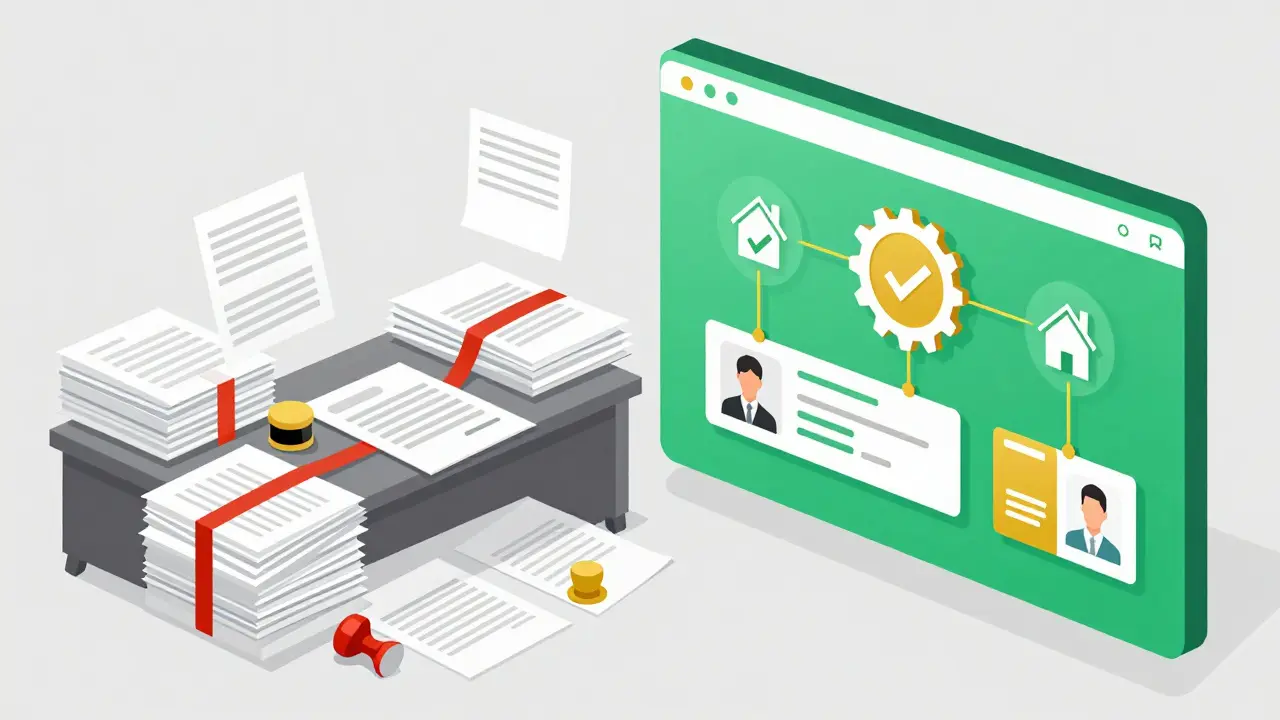
Between the offer and the closing, there’s a lot of manual work. Escrow holds funds, title companies verify history, inspectors check conditions, and lawyers draft agreements. Each step adds cost and delay. Smart contracts are self-executing codes on the blockchain that automatically enforce terms when conditions are met. In real estate, they act as digital escrow agents. Here’s how a smart contract handles a lease or sale:
- Automatic Payments: A tenant connects their crypto wallet. On the first of the month, rent is automatically transferred to the landlord’s wallet. No late fees, no chasing checks.
- Conditional Releases: Funds are only released to the seller once the buyer’s identity is verified and the title transfer is recorded on the chain.
- Compliance: J.P. Morgan’s Onyx platform uses smart contracts for commercial leases, automating compliance checks and reducing settlement times by 40%.
Cost Reduction and Transparency
One of the biggest complaints about real estate is the hidden cost. Agents take commissions, banks charge origination fees, title insurers add premiums, and government offices levy recording fees. These intermediaries are necessary in a low-trust environment, but they bloat the final price. Blockchain reduces transaction costs by up to 30%. How? By removing redundant middlemen. If the ledger proves ownership and the smart contract handles the exchange, you don’t need a title company to verify the same thing twice. You don’t need an escrow agent to hold cash because the code does it securely. Transparency also builds trust. Every transaction is visible to authorized parties on the ledger. In cross-border deals, where currency conversion and international law complicate things, blockchain provides a single source of truth. This is crucial for institutional investors who demand auditability.
Challenges and Risks to Watch
It’s not all smooth sailing. While the technology is powerful, adoption faces hurdles. Regulatory Uncertainty: Laws vary wildly by country. The EU’s MiCA framework (2024) standardized token disclosures, helping institutions feel safer. But in other regions, the SEC’s stance on whether tokenized real estate counts as a security remains evolving. This creates compliance risks for platforms. Technical Literacy: Setting up a digital wallet, managing private keys, and understanding gas fees (transaction costs on networks like Ethereum) can be daunting. Trustpilot reviews for blockchain registries rate security highly (4.7/5) but usability lower (3.8/5). Older stakeholders often struggle with the interface. Smart Contract Bugs: Code is only as good as its writing. The 2022 Solana exploit showed how vulnerabilities can lead to loss of funds. While rare in real estate so far, a bug in a property title contract could freeze assets or cause legal chaos. Audits by firms like Chainalysis are essential. Interoperability: Different blockchains don’t always talk to each other. Integrating legacy government systems with new blockchain solutions requires significant technical effort and standardization.
Who Should Care About This Now?
You don’t need to be a tech expert to benefit from this shift. Here’s who should pay attention:
- Retail Investors: If you’ve wanted to invest in real estate but lacked capital, look at platforms offering tokenized assets. Start small. Diversify.
- Commercial Landlords: Explore smart lease contracts. They reduce administrative overhead and ensure timely payments.
- Developers: Consider using blockchain for pre-sales. It offers transparent funding tracking and faster capital deployment.
- Buyers/Sellers: Expect faster closings. Ask your agents if they’re familiar with blockchain-verified titles, especially in forward-thinking markets like Dubai or Georgia.
Is blockchain real estate investment safe?
Safety depends on the platform and regulatory environment. Reputable platforms use audited smart contracts and comply with KYC/AML laws. However, risks include smart contract bugs and regulatory changes. Always research the platform’s track record and insurance coverage before investing.
Can I really buy property for $50?
Yes, through tokenization. You aren’t buying the whole property; you’re buying a fractional share represented by a digital token. Platforms like Lofty AI allow entry points as low as $50, giving you exposure to rental income and appreciation proportional to your share.
How do smart contracts prevent fraud in real estate?
Smart contracts execute only when predefined conditions are met. For example, funds are released only after title transfer is confirmed on the blockchain. Since the ledger is immutable, no one can alter the ownership history or double-spend the property, eliminating common fraud vectors.
What are the tax implications of tokenized real estate?
Tax treatment varies by jurisdiction. Generally, rental income from tokens is taxed as ordinary income, and selling tokens for a profit may trigger capital gains tax. Because regulations are still evolving, consult a tax professional familiar with digital assets in your country.
Will blockchain replace real estate agents?
Not entirely, but their role will change. Piper Moretti, CEO of Crypto Realty Group, notes that blockchain elevates professionals who leverage technology. Agents will shift from handling paperwork to providing advisory services, market analysis, and negotiation support, while automation handles transactions.