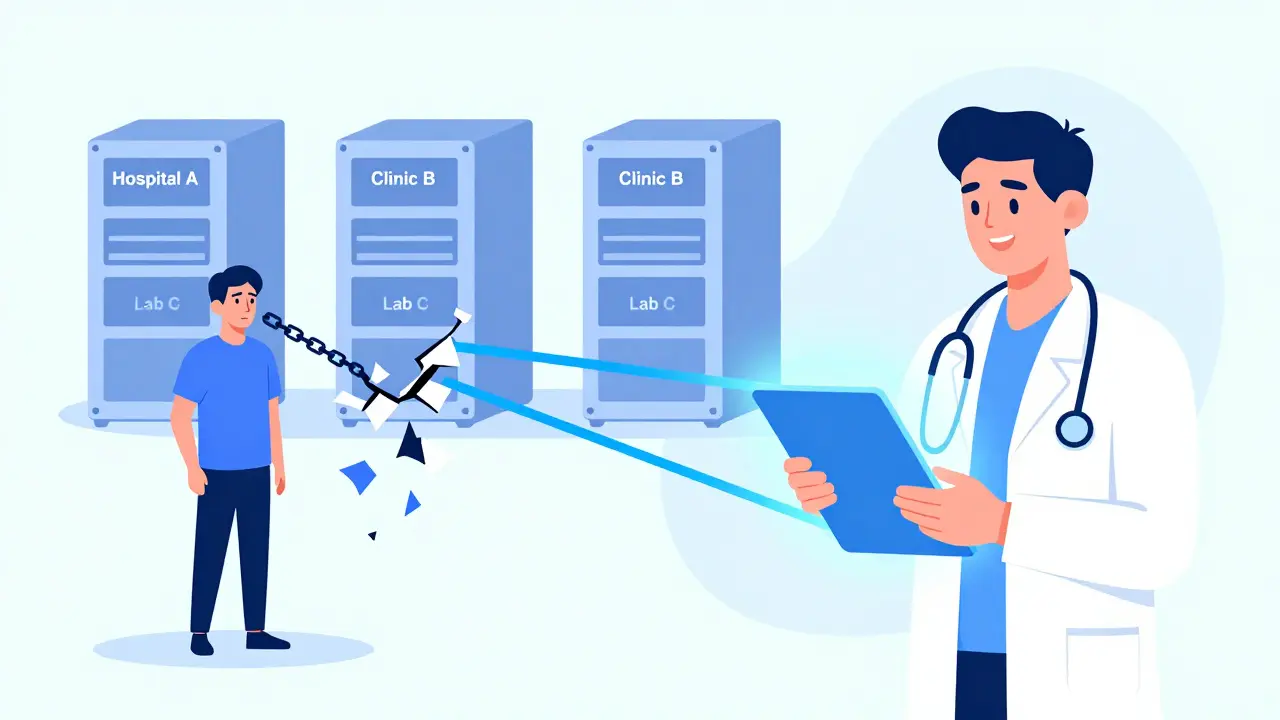
Imagine walking into a new specialist’s office, and instead of filling out endless forms or waiting weeks for records to arrive via fax, the doctor instantly sees your complete medical history. No gaps, no errors, just clear, accurate data. This is the promise of interoperability of blockchain health records, which aims to solve the fragmented nature of modern healthcare data. Today, most hospital systems operate in silos. They cannot easily or safely share data with one another, leading to inefficiencies, potential medical errors, and significant security risks. Blockchain technology offers a transformative solution by creating a unified, tamper-evident ledger that keeps patient data secure while making it accessible across different providers.
The Core Problem: Why Current Systems Fail
To understand why blockchain is necessary, we first need to look at why current Electronic Health Records (EHRs) fall short. Traditional EHR systems were not designed to manage multi-institutional, lifetime medical records. Instead, they are built around individual providers. When you switch doctors or hospitals, your data often stays behind. Patients lose easy access to their past information because providers retain primary stewardship over the data, not the patients themselves.
This fragmentation creates several critical issues:
- Data Silos: Information is trapped within specific organizations, preventing a holistic view of patient health.
- Security Risks: Centralized databases are prime targets for cyberattacks, which have intensified against hospitals and insurers in recent years.
- Inefficiency: Duplicate tests and procedures occur because new providers lack access to previous results.
- Patient Disempowerment: Individuals have little control over who sees their data or how it is used.
Blockchain addresses these problems by shifting from a centralized model to a decentralized, peer-to-peer network. In this system, each transaction is immutable, timestamped, and transparent, providing a sharing and trust mechanism that enables collaborative clinical decision-making.
How Blockchain Ensures Interoperability and Privacy
A common misconception is that blockchain stores all medical data directly on the chain. This would be impractical due to storage limits and privacy concerns. Instead, successful implementations use a hybrid architecture. Here is how it works:
- Off-Chain Storage: Protected Health Information (PHI), such as detailed lab results or imaging files, is stored off-chain in encrypted databases. These databases reside in HIPAA-compliant secure cloud environments.
- On-Chain Anchoring: Only transaction hashes-digital fingerprints of the data-are recorded on the blockchain. These hashes prove that the data exists and has not been altered without leaving the actual sensitive content exposed.
- Patient-Centric Control: Smart contracts allow patients to grant or revoke access to their data dynamically. You decide who sees what, and when.
This design preserves patient data privacy and regulatory compliance while enabling the blockchain's core benefits: decentralized trust, strong encryption, and immutable audit trails. For example, solutions like HealthChain utilize proxy re-encryption and smart contracts to allow patients to share data with specific stakeholders, including providers and researchers, while maintaining strict privacy controls.

Key Technical Frameworks and Standards
Not all blockchains are created equal, especially in healthcare. The industry relies on specific frameworks that prioritize permissioned access and scalability over public anonymity. Two prominent examples include:
| Framework | Type | Key Feature for Healthcare | Best Use Case |
|---|---|---|---|
| Hyperledger Fabric | Permissioned | Private channels and modular architecture | Enterprise-wide data sharing between trusted institutions |
| Ethereum | Public/Permissioned Hybrid | Robust smart contract ecosystem | Patient-owned data marketplaces and research incentives |
These frameworks improve data accessibility, privacy, and interoperability through patient-centric control mechanisms. They support the five necessary characteristics identified in systematic reviews of medical blockchain implementations: governance, interoperability, privacy, scalability, and security.
Regulatory Challenges: HIPAA vs. GDPR
Implementing blockchain in healthcare is not just a technical challenge; it is a legal minefield. The immutability of blockchain-the fact that once data is written, it cannot be changed-clashes directly with certain privacy regulations.
In the United States, HIPAA (Health Insurance Portability and Accountability Act) requires strict safeguards for patient data. While blockchain enhances security through encryption, the decentralized nature means there is no single "controller" responsible for breaches, complicating liability. However, the hybrid approach mentioned earlier helps maintain HIPAA compliance by keeping PHI off-chain.
In Europe, the GDPR (General Data Protection Regulation) presents a bigger hurdle. GDPR includes the "right to be forgotten," allowing individuals to request the deletion of their personal data. Since blockchain transactions are immutable, deleting data is technically impossible. To mitigate this, developers store only hashes on-chain and ensure the actual data off-chain can be deleted. If the off-chain data is destroyed, the hash on-chain becomes meaningless, effectively satisfying the spirit of the regulation.

Real-World Benefits and Use Cases
Beyond theory, blockchain interoperability delivers tangible benefits in real-world scenarios:
- Clinical Decision Support: By aggregating data from multiple sources, AI integration helps physicians make better clinical decisions by analyzing large volumes of medical data securely.
- Insurance Claims Processing: Smart contracts automate claims verification, reducing administrative costs and speeding up payments for both providers and patients.
- Supply Chain Management: Blockchain provides transparent tracking of pharmaceuticals and medical devices, ensuring authenticity and preventing counterfeit drugs from entering the supply chain.
- Telemedicine and Precision Medicine: Decentralized data sharing enables collaborative care models where specialists from different institutions can review a patient’s full history simultaneously.
Market adoption is accelerating, with healthcare data expected to grow significantly in the coming years. Federal initiatives and industry pilots highlight how blockchain could transform records management, offering resilience against cyberattacks and empowering patients.
Implementation Barriers and Future Outlook
Despite the potential, widespread adoption faces hurdles. Emergency situations require urgent access to data, but strict access control policies may restrict caregivers. Robust "break-glass" mechanisms are needed to allow emergency access while logging the event for audit purposes. Additionally, cross-border patient mobility remains complex. A patient traveling abroad may need to register under new controller smart contracts, preventing a global view of their records unless global healthcare decentralized applications (DApps) are integrated.
Furthermore, blockchain does not inherently solve intrinsic interoperability issues related to different data formats used by various health providers. Standardization efforts must continue alongside technological deployment. Successful integration requires enterprise-grade hosting, comprehensive change management strategies, and a shift in organizational culture to embrace shared data stewardship.
Is blockchain secure enough for sensitive medical data?
Yes, when implemented correctly. Blockchain uses advanced cryptographic techniques to secure data. In healthcare, a hybrid model is typically used where sensitive data is stored off-chain in encrypted, HIPAA-compliant clouds, and only data hashes are stored on the blockchain. This ensures that even if the blockchain is compromised, the actual patient data remains protected.
How does blockchain handle the GDPR "right to be forgotten"?
Since blockchain is immutable, data cannot be deleted from the chain. To comply with GDPR, systems store the actual personal data off-chain. When a user requests deletion, the off-chain data is destroyed. The hash remaining on the blockchain then points to nothing, rendering the data unrecoverable and effectively satisfying the deletion request.
What is the difference between public and private blockchains in healthcare?
Public blockchains like Ethereum are open to anyone and offer high transparency but lower privacy. Private or permissioned blockchains like Hyperledger Fabric restrict access to authorized participants only. Healthcare primarily uses permissioned blockchains to ensure that only verified patients, doctors, and institutions can access sensitive medical records.
Can blockchain replace existing Electronic Health Record (EHR) systems?
No, blockchain is not a replacement for EHR systems but rather an interoperability layer. EHRs are used by individual providers to manage daily operations. Blockchain connects these disparate EHR systems, allowing them to share data securely and efficiently without replacing the underlying software providers use.
What role do smart contracts play in health records?
Smart contracts are self-executing codes that automate processes. In health records, they manage access control (who can see what data), automate insurance claims processing by verifying conditions automatically, and ensure that data usage complies with predefined rules, reducing administrative overhead and human error.