Dealing with digital assets is easy until the tax man comes knocking. Depending on where you live, your crypto gains could be completely tax-free or sliced in half by the government. With the 2026 tax season approaching, understanding the gap between a "crypto haven" and a high-tax jurisdiction isn't just a matter of curiosity-it's a matter of keeping your portfolio intact.
The reality is that there is no global standard for crypto taxation rates. Some countries treat Bitcoin like a stock, others like currency, and some treat it like a luxury good. Whether you are a long-term HODLer or a daily trader, the laws of your home country dictate exactly how much of your profit actually belongs to you.
The High-Tax Zones: Where Profits Shrink
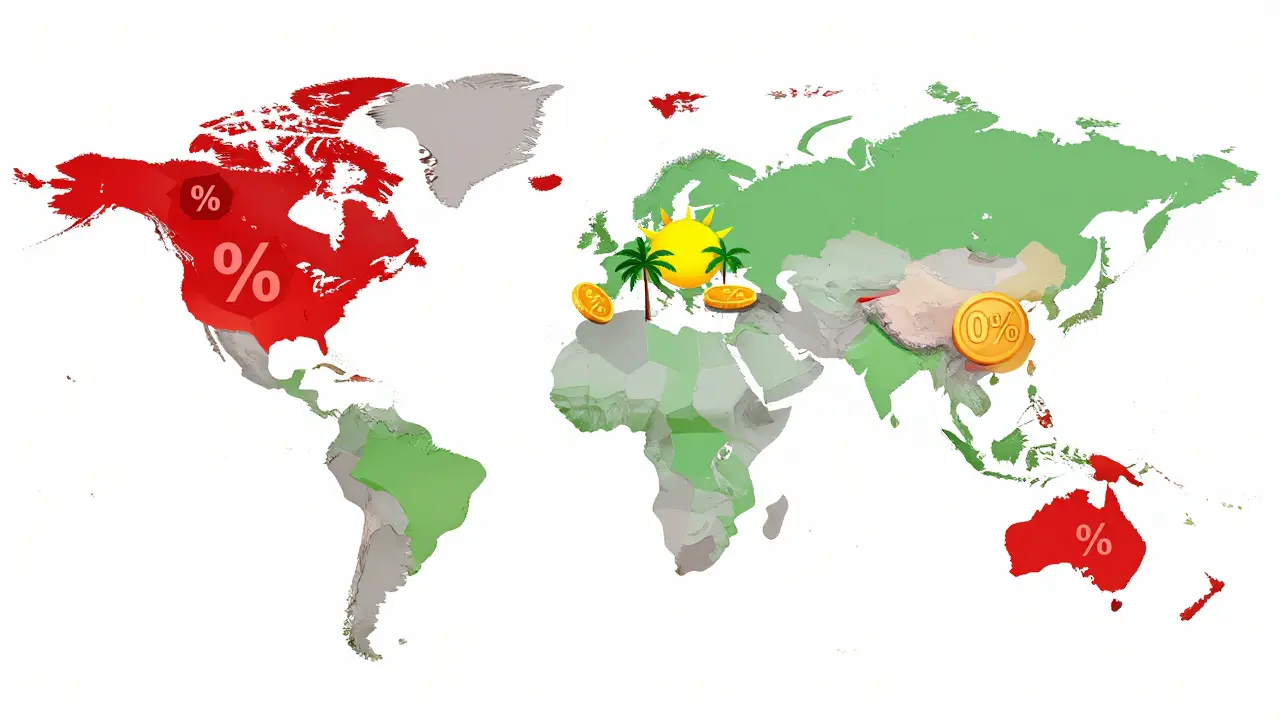
For those living in certain East Asian and European hubs, the tax burden can be staggering. Japan is currently one of the most expensive places for investors, utilizing a progressive tax structure that can hit as high as 55%. This means a significant chunk of your gains is gone before you even see it in your bank account.
Denmark follows a similar path, with rates swinging between 37% and 52% based on how much you earn annually. In France, the government keeps it simpler but still steep with a flat 30% tax. This covers both capital gains and social contributions, specifically when you convert your crypto back into a traditional currency (fiat). If you're just swapping one coin for another, France is more lenient, but the moment you cash out, the 30% rule kicks in.
The Tax-Free Havens: 0% Rates
On the flip side, there are jurisdictions where the government essentially gives you a free pass. These countries often use 0% tax rates to attract blockchain startups and wealthy investors. United Arab Emirates (UAE), the Cayman Islands, and Panama are prime examples where you won't find any one-size-fits-all tax on crypto transactions.
Then there is El Salvador, which took the boldest step by making Bitcoin legal tender. Because it's treated as a currency rather than just an asset, the tax implications are far more favorable than in the US or Europe. Other notable zero-tax spots include Hong Kong and Saudi Arabia, though they often distinguish between someone investing for a hobby and someone running a full-scale trading business.
| Country | Tax Rate | Key Condition | Tax Treatment |
|---|---|---|---|
| Japan | 15% - 55% | Progressive | Income Tax |
| UAE | 0% | None | Exempt |
| USA | 0% - 37% | Holding Period | Capital Gains/Income |
| Germany | 0% or up to 45% | Hold > 1 Year | Capital Gains |
| France | 30% | Fiat Exit | Flat Tax |
The "HODL" Advantage: Conditional Exemptions
Some countries reward patience. If you can keep your coins in a wallet for a specific amount of time, your tax bill might vanish. Germany is the gold standard here: if you hold your cryptocurrency for more than one year, it becomes entirely tax-free. However, if you panic-sell after six months, you're subject to progressive income tax rates that can reach 45%.
Portugal offers a similar incentive. While they charge 28% on short-term gains, holdings kept for over a year are exempt. The catch? You usually need to be a resident for at least 183 days to qualify for these benefits. This "holding period" strategy is a powerful tool for investors who aren't interested in day trading.

The US System: Short-Term vs. Long-Term
The United States uses a dual-track system managed by the IRS. It all comes down to the date you acquired the asset. If you sell a coin you've held for less than a year, it's a "short-term capital gain," and you're taxed at your ordinary income rate (10% to 37%).
If you hold for 366 days or more, you enter "long-term capital gains" territory. Depending on your total income, you could pay 0%, 15%, or 20%. It's a massive difference. For example, a high-earner might save 17% just by waiting a few extra weeks to sell. It's also worth noting that staking rewards, mining, and airdrops are treated as immediate income the moment you receive them, not when you sell them.
UK Regulations and the Compliance Trap
In the United Kingdom, crypto is treated as an asset subject to Capital Gains Tax (CGT). For 2025-2026, the tax-free allowance has tightened significantly to £3,000. Beyond that, basic-rate taxpayers pay 10% and higher-rate taxpayers pay 20%.
The UK is particularly strict about reporting. You must declare everything through a Self-Assessment Tax Return. If you "forget" to report a gain, the penalties are brutal, sometimes reaching 200% of the unpaid tax. This is a wake-up call for anyone thinking they can fly under the radar; blockchain transparency makes it very easy for authorities to spot unreported wealth.

How to Stay Compliant and Avoid Fines
Tax authorities are no longer guessing how to track crypto; they're using sophisticated blockchain analysis tools. From the BZSt in Germany to the French tax authorities, governments are conducting regular audits. In France, just failing to disclose an account can result in a fine of €750 per account.
To keep yourself safe, follow these three rules of thumb:
- Keep a detailed ledger: Record every trade, the date, the price in your local currency, and the wallet address.
- Distinguish your activity: Are you a "passive investor" or a "professional trader"? In places like Malaysia and Hong Kong, this distinction determines if you pay 0% or a full business tax.
- Track "Taxable Events": Remember that swapping BTC for ETH is often a taxable event (a sale and a purchase), not just a trade.
Is crypto-to-crypto trading taxable?
In most jurisdictions, including the US and UK, swapping one cryptocurrency for another is considered a taxable event. You are essentially selling one asset to buy another, and any gain in the value of the first asset at the time of the trade is taxable.
What happens if I move to a tax-free country?
Changing your tax residency can lower your future burden, but it doesn't always erase past obligations. Most countries require you to establish residency (typically 183+ days) and may have "exit taxes" on unrealized gains before you leave.
Are staking rewards taxed differently than trading?
Yes. In many countries, staking and mining are treated as "income" (like a salary) and taxed at progressive income rates the moment you earn the reward, whereas trading is taxed as a capital gain when you sell.
Which country is the absolute best for crypto investors?
The "best" depends on your strategy. For long-term holders, Germany and Portugal are excellent due to their one-year exemption. For active traders and businesses, the UAE and Panama offer the most freedom with 0% flat rates.
Do I have to report crypto if I haven't cashed out to fiat?
In the US, UK, and many EU nations, yes. Even if you keep your funds in a stablecoin or another cryptocurrency, the act of trading creates a taxable event that must be reported annually.
Next Steps for Your Portfolio
If you're currently sitting on a large gain, don't just guess. If you're in a high-tax zone like Japan or Denmark, look into whether your activity qualifies as a business or a personal investment, as this can sometimes shift your tax bracket. For those in the US, check your holding dates-waiting a few extra days to hit the one-year mark could save you thousands in taxes.
Regardless of where you live, the era of "invisible" crypto is over. Use specialized tax software that connects to your exchange APIs to generate accurate reports. It's much cheaper to pay a software subscription now than to pay a 200% penalty to the UK's HMRC or face an audit from the German BZSt later.