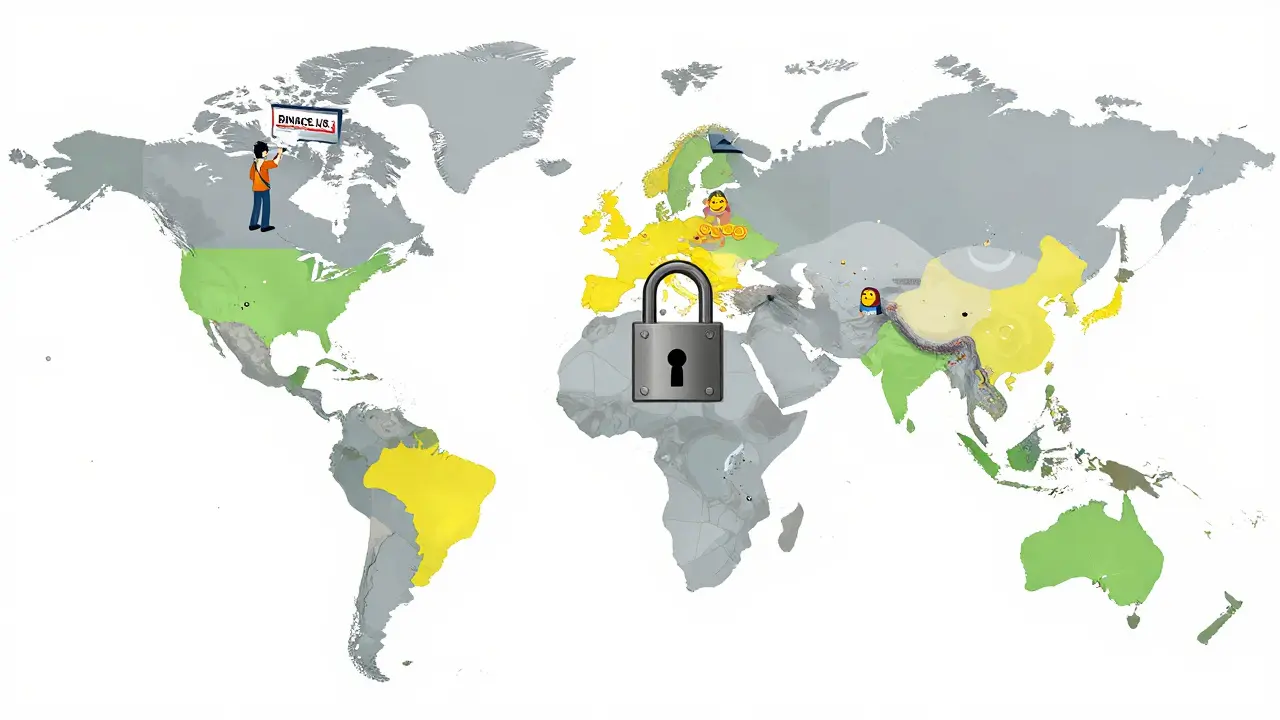
Not all crypto exchanges work everywhere. If you're in Nigeria, you might use Binance.ng. In the U.S., you're stuck with Binance.US. In Japan, you're limited to exchanges licensed by the Financial Services Agency. This isn't about technology-it's about crypto exchange availability, and it changes depending on where you live.
Why Your Region Controls What Exchanges You Can Use
It’s not that some exchanges are better than others. It’s that governments decide who can operate. A crypto exchange needs a license to serve customers in most countries. Without it, they can’t legally accept deposits, process trades, or even show their website to users in that region. That’s why Binance, the world’s largest exchange, doesn’t operate as one platform globally. It’s split into Binance.US, Binance TR, Binance.KR, and others-each built to meet local rules.The U.S. is the clearest example. In November 2023, Binance paid a $4 billion fine to U.S. regulators and agreed to fully exit the American market. Its founder, Changpeng Zhao, pleaded guilty to money laundering violations. Now, U.S. users must use Binance.US, a separate entity with fewer coins, stricter KYC, and no margin trading. You can’t just switch to the global site-it’s blocked. This isn’t a glitch. It’s policy.
Other countries follow similar logic. South Korea requires exchanges to register with its Financial Services Commission. Singapore demands strict anti-money laundering controls. In contrast, Ukraine, Moldova, and Georgia have no formal crypto licensing yet, but high adoption means exchanges flood in anyway. These places don’t ban crypto-they just don’t regulate it tightly, so users have more freedom.
Top Exchanges and Where They Operate
As of 2025, Binance controls nearly 40% of global trading volume, processing over $23.97 billion daily. But its global reach is fractured. Here’s how the top exchanges break down by region:| Exchange | Market Share | Key Regions | Restricted Regions |
|---|---|---|---|
| Binance | 38.0% | Europe, Southeast Asia, Latin America, Middle East | United States (Binance.US only), Canada (limited), Australia (restricted derivatives) |
| Gate.io | 9.0% | Global (including U.S., Japan, Brazil) | None major |
| Bitget | 7.2% | Asia, Africa, Latin America | U.S., U.K. (no leverage trading) |
| MEXC | 8.6% | Global, especially emerging markets | U.S. (limited coin list) |
| Koinbay | 5.1% | U.S., Canada, Australia | China, Russia, Iran |
Notice how Gate.io and MEXC operate almost everywhere. They don’t have the same brand power as Binance, but they avoid heavy regulatory entanglement. That’s why they’re growing-Gate.io’s spot volume jumped 14.4% month-over-month in early 2025. Meanwhile, Binance’s global volume dropped below $500 billion for the first time since late 2024. That’s not because people stopped trading. It’s because regulators forced them to split.

Where Crypto Trading Is Most Popular
The places with the highest crypto adoption aren’t always the richest. The 2025 Global Crypto Adoption Index shows Ukraine leading the world-not because of tech infrastructure, but because of war, inflation, and distrust in banks. Over 30% of Ukrainian adults hold crypto, mostly as a way to protect savings. Moldova and Georgia follow, with similar reasons: weak currencies, unreliable banking, and young populations embracing digital tools.In Asia, Vietnam and Hong Kong rank in the top six. Singapore is 15th, South Korea 18th. These countries have clear rules, which helps exchanges operate legally. In contrast, Yemen and Jordan rank high not because of wealth, but because their economies are unstable. People use crypto to send remittances, buy goods, or avoid capital controls.
Even in places like Venezuela, where the local currency is nearly worthless, crypto isn’t just a speculation-it’s a lifeline. Over 15% of Venezuelans use crypto daily. That’s why exchanges like Binance and Bitget have localized apps there, with support in Spanish and peso-denominated deposit options.
Spot Trading Dominates, But Not Everywhere
Spot trading-buying and selling crypto directly-is the most common way people trade. It made up 61.3% of global exchange volume in 2025. Why? Because it’s simple. You buy Bitcoin. You sell Ethereum. No complex derivatives. No leverage. No risk of liquidation.But spot trading isn’t available everywhere. In the U.S., many exchanges limit the number of coins you can trade. Binance.US offers only 130 coins. The global Binance site offers over 1,000. Why? Because U.S. regulators say some coins are “securities.” That’s why Solana, Cardano, and Polygon are missing from U.S. platforms-they’re under investigation by the SEC.
Meanwhile, in countries like Nigeria and India, users can trade hundreds of coins, including memecoins and low-cap tokens. That’s because regulators there haven’t defined what counts as a security. So exchanges offer everything-and users take the risk.
What’s Changing in 2025 and Beyond
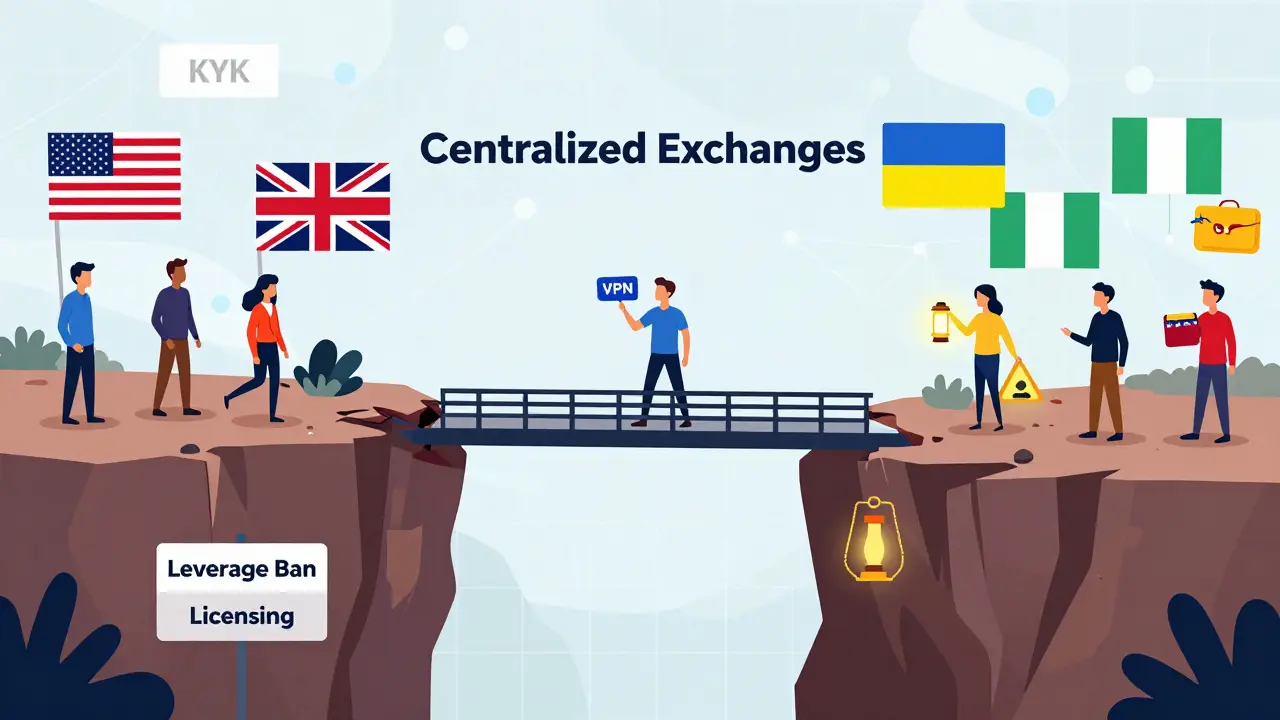
The crypto exchange market is growing fast-projected to hit $122.63 billion by 2032. But growth won’t be even. Countries with clear rules will attract more exchanges. The EU’s MiCA regulation, which went live in 2024, is already pushing exchanges to register across all 27 member states. That’s why Binance and Kraken now offer EU-specific platforms with unified KYC.On the flip side, countries cracking down are seeing exits. Australia banned certain high-risk crypto derivatives in late 2024. Canada is moving toward licensing all exchanges by 2026. That means some platforms will disappear from those markets unless they adapt.
Meanwhile, DeFi and peer-to-peer platforms are filling gaps. If you can’t use Binance in your country, you might use Uniswap or PancakeSwap. These aren’t exchanges in the traditional sense-they’re smart contracts. You don’t need approval. You just need a wallet. That’s why adoption keeps rising even where centralized exchanges are blocked.
What You Can Do Right Now
If you’re wondering whether your favorite exchange works where you are:- Check the exchange’s official website. Look for a “Region Restrictions” page.
- Search for local news: “Is [Exchange] banned in [Country]?”
- Don’t use a VPN to access blocked platforms. It violates terms of service and can freeze your funds.
- Consider regulated alternatives: Coinbase for the U.S., Kraken for Europe, KuCoin for Asia.
- If you’re in a country with no clear rules, stick to spot trading. Avoid leverage and derivatives.
There’s no universal crypto exchange. The internet makes it feel like there should be. But governments aren’t online. They’re real. And they’re writing the rules-one country at a time.