
Imagine you’re moving into a new house. You have a detailed inventory list in your pocket (the header) and boxes full of furniture and clothes (the body). If someone swaps one box for another, the inventory list won’t match, and you’ll know immediately. This is exactly how blockchain works.
Every time you send Bitcoin or Ethereum, that transaction gets packed into a digital container called a block. But a block isn’t just a random pile of data. It’s split into two distinct parts: the block header and the block body. Understanding the difference between these two components is the key to understanding why blockchain is secure, scalable, and decentralized.
The Block Header: The Cryptographic Fingerprint
The block header is small, precise, and incredibly important. In Bitcoin, it is exactly 80 bytes long. That’s tiny. To put that in perspective, a single tweet can be up to 280 characters (roughly 560 bytes if encoded simply), so a Bitcoin block header is smaller than half a tweet. Yet, this tiny piece of data holds the entire security weight of the network.
Think of the header as the metadata or the "fingerprint" of the block. It contains six critical fields:
- Version Number: Indicates which ruleset the block follows (4 bytes).
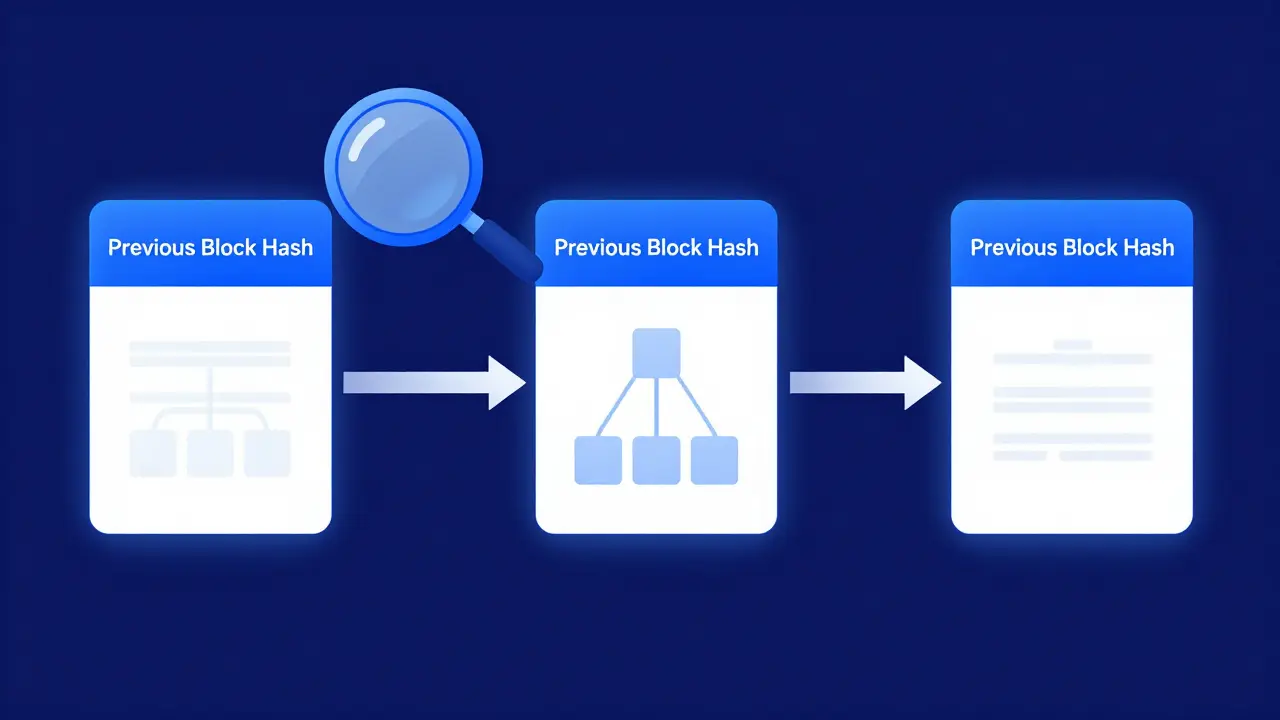
- Previous Block Hash: A 32-byte cryptographic link to the parent block, creating the chain.
- Merkle Root: A 32-byte hash that summarizes all transactions in the body.
- Timestamp: When the block was created (4 bytes).
- Difficulty Target: How hard it was to mine this block (4 bytes).
- Nonce: A number miners change to solve the puzzle (4 bytes).
The magic happens with the Previous Block Hash and the Merkle Root. The previous hash locks this block to the one before it. If you try to change a transaction in an old block, its hash changes. That breaks the link to the next block, which breaks the link to the one after that, and so on. This is why blockchain is immutable. You can’t edit history without redoing all the work from that point forward.
The Merkle Root is equally vital. It’s a single hash derived from all the transactions in the block body using a Merkle tree structure. This allows anyone to verify that a specific transaction is included in the block without downloading the entire block. This feature enables SPV (Simplified Payment Verification) wallets, like those on mobile phones, to check balances securely without storing the whole ledger.
The Block Body: The Transaction Vault
If the header is the fingerprint, the body is the payload. It contains the actual data people care about: the transactions. In Bitcoin, the body starts with a variable-length integer that counts how many transactions are in the block, followed by the transaction data itself.
Unlike the fixed-size header, the body is variable. A Bitcoin block can hold up to 1MB of standard transactions, or effectively 4MB if SegWit (Segregated Witness) data is included. This means some blocks are heavy with thousands of small payments, while others might be lighter. The size depends entirely on what users are sending at that moment.
In Ethereum, the body structure is slightly different. Besides transactions, it includes ommers (formerly called uncles). Ommers are blocks that were mined but didn’t make it into the main chain. Including them in the body helps reward miners who got close but lost out, improving network security and decentralization.
Why Separate Them? The Power of Efficiency
You might wonder, why not just hash the whole block? Why keep the header and body separate? The answer lies in efficiency and scalability.
By keeping the header small (80 bytes in Bitcoin), the network can process and verify the chain’s integrity very quickly. Full nodes don’t need to download every transaction to know the state of the chain. They can just download the headers. This is crucial for light clients and mobile devices.
Consider the math. If you have a 1MB block, the header is only 0.008% of the total size. Verifying the header takes milliseconds. Verifying every transaction in the body takes longer. By separating them, blockchain networks allow different types of participants to interact at their own level of trust and resource availability.
| Feature | Block Header | Block Body |
|---|---|---|
| Size | Fixed (e.g., 80 bytes in Bitcoin) | Variable (up to 1-4MB in Bitcoin) |
| Content | Metadata, hashes, nonce, timestamp | Transaction data, ommer blocks (Ethereum) |
| Primary Function | Security, chaining, verification | Data storage, value transfer |
| Verification Speed | Very fast (light clients use this) | Slower (requires full download) |
| Cryptographic Role | Contains the proof-of-work/stake solution | Summarized by the Merkle Root in the header |
Differences Across Networks: Bitcoin vs. Ethereum
While the concept of header and body is universal, the implementation varies. Bitcoin uses SHA-256 hashing and has a strict 80-byte header. Ethereum, especially after its transition to Proof-of-Stake (The Merge), has a more complex header structure.
Ethereum’s header includes additional roots: the State Root, Transactions Root, and Receipts Root. This makes Ethereum’s header larger (around 500 bytes) but provides more granular verification capabilities. For example, the State Root allows validators to verify the global state of the network without processing every transaction individually.
This difference highlights a trade-off. Bitcoin prioritizes simplicity and maximum security through minimalism. Ethereum prioritizes flexibility and smart contract functionality, accepting a slightly heavier header burden to enable more complex operations.
Real-World Implications for Users and Developers
For the average user, this distinction matters when choosing a wallet. If you use a lightweight mobile wallet, you’re likely an SPV client. You rely on the block headers to verify that your transaction is safe. You trust the network’s consensus on the headers because they are cryptographically linked and expensive to fake.
For developers, understanding this split is essential for building scaling solutions. Layer 2 protocols like the Lightning Network (Bitcoin) or Optimistic Rollups (Ethereum) often post compressed data or proofs to the main chain. These proofs frequently interact with the block header’s Merkle root to prove that certain events happened off-chain without clogging the main block body.
Furthermore, the rise of Ordinals and BRC-20 tokens on Bitcoin has pushed block bodies to near capacity. This has sparked debates about whether the header structure needs modification to handle increased data demands. Proposals like MAST (Merkelized Abstract Syntax Trees) aim to optimize how headers manage complex script conditions, showing that even mature architectures evolve.

Common Misconceptions
A common mistake beginners make is thinking that the entire block is hashed to create the chain. It’s not. Only the header is hashed. The body is secured indirectly via the Merkle Root inside the header. This distinction is subtle but powerful. It means you can prune (delete) old transaction data from your hard drive while still maintaining a valid, secure copy of the blockchain’s history through the headers.
Another misconception is that the nonce is part of the transaction data. It isn’t. The nonce is purely a mining tool, adjusted randomly until the header’s hash meets the difficulty target. Once the block is found, the nonce becomes permanent metadata, but it has no bearing on the financial transactions themselves.
Future Outlook: Evolution of the Structure
As blockchain technology matures, we see innovations targeting both components. Ethereum’s upcoming Verkle Trees upgrade aims to replace Merkle Patricia trees, potentially reducing the size of state proofs and making light clients even more efficient. This would mean smaller data requirements for verifying the connection between the header and the state.
Quantum computing remains a theoretical threat to current hash functions like SHA-256. If quantum computers become powerful enough to break these hashes, the block header structure will need fundamental redesigning. However, for now, the header-body dichotomy remains the bedrock of decentralized trust, balancing security, transparency, and efficiency in a way that continues to support trillions of dollars in market capitalization.
What is the exact size of a Bitcoin block header?
A Bitcoin block header is exactly 80 bytes long. This includes 4 bytes for version, 32 bytes for the previous block hash, 32 bytes for the Merkle root, 4 bytes for the timestamp, 4 bytes for the difficulty target, and 4 bytes for the nonce.
Why is the Merkle Root important in the block header?
The Merkle Root is a cryptographic summary of all transactions in the block body. It allows users to verify that a specific transaction is included in the block without downloading the entire block. This is essential for Simplified Payment Verification (SPV) used by mobile wallets.
How does Ethereum's block body differ from Bitcoin's?
Ethereum's block body includes transactions and 'ommers' (uncles), which are blocks that were mined but not included in the main chain. Bitcoin's body contains only transactions. Additionally, Ethereum's header is larger due to additional state roots.
Can I delete the block body and keep my wallet secure?
Yes, if you use a pruned node or an SPV wallet. Pruned nodes delete old block bodies to save space but keep the headers. Since the headers contain the cryptographic links and Merkle roots, you can still verify the chain's integrity and recent transactions without storing historical transaction data.
What role does the nonce play in the block header?
The nonce is a 4-byte field that miners adjust to find a block hash that meets the network's difficulty target. It is central to the Proof-of-Work consensus mechanism. Once a valid hash is found, the nonce is locked in the header, serving as proof of the computational work performed.