Most people hear about Bitcoin or Ethereum, but the crypto world is full of niche tokens solving very specific problems. TRRUE is one of those assets. It is the native utility token for Trrue Chain, a Layer-1 blockchain ecosystem designed for compliance-focused financial services and impact-driven investments. If you are wondering what makes this coin different from the thousands of others on the market, it comes down to its focus on regulatory alignment and sustainability reporting.
This article breaks down exactly what TRRUE is, how it works within the Trrue ecosystem, and where it stands in the current market. We will look at its technical specs, tokenomics, and the real-world challenges it faces as a small-cap asset trying to enter the institutional finance space.
Key Takeaways
- TRRUE is an ERC-20 utility token on the Ethereum network with a fixed maximum supply of 300 million coins.
- It powers the Trrue Chain, a proprietary Layer-1 blockchain focused on ESG compliance and verified credentials.
- The project targets financial institutions needing alignment with European regulations like MiCA, SFDR, and CSRD.
- As of mid-2025, TRRUE trades in the low single cents (approx $0.023-$0.030), making it a high-risk, small-cap investment.
- Liquidity is currently thin, with daily trading volumes typically under $150,000 across limited exchanges.
What is the Trrue Ecosystem?
To understand the token, you first need to understand the platform behind it. Trrue Chain is described as a "verified credential network" and trust infrastructure for financial services. Unlike general-purpose blockchains that aim to be everything to everyone, Trrue focuses on a narrow niche: helping companies and investors meet strict regulatory requirements.
The core value proposition here is compliance. In Europe, new rules like the Markets in Crypto-Assets (MiCA) regulation and the Sustainable Finance Disclosure Regulation (SFDR) require detailed reporting on environmental, social, and governance (ESG) factors. Trrue Chain aims to build these checks directly into the blockchain layer. This means that when a financial institution uses the network, they can trace transactions and verify identities more easily than on traditional systems.
The ecosystem was registered in Italy in 2021, giving it a formal corporate structure early on. The team has positioned itself not just as a tech company, but as a bridge between Web3 technology and traditional regulated finance. This is a bold move because it requires proving that blockchain can handle the rigorous audit trails demanded by banks and asset managers.
Technical Specs and Token Standards
From a technical standpoint, TRRUE operates as an ERC-20 token on the Ethereum blockchain. This is significant because it means you don't need a special wallet to hold it; any standard Ethereum-compatible wallet like MetaMask or Trust Wallet should work. However, the long-term vision involves migrating or bridging to the proprietary Trrue Chain mainnet.
Here are the hard numbers you need to know:
- Total Supply: 300,000,000 TRRUE (Fixed)
- Max Supply: 300,000,000 TRRUE
- Mining: Non-mineable (Proof-of-Stake or similar, no PoW)
- Network: Ethereum (ERC-20) / Trrue Chain (Layer-1)
- Launch Date: December 2024
Because the supply is fixed and non-mineable, there is no inflationary pressure from new coins being created through mining. This is typical for utility tokens used for payments and governance rather than securing a proof-of-work network. The "fixed supply" aspect appeals to some investors who dislike the dilution effects seen in other projects, but it also means the price depends entirely on demand for the token's utility.
Tokenomics and Distribution
How the 300 million tokens are distributed gives you a clue about who controls the project. According to data from the initial offering, the allocation looks like this:
| Category | Percentage | Amount (Millions) |
|---|---|---|
| Ecosystem Development | 38.33% | 115.0 |
| Token Sale (IDO) | 24.00% | 72.0 | Team | 15.00% | 45.0 |
| Liquidity | 12.00% | 36.0 |
| Association/Foundation | 10.67% | 32.0 |
A few things stand out here. First, nearly 40% of the supply is reserved for "ecosystem development." This suggests the team plans to use a large portion of the tokens to incentivize users, partners, or developers over time. Second, the team holds 15%, which is a standard but significant chunk. You should always check if these team tokens have vesting periods to prevent massive sell-offs later.
The IDO (Initial DEX Offering) took place on December 24, 2024, on the BullPerks launchpad. The sale price was set at $0.10 per token. Comparing this to the current market price of around $0.025, you can see that early buyers are currently sitting on a significant unrealized loss. This price drop is common in crypto, but it highlights the volatility inherent in small-cap tokens that haven't yet proven their utility.
Market Performance and Liquidity
Let’s talk about the reality of trading TRRUE right now. As of mid-2025, the token trades in a tight band between $0.023 and $0.030 USD. The all-time high was reported around $0.049, meaning the token is currently trading about 50% below its peak.
Liquidity is the biggest hurdle here. Daily trading volume typically ranges from $56,000 to $145,000. While that sounds like a decent number, it is tiny compared to major cryptocurrencies. For context, Bitcoin trades billions of dollars daily. For TRRUE, this means that if you try to buy or sell a large position, you might move the price significantly against yourself. This is known as slippage, and it is a real risk for anyone looking to enter or exit larger positions.
Where can you buy it? Currently, the primary active market is on BitMart. Other platforms like Poloniex list it, but activity is often negligible. If you are holding TRRUE, you need to be aware that getting out quickly might not be as easy as it is with top-50 coins. Always check the order book depth before executing large trades.
Regulatory Focus: Why Compliance Matters
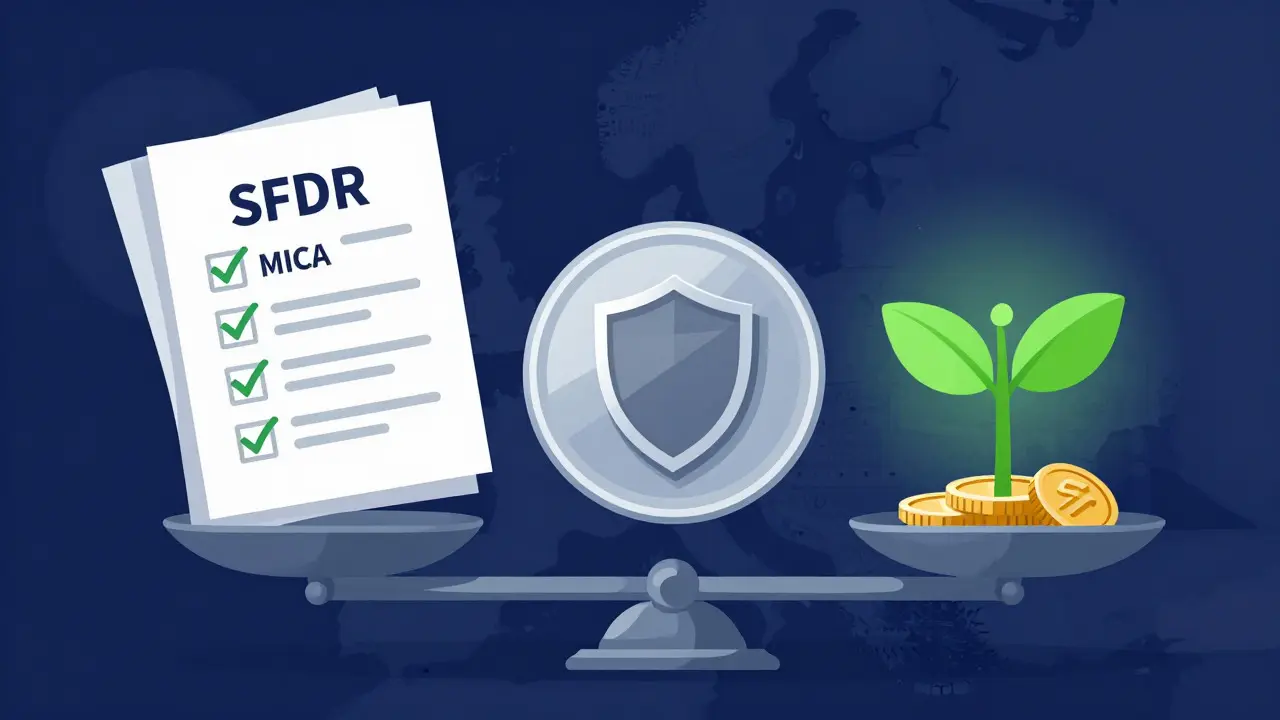
The unique selling point of Trrue is its integration with regulatory frameworks. Specifically, the project aligns with:
- MiCA: The EU’s comprehensive framework for crypto-assets.
- SFDR: Rules requiring financial market participants to report on sustainability risks.
- CSRD: Corporate Sustainability Reporting Directive, which expands ESG reporting requirements for companies.
- CASPs: Crypto-Asset Service Providers, ensuring intermediaries meet certain standards.
Why does this matter? Because most blockchains are built for speed or decentralization, not for passing an audit. If Trrue can successfully embed these compliance features into its chain, it could become the go-to infrastructure for European banks and asset managers who want to use blockchain without fearing regulatory penalties. This is a massive potential market, but it is also a slow-moving one. Institutional adoption takes years, not weeks.
Risks and Challenges
No investment is without risk, and TRRUE carries several specific ones you should consider.
1. Information Opacity: Public details on the consensus mechanism, validator set, and security audits are limited. Without clear technical documentation, it is hard to independently verify the security of the network.
2. Low Adoption Metrics: There is little public data on the number of active addresses or total value locked (TVL). The project ranks around #2700 to #5700 depending on the tracker, placing it deep in the tail end of the crypto market. This suggests that while the concept is sound, widespread usage hasn't kicked in yet.
3. Price Volatility: Trading 75% below the IDO price shows that the market has not yet validated the project's value proposition financially. Until there is strong product-market fit, the price may remain suppressed.
4. Regulatory Dependency: The entire business model relies on European regulations staying favorable and complex. If regulators simplify reporting or choose a different technological standard, Trrue's edge could diminish.
Who Should Consider TRRUE?
TRRUE is likely not for the casual trader looking for quick gains. It is a speculative bet on the future of compliant, ESG-focused finance. It might appeal to:
- Investors who believe in the "compliance-as-a-service" narrative in crypto.
- Long-term holders who think institutional adoption of blockchain in Europe will accelerate.
- Developers interested in building applications that require verified credentials and audit trails.
If you are considering buying, start small. Use limit orders to avoid slippage due to low liquidity. Keep an eye on the project's official channels for updates on mainnet migration and partnership announcements, as these are the catalysts that could drive real usage.
Frequently Asked Questions
Is TRRUE a good investment in 2026?
Whether TRRUE is a good investment depends on your risk tolerance. It is a high-risk, small-cap token with thin liquidity. Its value hinges on the success of Trrue Chain in capturing the institutional compliance market. If you believe in the growth of regulated DeFi and ESG tracking via blockchain, it offers exposure to that niche. However, the lack of established user metrics and the price drawdown from launch suggest caution is needed.
Where can I buy TRRUE coin?
As of mid-2025, the primary exchange for TRRUE is BitMart. It is also listed on Poloniex, though trading volume there is often very low. Before buying, check the current order book depth on these platforms to ensure you can execute your trade without excessive slippage. Since it is an ERC-20 token, you can also look for decentralized exchange pairs, though liquidity may be fragmented.
What is the difference between Trrue Chain and Ethereum?
Ethereum is a general-purpose Layer-1 blockchain supporting thousands of applications. Trrue Chain is a specialized Layer-1 blockchain designed specifically for financial services, focusing on compliance, verified credentials, and ESG reporting. Currently, TRRUE exists as an ERC-20 token on Ethereum, but the goal is for it to serve as the native asset of the Trrue Chain network, which may offer different performance characteristics tailored to institutional needs.
Does TRRUE have staking rewards?
Specific details on staking mechanisms and reward rates are not widely documented in public aggregators as of mid-2025. The token is intended for "network operations and platform rewards," which implies staking or locking might be part of the protocol design. You should monitor the official Trrue documentation or community channels for announcements regarding staking pools and APYs.
Is TRRUE mineable?
No, TRRUE is not mineable. It is a non-mineable ERC-20 token with a fixed maximum supply of 300 million. New tokens are released according to the predefined tokenomics schedule (team, ecosystem, etc.) rather than through proof-of-work mining. This makes it similar to other utility tokens like LINK or UNI, where supply is controlled by contract logic rather than hardware competition.