When you want to swap crypto without a middleman, SushiSwap on Polygon isn’t just another option-it’s one of the few platforms that actually makes decentralized trading feel fast, cheap, and useful. But is it right for you? If you’ve been burned by Ethereum gas fees or confused by DeFi jargon, this review cuts through the noise with real numbers, real user experiences, and no fluff.
What Exactly Is SushiSwap on Polygon?
SushiSwap started on Ethereum in 2020 as a community-driven fork of Uniswap. It didn’t just copy Uniswap-it added rewards, governance, and a token (SUSHI) to give users a real stake in the platform. By May 2021, it expanded to Polygon, a Layer 2 blockchain built to solve Ethereum’s high fees and slow speeds. Today, SushiSwap on Polygon lets you swap tokens, earn interest, stake, lend, and even vote on platform changes-all without giving up control of your crypto.
Unlike centralized exchanges like Binance or Coinbase, SushiSwap doesn’t hold your money. You connect your wallet (like MetaMask), and smart contracts handle everything. Your trades happen directly between liquidity pools-groups of tokens locked in code by users like you. No bank. No KYC. No delays.
Why Polygon? The Fee and Speed Advantage
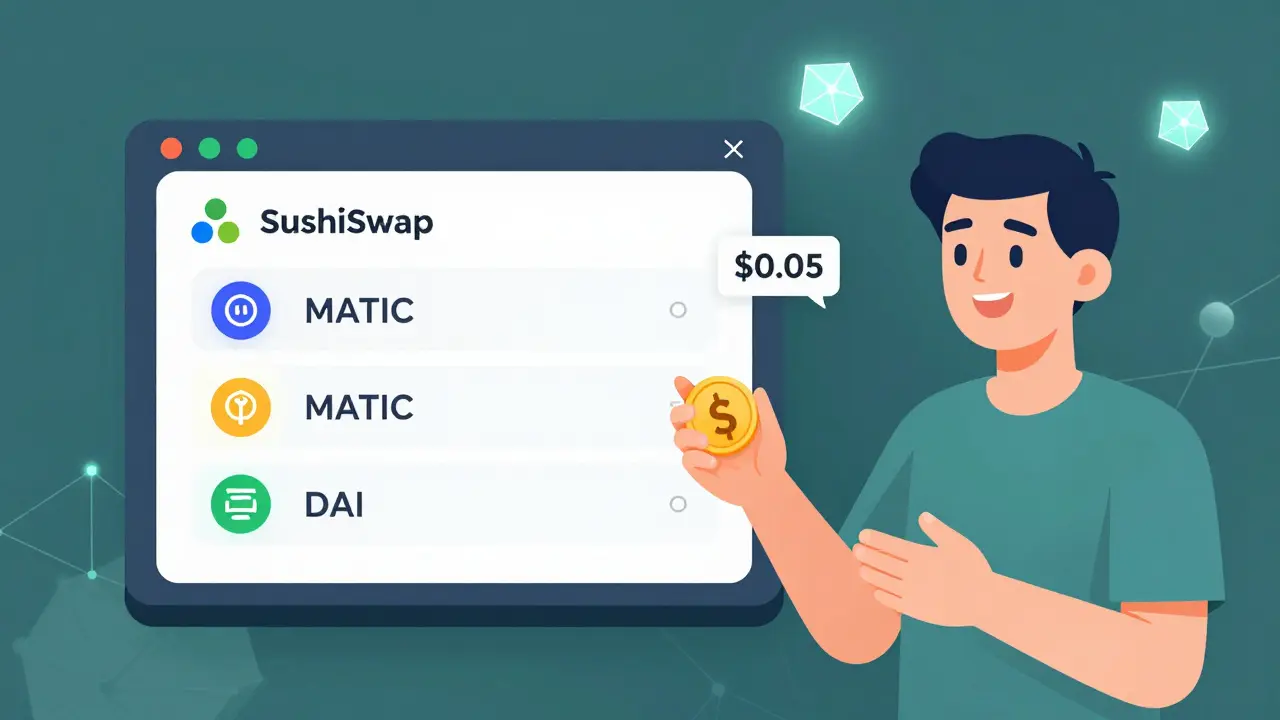
On Ethereum, a simple swap can cost $10-$50 during busy times. On Polygon? You’re looking at $0.01 to $0.10. That’s not a minor improvement-it’s a game-changer for small traders and frequent users.
Transaction speeds are just as dramatic. Ethereum takes 15-60 seconds to confirm. Polygon? 2-3 seconds. This matters because:
- You can make multiple trades in minutes without worrying about gas spikes
- Liquidity providers get paid faster, reducing risk from price swings
- Yield farming and staking rewards are claimed almost instantly
As of October 2025, about 30-40% of SushiSwap’s total trading volume happens on Polygon. That’s not a side project-it’s a core part of the platform’s strategy.
How SushiSwap Compares to Other Polygon DEXes
Polygon has its own native DEXes, like QuickSwap, which was built from the ground up for this chain. So why do people still use SushiSwap?
Here’s the breakdown:
| Feature | SushiSwap | QuickSwap | Uniswap V3 |
|---|---|---|---|
| Trading Fees | $0.01-$0.10 | $0.01-$0.05 | $0.01-$0.15 |
| Swap Speed | 2-3 sec | 2-3 sec | 2-3 sec |
| Yield Farming | Yes (multiple pools) | Yes | No |
| Staking (xSUSHI) | Yes | No | No |
| Governance (SUSHI voting) | Yes | No | No |
| Lending/Borrowing | Yes (via Kashi) | No | No |
| Market Share (Polygon DEX) | 5-8% | 15-20% | 25-30% |
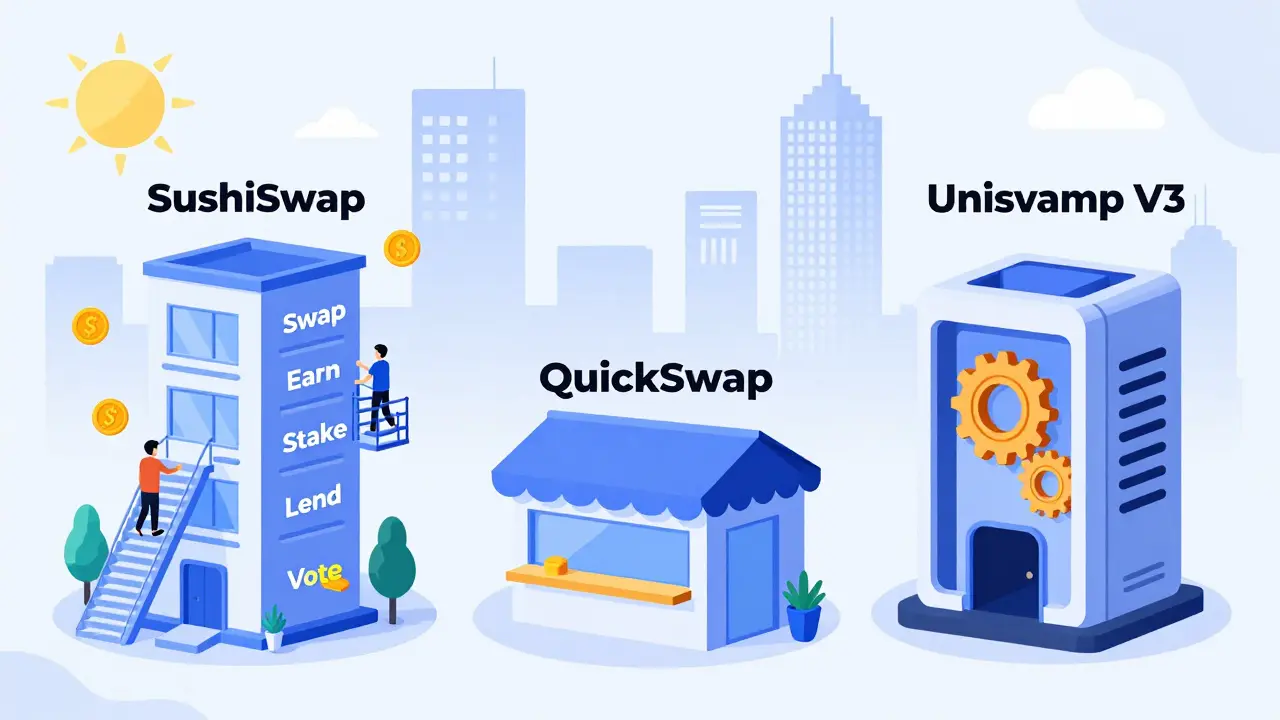
QuickSwap wins on simplicity and native Polygon integration. Uniswap V3 leads in trading efficiency with its concentrated liquidity model. But SushiSwap? It’s the only one that turns swapping into a full DeFi hub. You can swap, stake, farm, lend, and vote-all in one place.
The SUSHI Token: More Than Just a Reward
The SUSHI token isn’t just a way to earn rewards-it’s your voice in the platform’s future. Each SUSHI token gives you one vote on proposals like:
- Changing fee structures
- Adding new token pairs
- Allocating treasury funds
- Updating smart contracts
As of March 2026, SUSHI trades at $2.19 with a $574 million market cap. That’s down from its all-time high of $23.38 in 2021, but it’s also far above its 2024 low of $0.45. The token’s value is tied to platform usage. More swaps, more staking, more governance activity = more demand.
There’s a catch: large holders own a big chunk of SUSHI. A few wallets control over 15% of the supply. That means if one of them votes against a proposal, it could sway the outcome. Critics say this undermines decentralization. Supporters argue it’s just how early-stage DeFi works-power concentrates until broader adoption kicks in.
What Users Actually Experience
Reddit and Discord users give mixed reviews. Here’s what they say:
- Positive: "I swapped $500 of MATIC to DAI and paid 7 cents in fees. On Ethereum, that would’ve been $25. Game over."
- Positive: "Staking my SUSHI for xSUSHI gives me 12% APY. That’s better than most savings accounts."
- Negative: "I tried to farm on SushiBar and lost money because the token price dropped. Didn’t understand impermanent loss."
- Negative: "The interface is overwhelming. There are 10 tabs. Which one do I click to just swap?"
Most complaints come from new users trying advanced features too soon. The platform doesn’t hold your hand. If you’re used to Coinbase, you’ll need to learn:
- Slippage tolerance (how much price change you’ll accept)
- Impermanent loss (why your pool value might drop even if the token price goes up)
- Smart contract risks (bugs, exploits, frozen funds)
There were a few incidents in 2021-2022 where liquidity pools froze due to code bugs. But every time, the community voted to fix it. No central team shut it down. No customer support hotline. Just code, votes, and time.
How to Get Started
Here’s how to use SushiSwap on Polygon in 5 steps:
- Get a wallet: Install MetaMask (the most popular choice).
- Add Polygon network: Go to Settings > Networks > Add Network. Use Polygon’s RPC details (chain ID: 137, RPC URL: https://polygon-rpc.com).
- Fund your wallet: Buy MATIC on an exchange like Coinbase, then send it to your wallet. You’ll need MATIC to pay for transaction fees.
- Connect to SushiSwap: Go to app.sushi.com, click "Connect Wallet," and select MetaMask.
- Start swapping: Click "Swap," pick your tokens, set slippage to 0.5-1%, and confirm.
For advanced features like staking or lending, explore the "Earn" and "Lend" tabs. The Sushi Academy has guides, but they assume you already know what a liquidity pool is. If you’re new, watch YouTube tutorials first.

The Risks You Can’t Ignore
SushiSwap on Polygon is powerful-but it’s not safe by default.
- Smart contract risk: Code can have bugs. While Polygon is secure, SushiSwap’s contracts have been exploited before. Always check for audits (they’re public on GitHub).
- Impermanent loss: If you provide liquidity in a volatile pair (like ETH/MATIC), you could lose money even if the tokens rise in value. This isn’t a bug-it’s how AMMs work.
- Token volatility: SUSHI dropped 80% in 2024. Your rewards could be worth less tomorrow.
- Regulatory risk: If the U.S. or EU cracks down on DeFi governance, SushiSwap could be forced to change-or shut down.
- Support delays: No live chat. No phone number. You’re on Discord forums. Responses can take days.
There’s no insurance. No FDIC. If you mess up, you lose. That’s DeFi.
Who Is This For?
SushiSwap on Polygon isn’t for everyone.
- Perfect for: Traders who swap daily, yield farmers chasing APY, DeFi users who want governance power, people tired of Ethereum fees.
- Not for: Beginners who don’t know what a wallet is, people who want customer support, anyone who expects their crypto to be "safe" like a bank.
If you’re serious about decentralized finance and want more than just swapping-this is one of the few platforms that delivers.
What’s Next? The Road Ahead
SushiSwap launched V2 features on Polygon in late 2024, bringing concentrated liquidity (like Uniswap V3) to its platform. That means better trading efficiency without losing yield farming.
In 2025, they’re testing zkEVM integration-a technology that could slash fees even further and add privacy. If it works, SushiSwap could become the most efficient cross-chain DeFi hub.
But competition is fierce. QuickSwap is improving. Uniswap V3 is expanding. Other chains like Arbitrum and Avalanche are growing fast. SushiSwap’s future depends on one thing: keeping users engaged. Not just with rewards-but with real control.
Is SushiSwap on Polygon safe to use?
SushiSwap on Polygon is as safe as any DeFi platform can be. It uses audited smart contracts and runs on Polygon’s secure Layer 2 network. But safety in DeFi doesn’t mean protection from loss-it means transparency and community control. You can view every transaction on the blockchain. There’s no central authority that can freeze your funds. However, smart contract bugs, user errors, and volatile token prices can still cause losses. Always start small, understand impermanent loss, and never invest more than you can afford to lose.
How do I earn with SushiSwap on Polygon?
You can earn in three main ways: 1) Provide liquidity to trading pairs (like MATIC/USDC) and earn a share of trading fees. 2) Stake SUSHI tokens for xSUSHI, which gives you 10-15% APY and voting rights. 3) Join yield farms that offer extra SUSHI rewards for locking up specific tokens. Each option carries risk-especially if token prices drop. Always check the APY, token pair volatility, and contract duration before committing funds.
Do I need to pay gas fees on Polygon?
Yes, but they’re tiny. You need MATIC (Polygon’s native token) to pay for every transaction-swapping, staking, farming, or voting. Fees range from $0.01 to $0.10, depending on network activity. This is 100-1,000 times cheaper than Ethereum. You can buy MATIC on Coinbase, Binance, or Kraken and send it to your wallet. Never send ETH or ERC-20 tokens to Polygon-it won’t work.
Can I use SushiSwap without a wallet?
No. SushiSwap is a decentralized exchange, so it requires a non-custodial wallet like MetaMask, WalletConnect, or Rabby. You cannot sign in with an email or phone number. This is intentional-it’s what makes it decentralized. If you don’t have a wallet, you’re not ready for DeFi. Start by learning how wallets work before touching SushiSwap.
What’s the difference between SushiSwap on Ethereum and Polygon?
The core technology is the same: automated market maker, SUSHI rewards, governance. But on Ethereum, fees are high ($10-$50 per trade) and speeds are slow (15-60 seconds). On Polygon, fees are under $0.10 and swaps take 2-3 seconds. Most users now prefer Polygon for daily trading. Ethereum is still used for large swaps or when bridging assets from other chains. The Polygon version is faster, cheaper, and better for active users.
Is SushiSwap better than Uniswap on Polygon?
It depends on what you want. Uniswap V3 is better for pure trading-it has tighter price ranges and lower slippage for large swaps. SushiSwap is better if you want to earn, stake, or vote. It offers yield farming, staking rewards, and lending tools that Uniswap doesn’t. If you’re just swapping tokens once a week, Uniswap is simpler. If you’re active in DeFi, SushiSwap gives you more tools. Many users use both.