Quick Summary / Key Takeaways
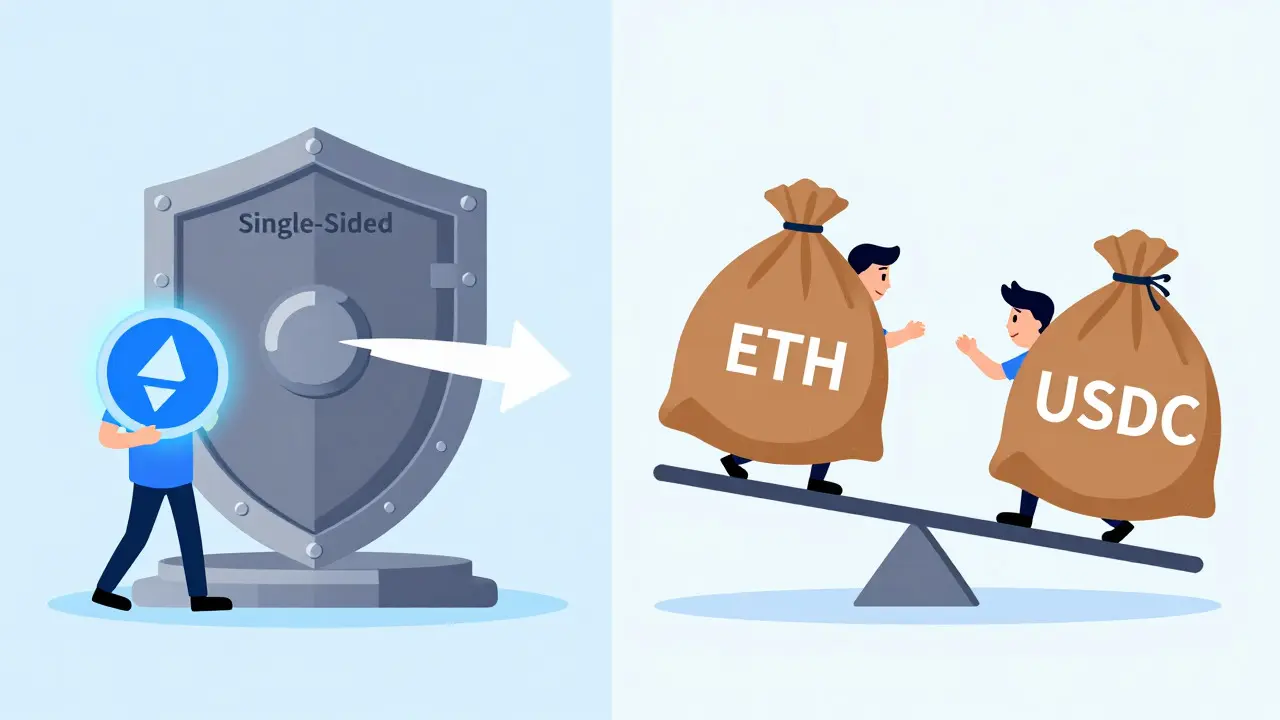
- Dual-sided liquidity requires depositing two tokens (e.g., ETH and USDC) in equal value, exposing you to full impermanent loss but offering higher potential fees during volatility.
- Single-sided liquidity lets you deposit just one asset. Protocols like Bancor or Uniswap v3/v4 use algorithms to manage the pair, drastically reducing entry barriers and IL risk for stable assets.
- Capital efficiency is the trade-off: Single-sided models can be up to 4,000x more efficient within tight price ranges, but earnings drop to zero if the price exits your range.
- For beginners, single-sided is safer and simpler. For experienced traders willing to monitor markets, dual-sided or concentrated liquidity offers higher yield potential.
- Hybrid strategies are emerging in 2026, using automated tools to rebalance positions dynamically across both models.
You’ve got some crypto sitting in your wallet, and you want it to work harder. You hear about providing liquidity on decentralized exchanges (DEXs), but the jargon gets messy fast. Should you dump just one token into a pool, or do you need to buy a matching pair? This isn’t just a technical question-it’s a decision that dictates how much money you make, how much risk you take, and how much time you spend staring at charts.
The core debate in modern decentralized finance (DeFi) is between single-sided liquidity and dual-sided liquidity. One promises simplicity and safety; the other offers raw power and higher yields. By mid-2026, the landscape has shifted significantly from the early days of DeFi. Let’s break down exactly how these models work, who they are for, and which one fits your portfolio right now.
Understanding Dual-Sided Liquidity: The Traditional Model
To understand where we are, we have to look at where we started. Dual-sided liquidity, also known as double-sided liquidity, is the traditional model where a liquidity provider (LP) deposits two different assets in a specific ratio, usually 1:1 by value. Think of a standard ETH/USDC pool on an older version of Uniswap. If you want to provide $1,000 worth of liquidity, you must deposit $500 worth of ETH and $500 worth of USDC.
This model was the backbone of DeFi for years. It’s straightforward. The protocol holds your two assets in a smart contract, and traders swap against them. In return, you earn a cut of the trading fees. But there’s a catch that keeps many LPs up at night: impermanent loss.
Impermanent loss happens when the price of your deposited tokens changes relative to each other. Because the pool automatically balances itself to maintain a constant product formula (like x * y = k), you end up holding more of the losing asset and less of the winning one compared to just holding the tokens in your wallet. If ETH skyrockets, the pool sells your ETH to buy more USDC to keep the ratio balanced. You miss out on the full upside of that ETH rally. While this is called "impermanent" because it disappears if prices revert, it can become permanent if you withdraw while the divergence remains.
Despite this risk, dual-sided liquidity remains popular for volatile pairs like ETH/BTC. Why? Because high volatility generates massive trading volume. More trades mean more fees. In a raging bull or bear market, the fee income from a dual-sided pool can often outweigh the losses from impermanent loss. However, it requires active management. You’re not just setting it and forgetting it; you’re managing a dynamic hedge that shifts with every price tick.
The Rise of Single-Sided Liquidity
Enter single-sided liquidity. This model flips the script. Instead of forcing you to buy two tokens, it allows you to deposit just one. Single-sided liquidity is a provision model where users contribute only one asset to a liquidity pool, relying on protocol algorithms or concentrated ranges to facilitate swaps.
Bancor pioneered this concept back in 2017, but it didn’t gain mainstream traction until Uniswap Labs introduced concentrated liquidity with Uniswap v3 in May 2021. With concentrated liquidity, you still technically interact with a pair, but you define a specific price range. If you believe SOL will stay between $15 and $25, you deposit only SOL. The protocol’s algorithm automatically converts your SOL to USDC as needed within that range to facilitate trades. To you, it feels like a single-sided deposit.
Why does this matter? First, it lowers the barrier to entry. You don’t need to go out and buy a second token, paying gas fees and slippage to acquire it. Second, it dramatically improves capital efficiency. By concentrating your capital in a narrow price band, your funds are working much harder. Uniswap’s whitepaper noted that this approach could achieve up to 4,000x capital efficiency improvements compared to traditional pools within tight ranges.
In 2026, this model has evolved further. Uniswap v4, launched in July 2023, introduced "hooks"-smart contract extensions that allow developers to create sophisticated single-sided strategies. These hooks can automate rebalancing, adjust fees dynamically, and even integrate with external data feeds. This means single-sided liquidity is no longer just for stablecoins; it’s becoming a viable strategy for volatile assets too, thanks to better automation.

Head-to-Head Comparison: Risk, Reward, and Efficiency
So, which one should you choose? It depends on what you value more: simplicity, yield, or control. Let’s look at the hard numbers and practical differences.
| Feature | Single-Sided Liquidity | Dual-Sided Liquidity |
|---|---|---|
| Asset Requirement | One token only | Two tokens (equal value) |
| Impermanent Loss Risk | Low to None (if in range) | High (proportional to price divergence) |
| Capital Efficiency | Very High (up to 4,000x in tight ranges) | Standard (spread across entire curve) |
| Yield Potential (APY) | 2-5% (fees only) or higher with incentives | 10-25% (higher fees due to depth) |
| Complexity | Medium (requires range selection) | Low (simple deposit) to High (active management) |
| Best For | Stablecoins, bullish/bearish views, beginners | Volatile pairs, neutral market views, pros |
Let’s unpack those numbers. If you’re new to DeFi, single-sided liquidity is arguably friendlier. A survey by MEXC in 2023 found that 73% of new LPs preferred single-sided models because they eliminated the hassle of acquiring a second token. You hold BTC? Deposit BTC. Done.
However, the yield gap is real. Dual-sided pools often offer higher APYs because they provide deeper market depth. Traders prefer deep pools for large orders because it reduces slippage. Since dual-sided pools spread liquidity across all possible prices, they handle large swings better without running dry. Single-sided pools, especially concentrated ones, can run out of liquidity quickly if the price moves outside your set range. When that happens, your position earns zero fees until you rebalance or the price returns.
Consider the impermanent loss factor. Vitalik Buterin analyzed historical data and found that single-sided models reduce average impermanent loss by nearly 59% compared to traditional pools. If you’re holding a volatile asset like ETH, a dual-sided pool exposes you to the full brunt of price swings. A single-sided position, particularly if you set a wide range or use a protocol with elastic IL protection like Bancor, shields you from much of that pain.
Real-World Scenarios: Who Wins?
Theory is great, but let’s talk about what actually happens in the wild. Imagine two scenarios based on real user experiences from late 2023 and early 2024 trends that continue into 2026.
Scenario A: The Stablecoin Play
You have $10,000 in USDC. You want yield without selling your stablecoin exposure. You enter a single-sided USDC pool on a DEX, setting a tight range around $1.00. Over three months, you earn a steady 6% APY from trading fees. There’s virtually no impermanent loss because USDC stays pegged. This is a classic win for single-sided liquidity. It’s simple, safe, and effective.
Scenario B: The Volatile Swing
You hold ETH and think it will pump. You put it into a dual-sided ETH/USDC pool on Uniswap v2. ETH goes up 30%. Your pool sells off your ETH to buy USDC. You end up with more USDC and less ETH than you started with. Meanwhile, your friend who just held ETH in their wallet made 30%. You earned fees, but did they cover the opportunity cost? Probably not. Now, imagine your friend used a single-sided concentrated liquidity position on Uniswap v3, setting a range above the current price. As ETH rose, their position converted to USDC efficiently, capturing fees along the way, but they still retained significant upside compared to the dual-sided model. This highlights the nuance: single-sided doesn’t eliminate IL entirely; it manages it through range selection.
Experienced LPs often use hybrid approaches. They might use single-sided liquidity for stablecoin pairs and dual-sided for highly volatile pairs where they expect high volume. According to Messari, 78% of new protocols launched in 2023 incorporated elements of both models, recognizing that neither is a silver bullet.
Practical Tips for Implementing Your Strategy
If you’re ready to dive in, here’s how to avoid common pitfalls.
- Know Your Range: For single-sided/concentrated liquidity, selecting the right price range is critical. A rule of thumb from expert LPs is to set ranges at ±15-20% from the current price for volatile assets like ETH, and ±0.5-1% for stablecoins. Too narrow, and you’ll exit the range constantly. Too wide, and your capital efficiency drops.
- Monitor Gas Fees: Frequent rebalancing costs money. If you’re adjusting your single-sided position every day, Ethereum gas fees can eat your profits. Consider Layer 2 solutions like Arbitrum or Optimism, where gas is negligible.
- Use Automation Tools: Platforms like GammaXYZ or Zapper.fi offer automated vaults that manage your ranges for you. They rebalance positions when prices drift, saving you time and emotional stress. This is especially useful for single-sided strategies that require active maintenance.
- Start Small: Before committing thousands, test with a small amount. Understand how the interface works, how withdrawals function, and how fees are calculated. DeFi interfaces can be complex, and mistakes are costly.
- Check Oracle Reliability: Single-sided pools rely heavily on price oracles like Chainlink to determine fair values. Ensure the protocol uses reputable oracles to prevent manipulation or incorrect pricing during volatile periods.
Documentation quality matters too. Stick to established protocols like Uniswap, PancakeSwap, or Bancor, which have robust community support and clear guides. Newer projects may promise higher yields but often lack the security audits and user experience polish needed for reliable long-term provisioning.
The Future of Liquidity Provision
As we move through 2026, the line between single-sided and dual-sided liquidity continues to blur. Innovations like Uniswap v4’s hooks allow for dynamic fee structures and automatic rebalancing, making single-sided positions more resilient. Meanwhile, dual-sided pools are integrating better IL protection mechanisms.
Institutional adoption is accelerating. Electric Capital’s 2023 report showed that 23% of institutional participants now use single-sided strategies, up from just 7% the previous year. Institutions favor the predictability and lower IL risk of single-sided models, especially for stable assets.
Regulatory clarity is still evolving, but the trend is toward greater acceptance of DeFi infrastructure. The SEC’s earlier guidance suggested different classifications for various liquidity models, but no definitive rulings have stifled innovation. Instead, protocols are adapting, adding compliance features and transparency tools.
Ultimately, there’s no single winner. Single-sided liquidity democratizes access and reduces risk for most retail users. Dual-sided liquidity remains essential for deep market making and high-yield opportunities for pros. The smartest approach? Use both. Allocate your stablecoins to single-sided pools for steady, low-risk yield. Deploy your volatile assets in dual-sided or concentrated pools where you can actively manage risk and capture higher fees. Diversification isn’t just for stocks; it’s crucial for liquidity providers too.
What is the main difference between single-sided and dual-sided liquidity?
The main difference lies in the assets required. Dual-sided liquidity requires depositing two tokens in equal value (e.g., ETH and USDC), exposing you to impermanent loss from price divergence. Single-sided liquidity allows you to deposit just one token, with the protocol managing the pair via algorithms or concentrated price ranges, reducing entry barriers and IL risk.
Is single-sided liquidity safer than dual-sided?
Generally, yes. Single-sided liquidity reduces exposure to impermanent loss, especially when configured within expected price ranges. However, it carries its own risks, such as earning zero fees if the price moves outside your specified range. Dual-sided liquidity offers higher potential yields but comes with full impermanent loss risk.
Which model is better for beginners?
Single-sided liquidity is typically better for beginners. It simplifies the process by requiring only one asset, eliminating the need to buy a second token. It also offers easier risk management, as you can select narrower price ranges for stable assets to minimize volatility exposure.
How does Uniswap v3 change the game for single-sided liquidity?
Uniswap v3 introduced concentrated liquidity, allowing LPs to allocate capital within specific price ranges rather than across the entire curve. This enables effectively single-sided positioning with vastly improved capital efficiency (up to 4,000x). Uniswap v4 further enhanced this with "hooks" for automated strategies.
Can I lose money with single-sided liquidity?
Yes. While impermanent loss is reduced, you can still face smart contract risks, oracle failures, or opportunity costs if the price moves out of your range and you stop earning fees. Additionally, if the underlying asset crashes, you still hold a depreciating asset.