
Imagine sending $500 to a family member overseas. In the traditional banking system, that money sits in limbo for days while it hops between correspondent banks. You pay high fees, often over 6%, and wonder where the rest of your cash went. Now, picture doing the same thing with cryptocurrency, specifically stablecoins like USDC or USDT. The transaction clears in minutes. The fee is pennies. But there’s a catch: navigating the complex web of global regulations and local restrictions.
In 2026, the landscape has shifted dramatically. Stablecoins moved an eye-opening $15.6 trillion in value last year, matching Visa's annual volume. Yet, despite this massive throughput, stablecoins still handle only about 3% of the $200 trillion in total global cross-border payments. Why? Because while the technology works beautifully, the regulatory environment remains fragmented and restrictive in many key corridors.
The Cost of Traditional Remittances vs. Blockchain
Let’s look at the numbers because they tell a stark story. According to the World Bank’s September 2024 report, the average global cost to send a $200 remittance was approximately 6.62%, or about $13.24. This isn’t just a minor inconvenience; it’s a significant burden for families relying on these funds for daily survival. Regional variations make it worse, with some corridors costing even more due to lack of competition and heavy regulatory overhead.
Contrast this with blockchain-based transactions. On certain Layer 2 networks and high-throughput blockchains, settlement fees often drop below $0.01. That’s not a typo. We’re talking about a reduction in transaction costs by 60-80% compared to traditional systems. For businesses, this difference is life-changing. A manufacturing executive using platforms like BVNK reported reducing payment processing time from 3-5 business days to under 15 minutes for suppliers in Singapore who accept USDC. The speed and cost efficiency are undeniable.
| Metric | Traditional Banking (SWIFT/Wire) | Crypto Stablecoins (Layer 2/Blockchain) |
|---|---|---|
| Average Fee ($200 transfer) | $13.24 (6.62%) | <$0.01 |
| Settlement Time | 1-5 Business Days | Seconds to Minutes |
| Intermediaries | Multiple Correspondent Banks | None (Peer-to-Peer) |
| Regulatory Friction | Low (Established Frameworks) | High (Fragmented Rules) |
The Hidden Barrier: Regulatory Restrictions
If the tech is so much better, why isn’t everyone using it? The answer lies in restrictions. While blockchain operates as a territory-agnostic network-meaning anyone with an internet connection can transact-the real world doesn’t work that way. Governments impose strict rules on how money enters and leaves their borders.
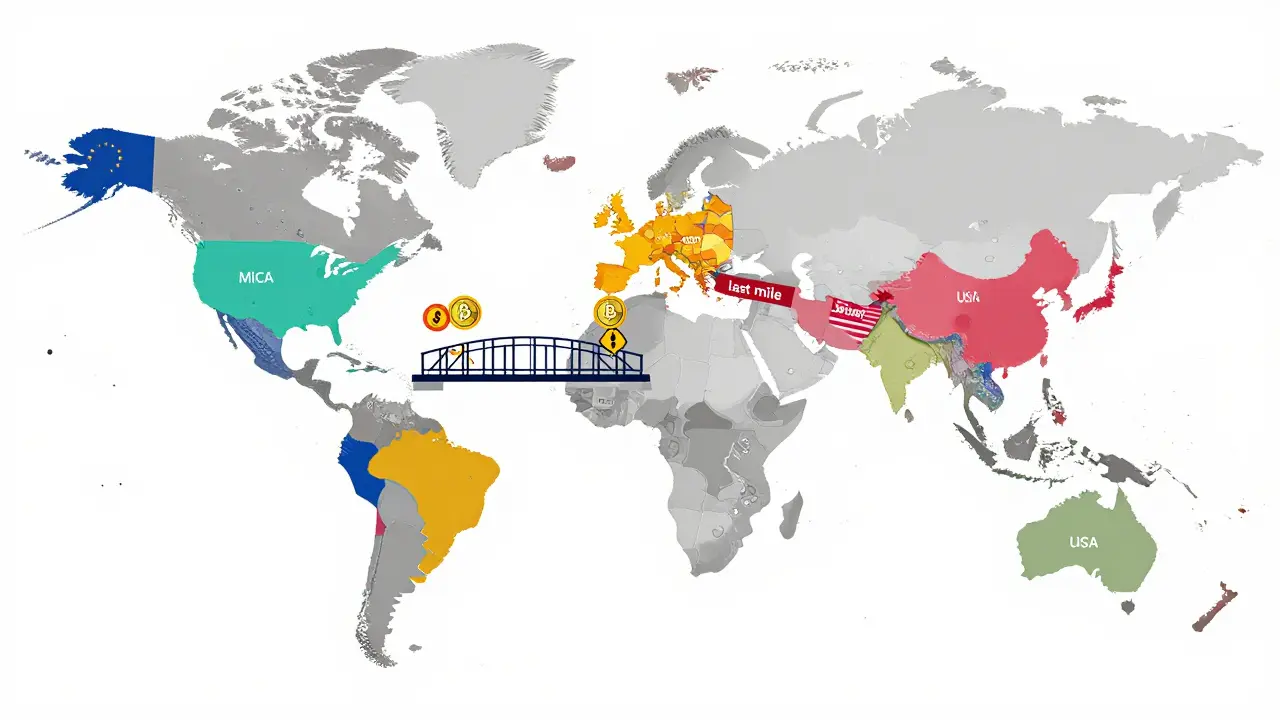
In 2025 and early 2026, we’ve seen a patchwork of regulatory approaches. The European Union implemented the Markets in Crypto-Assets (MiCA) regulation, providing clarity but also adding compliance burdens. The U.S. is still developing its framework, creating uncertainty for businesses trying to operate across borders. Meanwhile, major Asia-Pacific hubs have their own distinct rules. This fragmentation means that while you can send USDC instantly, converting it to local fiat currency for the recipient might be illegal or heavily restricted in their country.
This creates a "last mile" problem. As one user noted in a March 2025 Reddit discussion, their family in Nigeria could receive stablecoins, but converting them to Naira required third-party services charging 3-5% fees. This negates much of the cost benefit gained during the transfer. The restriction isn’t always on the crypto itself, but on the on-ramps and off-ramps-the bridges between digital assets and local economies.
Stablecoins: The Bridge Between Old and New
Among cryptocurrencies, Stablecoins are digital currencies pegged to stable assets like the US Dollar have emerged as the primary vehicle for cross-border payments. Unlike volatile assets like Bitcoin, stablecoins offer price stability, making them practical for everyday transactions. In Q1 2025, stablecoin usage grew to handle $6 trillion of global cross-border payments.
Technological advancements have made stablecoins more interoperable than ever. Circle’s Cross-Chain Transfer Protocol (CCTP), launched in 2024, allows USDC to be burned on one chain (like Ethereum) and minted on another (like Solana or Avalanche) while preserving fungibility. This solves a major technical hurdle: previously, moving stablecoins between chains was risky and expensive. Now, businesses can choose the most efficient chain for each transaction without worrying about asset compatibility.
However, adoption varies significantly by region. Southeast Asia and Africa show the fastest growth in cryptocurrency-based remittances. The Philippines’ central bank reported a 217% year-over-year growth in crypto remittances in 2024, though they still represent only 4.3% of total volume. This surge is driven by high traditional remittance costs and a young, tech-savvy population eager to bypass inefficient banking infrastructure.
Navigating Compliance and Security
You might think that going crypto means avoiding regulation entirely. That’s a dangerous misconception. In fact, compliance is becoming stricter. Blockchain-based payment providers now implement on-chain Anti-Money Laundering (AML) and Know Your Customer (KYC) requirements. They also follow the Travel Rule, which mandates passing originator and beneficiary information during transfers.
For businesses, this means partnering with licensed providers who offer hosted wallets, auto-conversion features, and robust reporting tools. Platforms like BVNK and Yellow Card help enterprises navigate these complexities. Yellow Card’s Q2 2025 merchant survey found that while 89% of business users were satisfied with transaction speed, 63% cited regulatory compliance as their primary implementation challenge. It’s not enough to move money fast; you have to prove it’s clean money.
Security features have improved, but risks remain. Smart contract vulnerabilities and exchange hacks are still threats. However, the shift towards regulated stablecoins and institutional-grade custody solutions has reduced these risks significantly for mainstream users. The key is choosing partners with licenses in your key operating regions and ensuring they satisfy requirements like the Bank Secrecy Act in the U.S.

The Future: CBDCs and Interoperability
Looking ahead, the next frontier involves Central Bank Digital Currencies (CBDCs). Approximately 90% of central banks globally are working on developing CBDCs. The Bank for International Settlements (BIS) is advancing its mBridge project, which aims to enable cross-border CBDC payments. Pilot results show settlement finality in seconds rather than days.
But here’s the twist: experts warn that blockchain won’t replace existing payment systems in the short term. J.P. Morgan’s Clinton stated that "in the short-term, blockchain will not replace existing payments systems-it will complement them." The challenge is interoperability. Unless one blockchain network becomes the global standard, we risk replicating the siloed nature of current banking systems in a new digital form. The goal is composability-where different systems can interact seamlessly through atomic transactions.
McKinsey projects that stablecoin usage in capital markets could grow to 5-7% of global transactions by 2027. However, traditional financial institutions face challenges adapting their business models. They’ve historically relied on deposits for generating margins, and tokenized money market funds are still scarce and immature. This tension between old and new finance will define the next few years.
Practical Steps for Users and Businesses
If you’re looking to leverage cryptocurrency for cross-border payments, here’s what you need to do:
- Check Local Regulations: Before sending or receiving crypto, verify if your country restricts crypto-to-fiat conversions. Some nations ban it outright, while others require licensed exchanges.
- Choose Reputable Providers: Use established platforms like Circle, Ripple, or licensed payment processors like BVNK. Avoid unregulated peer-to-peer apps for large amounts.
- Understand Off-Ramp Costs: The transfer fee might be low, but check the conversion fee when turning crypto into local currency. This is where hidden costs often lurk.
- Implement Compliance Tools: For businesses, invest in KYC/AML solutions. Don’t cut corners on compliance; regulators are watching closely.
- Start Small: Test the process with small amounts before committing large sums. Ensure your recipients can actually access the funds easily.
The learning curve for finance teams is typically 2-3 weeks, according to BVNK’s onboarding data. But the payoff in speed and cost savings makes it worth the effort. Just remember, technology is only half the battle. The other half is navigating the legal and regulatory landscape of every jurisdiction involved.
Is it legal to use cryptocurrency for international remittances?
Legality varies by country. In many nations, including parts of Europe and Asia, it is legal provided you use licensed exchanges and comply with AML/KYC laws. However, some countries restrict or ban crypto-to-fiat conversions. Always check local regulations before proceeding.
How much cheaper are crypto remittances compared to traditional banks?
Crypto remittances via stablecoins can reduce transaction costs by 60-80%. While traditional banks charge around 6.62% on average, blockchain transactions on Layer 2 networks often cost less than $0.01. However, off-ramp fees (converting to local currency) may add 3-5% in some regions.
What are the main risks of using stablecoins for cross-border payments?
Key risks include regulatory uncertainty, potential de-pegging of stablecoins (though rare for major ones like USDC), and technical issues like smart contract bugs. Additionally, if you lose access to your wallet, recovery is difficult. Using reputable, insured custodial services mitigates many of these risks.
Which stablecoins are best for international transfers?
USDC (USD Coin) and USDT (Tether) are the most widely accepted. USDC is often preferred for its transparency and regulatory compliance, especially with the introduction of Circle’s CCTP for seamless cross-chain transfers. USDT has higher liquidity but faces occasional regulatory scrutiny.
Will CBDCs replace private stablecoins in the future?
Not necessarily. Experts suggest CBDCs will complement rather than replace private stablecoins. CBDCs offer state-backed stability, while private stablecoins provide flexibility and innovation. The future likely involves a hybrid system where both coexist, connected by interoperable protocols.