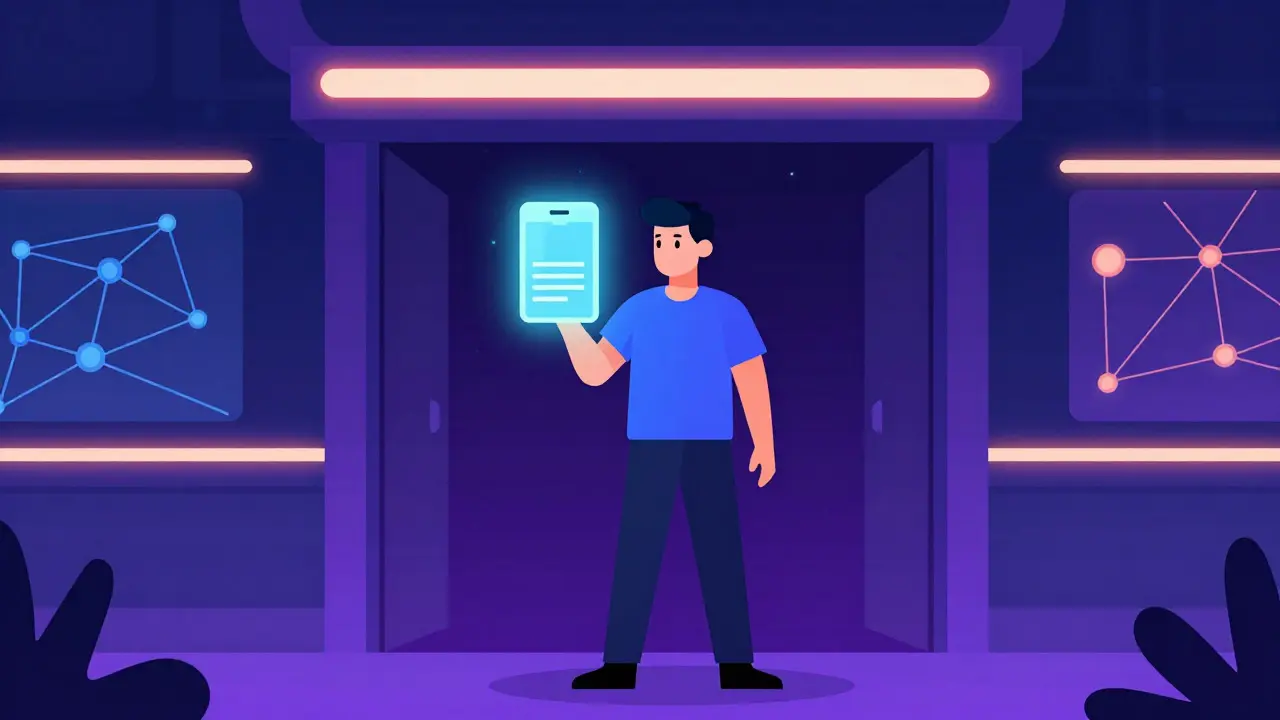
Imagine showing your ID to enter a club, but instead of handing over a physical card, you flash a digital token that proves you are over 21 without revealing your name, address, or birth date. That is the promise of NFT-based digital identity is a system where non-fungible tokens serve as verifiable credentials on public blockchains, allowing users to prove specific attributes without exposing their full personal data. It sounds like the ultimate privacy upgrade. In reality, it is a minefield. Most public blockchains are designed for total transparency. Every transaction is visible to everyone forever. So, how do we put private identity data on a ledger that was built to be open? The tension between blockchain immutability and the right to privacy is the central conflict defining this space in 2026.
The Core Problem: Public Ledgers vs. Private Data
To understand the risk, you have to look at how standard ERC-721 tokens work. They live on public networks like Ethereum. If you mint an NFT that contains your passport number or biometric data in its metadata, that data is technically accessible by anyone with a wallet explorer. While some metadata is stored off-chain, the link between your wallet address and that off-chain data can often be traced. This creates a significant compliance headache. Regulations like the GDPR grant individuals the "right to be forgotten," yet blockchain data is immutable. You cannot delete a record once it is written. This fundamental mismatch means that naive implementations of NFT identity can easily violate data protection laws, turning a tool for empowerment into a liability for both users and platforms.
How Secret NFTs Change the Game
Enter Secret NFTs, which represent a major leap forward in solving these privacy issues. Unlike standard tokens, Secret NFTs utilize private metadata and ownership features powered by confidential computing. On networks like the Secret Network, the data inside the NFT is encrypted until the owner decides to decrypt it. This allows a user to keep their wallet address secret while still displaying their collection publicly. For high-value collectors, this is crucial; it prevents hackers and scammers from targeting them based on what they own. But for identity, it’s even more powerful. It enables true selective disclosure. You can prove you own a specific credential (like a university degree) without revealing who issued it or any other details attached to that token, unless you choose to share them.
User Control and Soulbound Tokens
Another critical aspect of privacy in this ecosystem is control. Traditional Web2 identity systems rely on centralized servers that store all your data in one place. When those servers get breached, millions of identities are exposed at once. NFT-based systems flip this model. Users hold the keys to their own identity. Many modern protocols use Soulbound Tokens (SBTs), which are non-transferable NFTs. Once minted to your wallet, they stay there. They act as permanent, unchangeable records of your achievements or certifications. Because they cannot be sold or traded, they reduce the noise of speculative market activity. However, SBTs bring their own privacy challenge. Since anyone can issue an SBT to any wallet, malicious actors could spam your wallet with unwanted tokens, creating false associations. To mitigate this, new standards are emerging that require explicit user consent before an SBT can be linked to your identity, ensuring that your digital footprint remains curated rather than cluttered.
Zero-Knowledge Proofs: The Technical Backbone
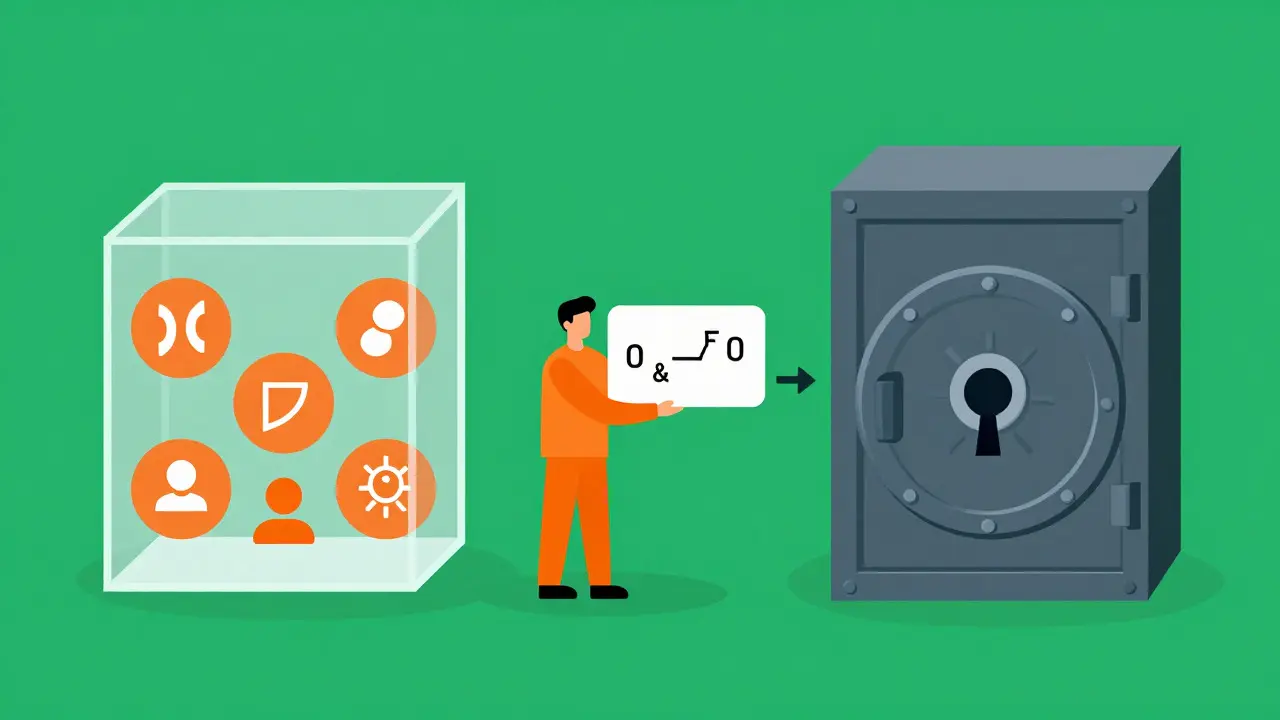
If Secret NFTs handle storage, Zero-Knowledge Proofs (ZKPs) handle verification. ZKPs allow one party to prove to another that a statement is true without revealing anything other than the truth of that statement. In the context of NFT identity, this is game-changing. Instead of sending your entire resume to a job portal, you generate a ZKP that says, "I have a degree in Computer Science from a reputable university." The employer verifies the proof mathematically. They know you are qualified, but they don’t know your name, graduation year, or GPA unless you explicitly include those in the proof. This technology decouples verification from data exposure, allowing for a privacy-by-design approach where the default state is secrecy, not transparency.
Comparing Privacy Mechanisms
Not all privacy solutions are created equal. Here is how the main approaches stack up against each other in terms of security, usability, and regulatory compliance.
| Method | Privacy Level | Data Storage | Key Risk |
|---|---|---|---|
| Standard ERC-721 | Low | Public Metadata | Full data exposure via chain analysis |
| Secret NFTs | High | Encrypted On-Chain | Dependency on specific network infrastructure |
| ZK-Powered Credentials | Very High | Minimal On-Chain Data | Complexity in implementation and key management |
| Soulbound Tokens | Medium | Public Ownership | Unwanted associations via wallet spam |
Regulatory Hurdles and Compliance
Technology moves fast, but regulation lags behind. For NFT identity to go mainstream, it must satisfy legal requirements. Anti-Money Laundering (AML) and Know Your Customer (KYC) rules require businesses to verify who their customers are. NFT systems can help here by providing tamper-proof records of verification. However, the global nature of blockchain conflicts with local data residency laws. Some countries require data to stay within borders, while blockchain is borderless by design. Hybrid models are emerging to solve this, where the cryptographic hash of the identity is stored on-chain, but the actual personal data is kept in a regulated, off-chain database. This allows companies to comply with local laws while still leveraging the security benefits of decentralized verification.
Implementation Challenges for Developers
Building these systems is not plug-and-play. Developers face three main hurdles. First, interoperability. Different blockchains use different standards for NFTs. Creating a universal identity layer that works across Ethereum, Solana, and newer L2s requires robust middleware. Second, scalability. Real-time identity verification needs to be fast. If checking a user's credentials takes ten seconds because of network congestion, the user experience suffers. Third, user education. Most people are comfortable with passwords and two-factor authentication. Asking them to manage seed phrases and understand gas fees for identity verification is a steep learning curve. Successful projects are focusing on abstraction layers that hide the blockchain complexity, presenting users with a simple interface that feels like a traditional app, while the NFT mechanics happen invisibly in the background.
Future Outlook: Privacy by Design
The trajectory for this field is clear. We are moving away from "privacy as an add-on" toward "privacy by design." Future NFT identity systems will likely combine multiple technologies: ZKPs for verification, Secret Networks for storage, and soulbound structures for permanence. As regulatory pressure increases, the demand for compliant, privacy-preserving solutions will only grow. The goal is no longer just to prove you exist, but to prove exactly what you need to prove, and nothing more. This shift represents a fundamental change in how we view digital rights, giving individuals back the power to decide who sees what, when, and why.
Are NFTs safe for storing personal identity data?
Only if using privacy-enhanced standards like Secret NFTs or Zero-Knowledge Proofs. Standard public NFTs expose metadata to chain analysis, making them risky for sensitive personal data without additional encryption layers.
What is the difference between a regular NFT and a Soulbound Token?
A regular NFT can be bought, sold, and transferred between wallets. A Soulbound Token (SBT) is non-transferable; once minted to a wallet, it stays there permanently, making it ideal for representing unique identity attributes like degrees or licenses.
How do Zero-Knowledge Proofs protect privacy in identity verification?
ZKPs allow a user to prove a specific fact (e.g., "I am over 18") without revealing the underlying data (e.g., my exact birth date). The verifier checks the mathematical proof, not the personal information itself.
Do NFT identities comply with GDPR?
Compliance is challenging due to blockchain immutability. Most compliant systems use hybrid models where the actual personal data is stored off-chain and can be deleted, while only a cryptographic hash or proof remains on-chain to maintain verification integrity.
Can anyone issue a Soulbound Token to my wallet?
Technically, yes, which leads to "wallet spam." However, emerging standards and user consent mechanisms are being developed to ensure that only verified issuers or explicitly accepted tokens appear in your identity profile.