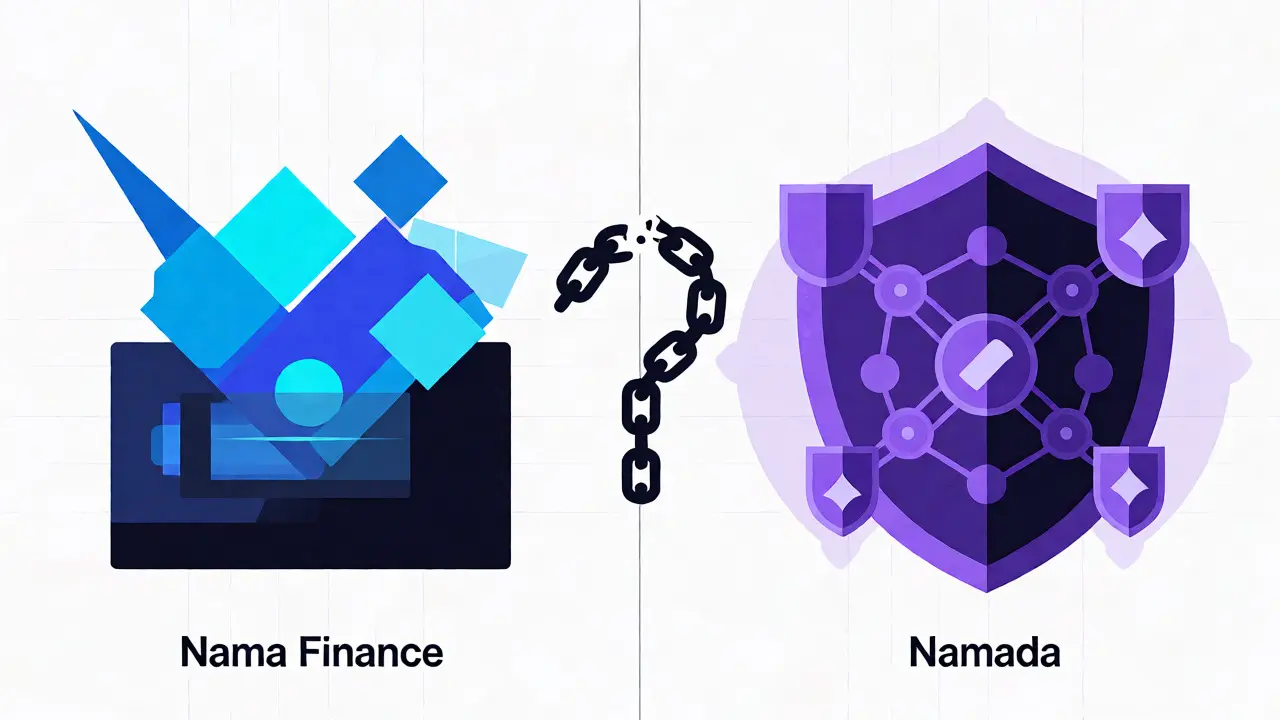
You probably clicked on this because you saw "NAMA" and thought about free money. Or maybe you're trying to figure out if your wallet is eligible for something big. Here’s the hard truth: there are two different projects with confusingly similar names, and mixing them up could cost you time or lead you down a rabbit hole of fake claims.
One is Nama Finance, which runs the NAMA protocol for NFT liquidity. The other is Namada, a privacy-focused blockchain that ran a massive airdrop for its NAM token. If you’re looking for an active "NAMA Protocol airdrop" by Nama Finance right now, you might be chasing a ghost. But if you’re looking for the big retroactive rewards people talked about, you’re likely thinking of Namada. Let’s untangle this mess so you know exactly where your attention should go.
The Name Game: Why This Confusion Exists
Crypto loves acronyms and short names. It creates brandability, but it also creates chaos. When you search for "NAMA," you get results for both Nama Finance and Namada. They are not the same company. They do not share the same team. They do not have the same technology stack.
Nama Finance is a DeFi platform focused on lending against NFTs. Its native token is NAMA. On the other hand, Namada is a Layer-1 blockchain built for privacy and interoperability, developed by the Anoma Foundation. Its native token is NAM.
This distinction matters because the major airdrop news you’ve likely heard-millions of tokens distributed to early users-belongs to Namada (NAM), not Nama Finance (NAMA). While Nama Finance has reward mechanisms, they function differently from the one-time retroactive drops that made headlines in late 2024.
Namada (NAM): The Real Airdrop Story
If you were hoping for a check from the "NAMA" airdrop, you were probably tracking Namada. The Anoma Foundation launched a Retroactive Public Goods Funding (RPGF) program that was huge. They distributed 65 million NAM tokens. That’s 6.5% of their total supply. Why? To reward people who actually helped build the ecosystem before it went live.
Christopher Goes, co-founder of Namada, explained that this wasn’t just marketing fluff. It was about giving ownership back to creators. The deadline to claim these tokens was December 28, 2024. If you missed that window, you missed out on the initial distribution.
| Category | Requirement Details | Status |
|---|---|---|
| Open Source Contributors | Developers contributing to Zcash, Rust, or Interchain tech | Claimed by Dec 2024 |
| Stakers | ATOM/OSMO stakers with >$100 value by Nov 1 | Claimed by Dec 2024 |
| NFT Holders | BadKid NFT holders (1+ NFT by Nov 14) | Value est. $200-$300 per NFT |
| Gitcoin Donors | Donations to ZK Tech and crypto advocacy groups | Claimed by Dec 2024 |
The technical side of Namada is what justified the hype. It uses Multi-Asset Shielded Pools (MASP). Think of it as extending Zcash’s privacy tech to any asset, including NFTs. You can transfer ATOM, OSMO, or TIA privately across chains using IBC. The consensus mechanism, Cubic Proof-of-Stake, makes attacks exponentially more expensive for validators. It’s sophisticated tech, which is why the community rallied behind it so hard.
Nama Finance (NAMA): What Is It Actually Doing?
Now, let’s look at the actual subject of your query: Nama Finance. This project isn’t sitting idle waiting for a viral airdrop moment. It’s building infrastructure for NFT liquidity. The core problem they solve is simple: NFTs are illiquid. You own a Bored Ape, but you can’t easily spend it or use it as collateral without selling it.
Nama Finance allows you to use ERC721 or ERC1155 tokens as collateral to take loans. You can mint on Ethereum but borrow on Solana or Binance Chain. For lenders, it offers stablecoin farming. You stake USDT, USDC, or DAI, and earn NAMA tokens plus interest rates that can hit 35% APY in high-demand pools.
Here’s the catch regarding the "airdrop." Nama Finance doesn’t have a single, massive retroactive drop like Namada did. Instead, they distribute NAMA tokens as ongoing rewards for platform usage. If you lend stablecoins or borrow against NFTs, you earn NAMA. It’s a continuous emission model, not a one-time snapshot.

Tokenomics Reality Check: NAMA vs. NAM
Data tells a different story than marketing tweets. As of late 2025/early 2026 trends, Namada’s NAM token has established circulation and market activity. The airdrop created a broad holder base. Nama Finance’s NAMA token, however, shows limited trading volume on major aggregators like CoinMarketCap. Some data points even list circulating supply as near zero or inactive.
This suggests two things. First, Nama Finance might still be in early development phases or has a very niche user base. Second, the "airdrop" narrative around NAMA might be speculative rather than based on historical precedent. If you see claims of a "huge NAMA airdrop coming," verify the source. Is it official from Nama Finance, or is it a rumor fueled by confusion with Namada?
Be careful with scams. Because the names are similar, bad actors create fake websites claiming to be "Nama Finance Airdrop Claim." Always check the URL. Namada uses `namada.net`. Nama Finance uses domains related to `nama.finance` or similar. Never connect your main wallet to a site unless you are certain of its legitimacy.
How to Verify Your Eligibility Today
If you think you missed the Namada boat, don’t panic. Protocols often have secondary distributions or governance rounds. But for Nama Finance, your strategy is different. You need to engage with the platform to earn rewards.
- Check Wallet History: Did you interact with Namada testnets or contribute to open-source repos in 2023-2024? You might have been eligible for the past NAM drop.
- Monitor Nama Finance Docs: Look for updates on "liquidity mining" campaigns. These are effectively rolling airdrops for new users.
- Watch for Governance Proposals: Both projects use DAO structures. Future token emissions are often decided via votes. Keep an eye on their forums.
For Namada, the game is now about staking NAM to secure the network and earning inflationary rewards. For Nama Finance, the game is providing liquidity or borrowing to generate yield. There is no magic button to press today to get a pile of NAMA tokens if you haven’t used the platform.

Common Pitfalls and Scams
The biggest risk here is phishing. Scammers love name collisions. They buy domains like `nama-finance-airdrop.com` and ask you to sign a transaction that drains your wallet. Remember: legitimate airdrops rarely require you to send ETH or SOL to "verify" your address. They usually ask you to sign a message off-chain or claim via a smart contract interaction that costs gas, not principal.
Another pitfall is assuming all "privacy coins" are the same. Namada is privacy-focused. Nama Finance is liquidity-focused. They serve different masters. Investing in one expecting the performance of the other is a classic portfolio mistake.
What Should You Do Next?
If you are holding NAM, you are part of a growing privacy ecosystem. Monitor the Cosmos IBC integrations. If you are interested in NAMA, look at the NFT market. If NFT liquidity dries up, protocols like Nama Finance become more valuable. But don’t wait for a windfall airdrop that may never come in the form you expect.
Stay skeptical. In crypto, clarity is rare. When you see "NAMA," pause. Ask: "Is this Namada or Nama Finance?" The answer changes everything about your next move.
Is the NAMA Protocol airdrop the same as the Namada NAM airdrop?
No. They are two distinct projects. Namada (NAM) had a major retroactive airdrop in late 2024. Nama Finance (NAMA) distributes tokens primarily through liquidity mining and platform usage rewards, not a single large retroactive drop.
Can I still claim the Namada NAM airdrop?
The primary deadline for the Namada RPGF airdrop was December 28, 2024. If you missed it, you likely cannot claim those specific retroactive allocations, though future governance-based distributions may occur.
What is the main use case for Nama Finance?
Nama Finance provides NFT liquidity solutions. It allows users to borrow against NFTs and lenders to earn yield by staking stablecoins in lending pools, facilitating cross-chain NFT collateralization.
Why is the NAMA token price showing zero on some trackers?
This indicates low trading volume or limited circulating supply on major exchanges. It suggests the token is either in early stages or trades on smaller, less-tracked venues compared to the more liquid NAM token.
Are there scams related to NAMA/NAM airdrops?
Yes. Due to the similar names, scammers create fake claim sites. Always verify URLs against official documentation. Legitimate claims typically involve signing messages or small gas fees, not sending significant funds upfront.