Most decentralized exchanges feel like a gamble for liquidity providers. You put your assets in, hope for the best, and pray that "impermanent loss" doesn't eat your profits before you can withdraw. Then comes Meteora DAMM v2 is a decentralized exchange protocol on the Solana blockchain that uses a Dynamic Automated Market Maker (DAMM) model to reward liquidity providers during high volatility. Also known as a Dynamic Liquidity Market Maker (DLMM), it flips the script by charging higher fees when the market gets chaotic, potentially turning a volatile price swing into a massive payday for those providing the funds. But is it a goldmine or a trap for the unwary?
The Core Concept: How Dynamic Liquidity Actually Works
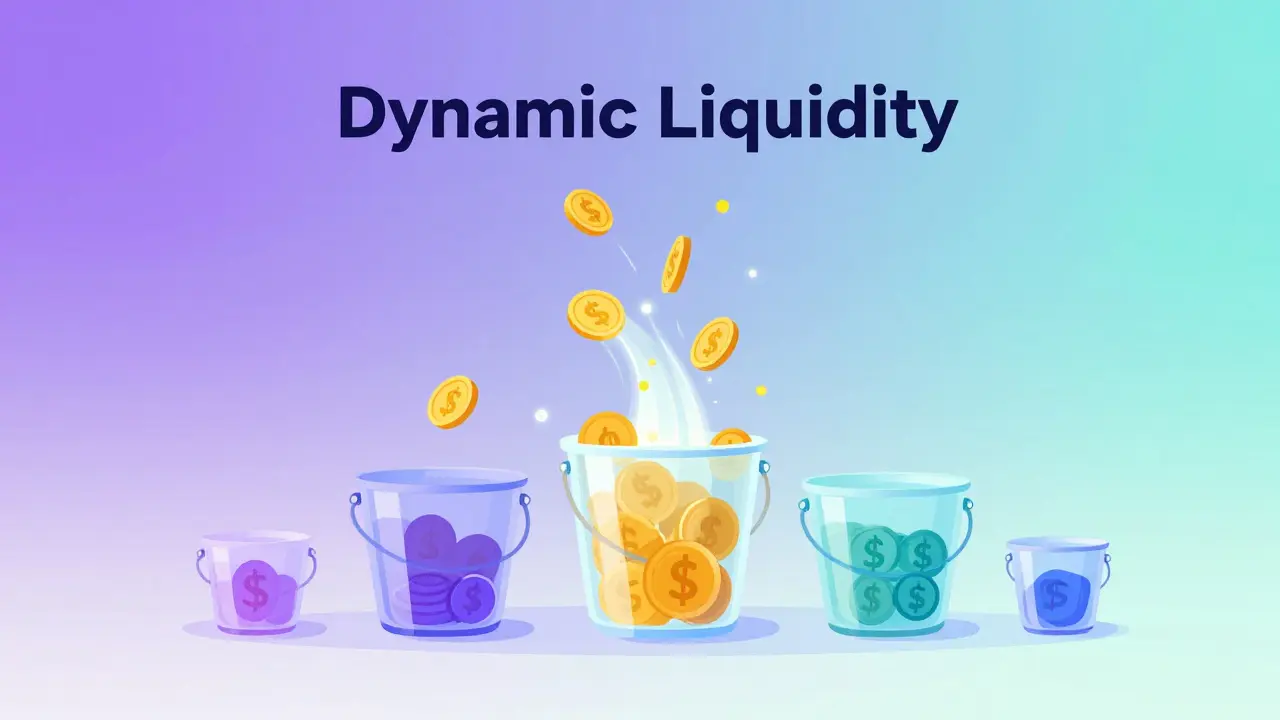
Unlike the old-school AMMs you might be used to, Meteora doesn't just throw all your assets into one giant pot. Instead, it uses a bin-based system. Imagine a series of narrow price buckets. As a liquidity provider (LP), you decide which buckets (bins) to put your assets in. This allows for concentrated liquidity, meaning your assets only work when the price is within your chosen range.
The real magic, however, is the fee structure. In a typical DEX, fees are static-say 0.3%. In Meteora DAMM v2, the fees are adaptive. When the market is calm, fees are low to attract traders. But when a token starts swinging wildly, fees can spike up to 50%. This serves two purposes: it protects LPs from losing too much value during a crash and discourages traders from panic-selling instantly. For the LP, this means that the more volatile the asset, the more you can potentially earn in fees.
| Feature | Traditional AMM (e.g., Uniswap V2) | Meteora DAMM v2 |
|---|---|---|
| Fee Structure | Fixed (e.g., 0.3%) | Dynamic (0% to 50%) |
| Liquidity Model | Full Range (Passive) | Bin-based (Concentrated) |
| Volatility Impact | High risk of impermanent loss | Higher fee rewards during swings |
| Management Style | Set-and-forget | Active bin management |
Performance and Market Position on Solana
Since its rollout, Meteora has carved out a serious niche in the Solana ecosystem. It's not the biggest player-Raydium and Orca still hold more volume-but it's the fourth largest DEX by volume, capturing around 8.3% of the total Solana DEX activity. The most popular pair is SOL/USDC, which handles a huge chunk of the platform's traffic.
From a technical standpoint, the bid-ask spread is about 0.656%. While this is a bit higher than Raydium's 0.48%, the trade-off is the unique reward potential for LPs. We've seen reports of users making 10x to 100x returns on tiny 0.1 SOL positions in specific high-volatility pools. However, these aren't typical results; they are the product of perfect timing and strategic bin placement.

The Learning Curve: Why You Might Lose Money
Here is the cold truth: Meteora DAMM v2 is not for beginners. If you're looking for a way to earn a passive 5% while you sleep, this isn't it. About 78% of users in community polls admit the learning curve is steep. You need to understand how to manage your bins. If you place your liquidity in the wrong price bins and the market moves away from you, you're not earning any fees, and you're staring down the barrel of impermanent loss.
One Reddit user, 'LP_Newbie99', reported losing 62% of a 2 SOL position because they didn't understand the bin mechanics during a sideways market. This highlights the danger: the system rewards experts who can forecast volatility but punishes those who just click "deposit" without a plan. You'll likely need 15 to 20 hours of study and practice before you're comfortable managing your positions effectively.
How to Get Started Without Getting Burned
If you're determined to try it, don't go all-in on day one. The process of setting up takes about 30 to 45 minutes for a first-timer. You'll need a Solana-compatible wallet like Phantom or Backpack.
- Start Small: Deposit 0.05 to 0.1 SOL. Treat this as your "tuition fee" to learn the interface.
- Stick to Major Pairs: Begin with SOL/USDC. It's more stable and provides a better environment to test your bin strategies.
- Monitor Volatility: Don't treat this as a passive investment. Use volatility indicators to decide when to shift your bins.
- Avoid Impulsive Moves: The 50% fee ceiling can be tempting, but don't chase spikes. Wait for a calculated entry point.

The Competitive Landscape and Future Outlook
Meteora doesn't exist in a vacuum. It often works alongside Jupiter Swap, which acts as an aggregator. When you trade on Jupiter, it might route your trade through Meteora to get you the best price. This integration is a huge win for Meteora's liquidity, as it brings in a constant stream of traders.
Looking ahead, the project has a roadmap that includes integration with Firedancer (a high-performance Solana validator client) and a potential expansion to Ethereum Layer 2s by late 2025. There is also the MET governance token (TGE expected Q1 2025), with a portion of the supply earmarked for airdrops to LPs. This creates a strong incentive for users to provide liquidity now to secure a future stake in the protocol.
Final Verdict: High Risk, High Reward
Meteora DAMM v2 is a sophisticated tool for a specific kind of user. If you enjoy the technical side of DeFi and have the time to actively manage your positions, the dynamic fee model is a game-changer. It turns market chaos into a profit engine. But for the average retail investor, the complexity of bin management and the risk of significant loss make it a dangerous place to park a large portfolio.
What is the maximum fee in Meteora DAMM v2?
The dynamic fee structure can reach up to 50% during periods of extreme market volatility. These fees are designed to protect liquidity providers and are automatically reduced as the market stabilizes.
Which wallets are compatible with Meteora?
Meteora requires Solana-compatible wallets. The most commonly used options are Phantom and Backpack.
Is there a minimum deposit for liquidity pools?
Minimum deposits vary by pool, but they typically start at the equivalent of 0.01 SOL.
How does Meteora differ from Uniswap V3?
While both use concentrated liquidity, Uniswap V3 uses fixed fee tiers (e.g., 0.05% or 0.3%). Meteora uses a dynamic model where fees adjust automatically based on real-time volatility.
When is the MET token launch?
The Token Generation Event (TGE) for the MET governance token is scheduled for Q1 2025, with allocations planned for liquidity providers and MERmaid NFT holders.