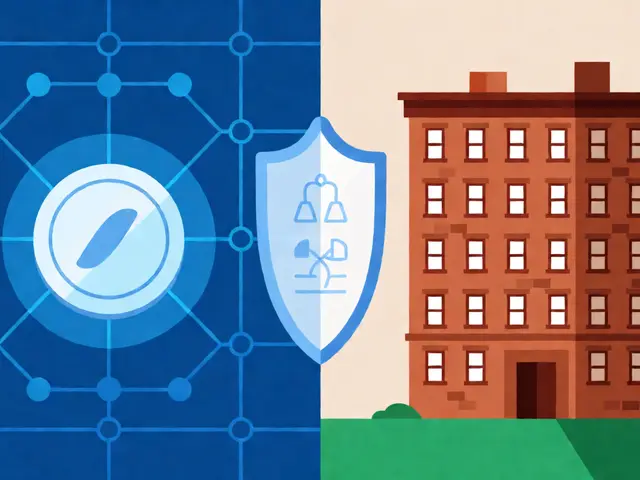
You think your backups are safe because you locked the file. You’re wrong. In 2025, Veeam reported that 89% of organizations had their backup repositories targeted by attackers. If an attacker gets root access to your server, they can delete or alter those "locked" files just as easily as any other document. This is why Metadata Security and Immutability is the cryptographic enforcement mechanism ensuring data records cannot be altered, deleted, or tampered with after creation. It has become the single most critical defense against ransomware, insider threats, and regulatory non-compliance in modern enterprise architecture.
We are no longer talking about simple password protection. We are talking about structural guarantees where data, once written, becomes physically impossible to modify-even for the system administrator. As we move through 2026, this concept has shifted from a nice-to-have feature to a mandatory compliance requirement for industries handling sensitive data.
What Is Metadata Immutability?
To understand why this matters, you first need to separate data from metadata. Data is the content-a PDF invoice, a patient record, a video file. Metadata is the information *about* that data: who created it, when it was last accessed, its IP address origin, and its hash signature.
Immutability is a state where data cannot be modified, altered, or deleted after initial creation. When applied to metadata, it creates an unbreakable chain of custody. If a hacker alters a financial transaction log, they must also alter the timestamp and the user ID associated with it. With immutable metadata, that alteration fails. The system rejects the change because the cryptographic signature no longer matches the original entry.
This operates on the principle of WORM (Write Once, Read Many) storage is a data storage method that allows writing data once but prohibits subsequent modification or deletion. Unlike standard databases that allow updates (mutable), immutable systems are strictly append-only. You add new records; you never edit old ones. This distinction is vital. A mutable database lets you fix a typo. An immutable database forces you to create a new corrected record while keeping the original error visible for audit trails. For forensic investigations, that visibility is gold.
The Difference Between True and Fake Immutability
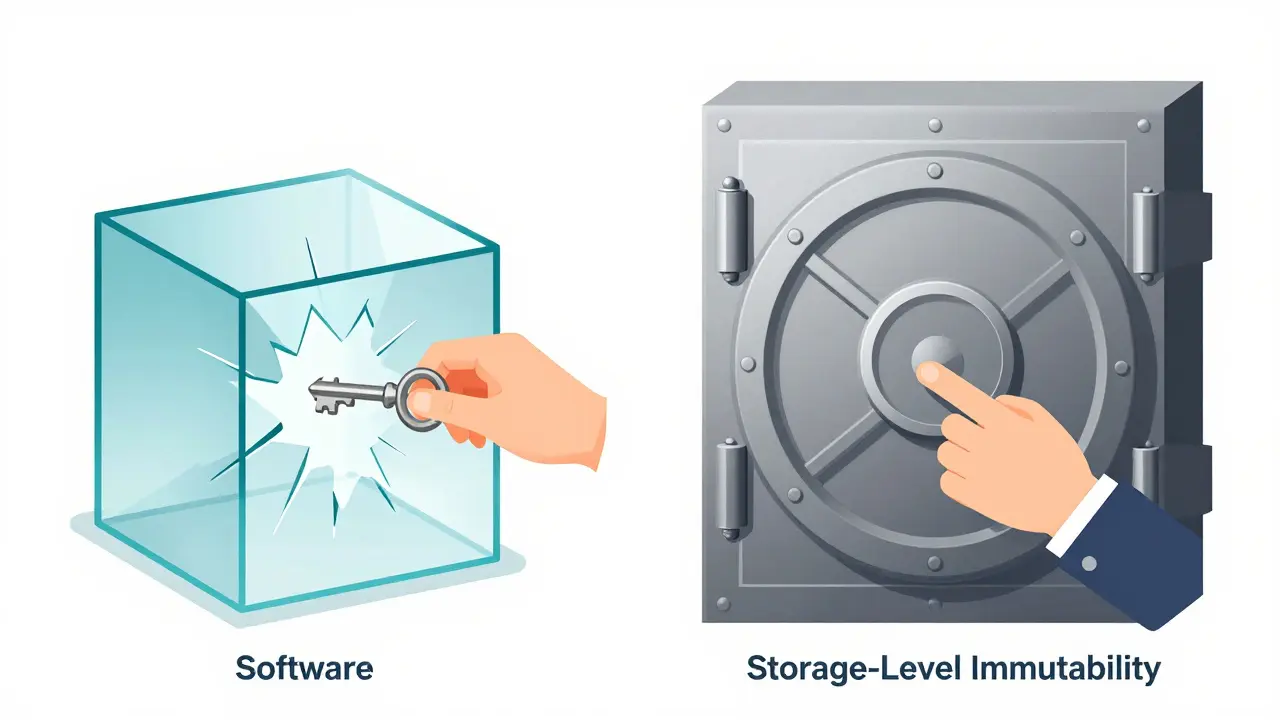
Here is where most companies get burned. Not all "immutable backups" are actually immutable. In June 2024, n2ws.com warned that relying on software-enforced immutability leaves you vulnerable. If the immutability is controlled by the SaaS platform itself, a compromised admin token or a privileged user exploit can bypass those controls. One hack away, and your safety net vanishes.
True immutability happens at the storage level. Think of AWS S3 Object Lock in Compliance Mode or Azure Immutable Blobs. These solutions prevent modification even by the root account. There is no backdoor. No override switch. If you try to delete a file protected by these mechanisms before its retention period expires, the request simply fails. This is the difference between locking your door with a key you keep under the mat versus welding the door shut.
| Feature | Software-Enforced Immutability | Storage-Level Immutability (e.g., AWS S3 Object Lock) |
|---|---|---|
| Root Access Bypass | Possible if admin credentials are compromised | Impossible; enforced by infrastructure layer |
| Single Point of Failure | Yes (the management console) | No (distributed across storage nodes) |
| Ransomware Resilience | Moderate; vulnerable to insider threats | High; protects against external and internal attacks |
| Regulatory Acceptance | Often insufficient for strict audits | Meets HIPAA, SEC, and GDPR standards |
How Blockchain Enhances Metadata Security
While cloud providers offer robust storage-level locks, blockchain technology introduces a decentralized layer of verification that eliminates trust in any single entity. Traditional centralized systems rely on the provider’s honesty and security. Blockchain relies on mathematics.
Consider Myota’s Shard & Spread™ Technology is a data fragmentation and encryption protocol that distributes encrypted data shards across geographically dispersed storage locations. Instead of storing a whole file in one place, the system breaks it into pieces, encrypts them, and scatters them globally. But here is the kicker: the metadata-the map telling you how to reconstruct the file-is stored on a decentralized ledger. To tamper with the data, an attacker would need to compromise multiple independent nodes simultaneously and rewrite the blockchain history. That is computationally impractical.
This approach addresses the "single point of failure" problem inherent in centralized cloud storage. If AWS goes down or suffers a breach, your data fragments remain secure elsewhere. The metadata remains verifiable because its integrity is secured by cryptographic hashes linked to previous blocks. As noted in Myota’s 2023 whitepaper, this ensures "tamper-proof data integrity and enables seamless recovery while eliminating vulnerabilities common in conventional immutability systems."
Why Metadata Matters More Than Data
You might wonder: why focus on metadata? Why not just protect the file itself? Because metadata tells the story of what happened. In a security incident, auditors and law enforcement don’t just want the stolen data; they want to know *who* accessed it, *when*, and *from where*.
Microsoft 365 implements metadata immutability through unalterable timestamps. According to their March 2024 documentation, these timestamps "can't be modified or removed from the metadata." If an employee deletes a confidential contract, the system retains the immutable record of that action. You can recover the file, but more importantly, you have undeniable proof of the deletion event. This is crucial for forensic analysis. Without immutable metadata, an attacker could wipe their tracks, deleting logs of their intrusion. With it, every keystroke and login attempt is permanently recorded in a way that cannot be erased.
immudb.io emphasizes that "storing server metadata immutably has become a must" because "auditors, regulators, and law enforcement will ask for this information, and the number one question is: can you trust these logs?" If your logs are mutable, the answer is no. If they are immutable, the answer is yes.

Implementation Challenges and Best Practices
Adopting immutable metadata isn’t just flipping a switch. It requires careful planning around retention periods and storage costs. Veeam’s 2025 guidance highlights a delicate balance: set the immortality period too short, and you lose rollback capability during a long-dormant attack. Set it too long, and storage costs skyrocket.
For example, HIPAA-covered entities typically require a minimum of 6 years of retention. Financial institutions facing SEC Rule 17a-4(f) may need 7+ years. You must configure your immutability windows to match these legal requirements precisely.
Here are practical steps to implement effective metadata security:
- Audit Your Current Stack: Identify where your metadata lives. Is it in a mutable SQL database? Move it to an append-only structure like an immutable object store or a blockchain-integrated solution.
- Enable Storage-Level Locks: Use features like AWS S3 Object Lock Compliance Mode or Azure Immutable Blobs. Do not rely solely on application-layer permissions.
- Decouple Metadata from Primary Data: Store metadata separately from the primary data payload. This prevents a breach in one area from compromising the integrity proofs of the other.
- Verify Third-Party Claims: As of 2025, 82% of enterprises require third-party validation of immutability claims. Ask vendors for independent audits proving their "immutable" status holds up against root-level exploits.
- Test Recovery Regularly: Immutability is useless if you can’t restore the data. Run quarterly drills to ensure your immutable backups can be decrypted and reconstructed within your RTO (Recovery Time Objective).
The Future of Data Trust
The market for immutable storage solutions is exploding, projected to grow from $4.2 billion in 2024 to $12.7 billion by 2028. This growth is driven by two factors: escalating cyber threats and stricter regulations. GDPR Article 32 and HIPAA Security Rule §164.312(c)(1) increasingly mandate verifiable immutable records. Enterprise adoption jumped from 28% in 2022 to 67% in 2025.
By 2027, Forrester predicts that 95% of enterprise data storage solutions will incorporate some form of metadata immutability. The days of trusting digital records based on hope are over. We are moving toward a world where data integrity is mathematically guaranteed, not just policy-assured. Whether you use traditional WORM tape drives or blockchain-sharded cloud storage, the goal remains the same: make tampering impossible, not just difficult.
Is immutable storage the same as a backup?
No. A backup is a copy of your data. Immutable storage is a method of protecting that copy so it cannot be altered or deleted. You can have backups that are not immutable (and thus vulnerable to ransomware), and you can have immutable storage without regular backups (which doesn't help if the primary data is lost). The best practice is to combine both: frequent backups stored in immutable containers.
Can I delete immutable data if I make a mistake?
Not before the retention period expires. This is the core trade-off. If you accidentally upload sensitive personal data to an immutable bucket with a 7-year lock, you cannot delete it until year seven. This makes governance and pre-upload validation critical. Some systems allow "legal holds" that can be extended, but rarely shortened.
Does blockchain guarantee immutability?
Blockchain provides strong cryptographic guarantees against tampering due to its decentralized consensus mechanism. However, it does not protect against errors in the data input (garbage in, garbage out) or issues with the private keys used to sign transactions. Additionally, the cost and scalability of public blockchains can be prohibitive for large-scale enterprise metadata storage, leading many to use hybrid or permissioned blockchain solutions.
What is the difference between mutable and immutable databases?
Mutable databases (like typical OLTP systems) allow records to be updated or deleted, changing the current state. Immutable databases (often used in OLAP or audit logging) are append-only. New data is added, but existing records are preserved forever. This creates a complete historical trail, which is essential for compliance and forensic analysis.
How much does immutable storage cost compared to standard storage?
Immutable storage often incurs higher costs due to the inability to overwrite data efficiently and the need for redundant, distributed architectures. However, the cost of a successful ransomware attack or regulatory fine far exceeds the premium for immutable storage. Cloud providers like AWS and Azure charge slightly more for Object Lock-enabled buckets, but the price gap is narrowing as demand increases.