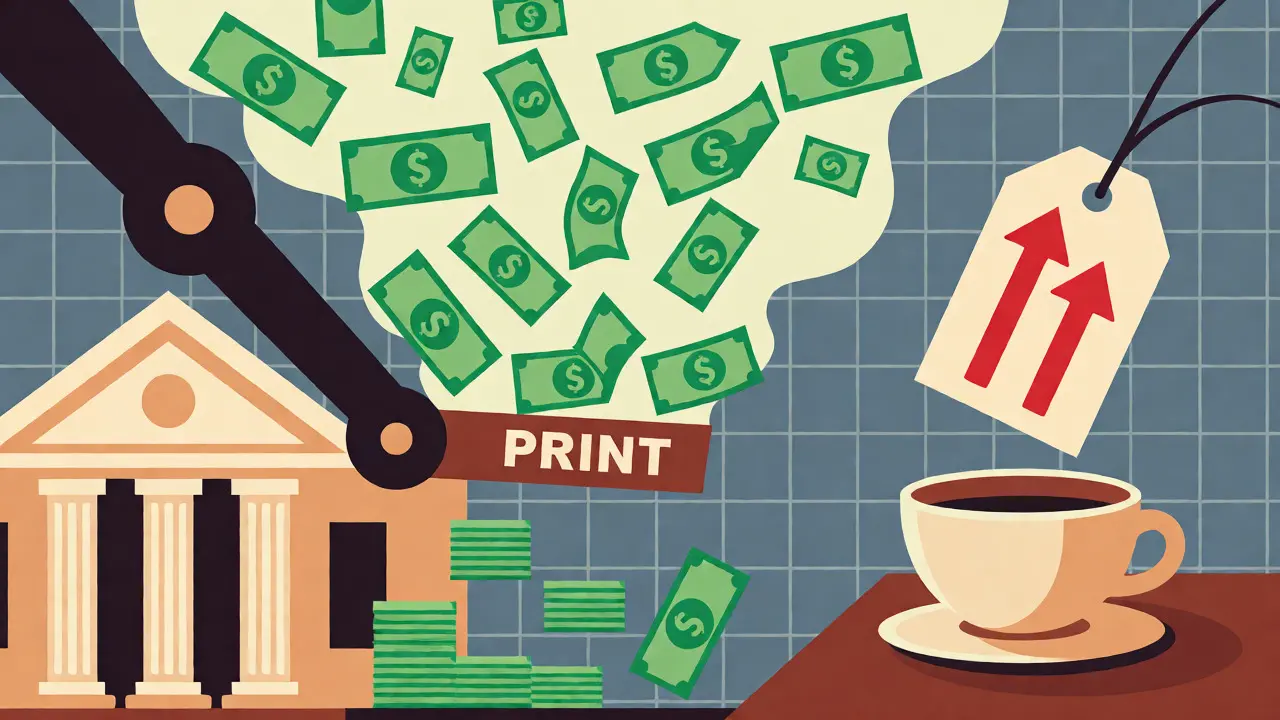
Imagine waking up tomorrow and finding out that the government just decided to double the number of dollars in your bank account. Sounds great, right? But then you go to buy coffee, and the price has also doubled. That’s the core problem with fiat currency: it is money issued by governments that isn’t backed by a physical commodity like gold or silver. Its value relies entirely on trust and legal tender laws. Since President Richard Nixon ended the convertibility of the US dollar to gold in 1971, we’ve lived in a world where central banks can print as much money as they want. This flexibility sounds nice for managing crises, but it comes with a hidden tax called inflation.
On the other side of the spectrum sits cryptocurrency. Unlike fiat, most major cryptocurrencies like Bitcoin use code to dictate exactly how much new money enters circulation. There are no politicians, no central bankers, and no sudden surprises about how many coins will exist next year. The rules are hard-coded into the software. If you’re trying to figure out whether your wealth is safer in a traditional bank account or a crypto wallet, you need to understand the fundamental difference between discretionary policy and algorithmic scarcity.
The Mechanics of Fiat Money Printing
Fiat money is defined by its lack of intrinsic value. You can’t eat a dollar bill, and you can’t build a house with it. It works because the government says it does, and because you have to pay taxes in it. Historically, this system allowed governments to fund wars and social programs without raising taxes immediately. They simply created more money. The problem arises when the supply of money grows faster than the goods and services available to buy. When there’s too much cash chasing too few products, prices rise.
Look at the numbers. According to the International Monetary Fund, global consumer price inflation hovered around 3-5% annually for decades, but spiked to 8.8% in 2022 due to post-pandemic shocks. In the United States, the M2 money supply-a broad measure of cash and bank deposits-hit a record $22.8 trillion in April 2026. That’s an increase of roughly 7,856% since 1959. During the pandemic years alone (2017-2021), the US money supply jumped by 49%. This massive expansion diluted the purchasing power of every dollar held by savers. Central banks like the Federal Reserve target a low positive inflation rate, usually around 2%, believing that slight inflation encourages spending and investment. But critics argue this is just a polite way of saying "we will slowly steal your savings."
Hyperinflation is the extreme case. Think of Zimbabwe in the late 2000s or Venezuela recently. When governments lose fiscal discipline and monetize debt by printing trillions, their currencies collapse. While advanced economies rarely see such extremes, the steady erosion of value through 2-5% annual inflation is a guaranteed loss for anyone holding cash long-term. Your $100 today won’t buy $100 worth of groceries in ten years. That’s not a bug; it’s a feature of the fiat design.
Bitcoin’s Algorithmic Scarcity
Now, let’s look at Bitcoin, launched in 2009 by the pseudonymous Satoshi Nakamoto. Its creator embedded a strict rule into the protocol: there will never be more than 21 million bitcoins. This cap isn’t a suggestion or a policy goal that can be changed by a vote. It’s enforced by thousands of independent computers (nodes) worldwide. If someone tries to create a block with 51 BTC when only 3.125 is allowed, the network rejects it instantly.
Bitcoin controls its supply through a mechanism called "halving." Every 210,000 blocks (roughly four years), the reward miners receive for securing the network is cut in half. We started at 50 BTC per block in 2009. After the first halving, it dropped to 25. Then 12.5, then 6.25. As of April 2024, the fourth halving reduced the reward to 3.125 BTC. This schedule means Bitcoin’s inflation rate-the growth of its total supply-is predictable and declining. Currently, it sits at about 0.83% per year. By comparison, US CPI inflation averaged 4.46% from 2021 to 2025. Bitcoin’s monetary base is expanding five times slower than the cost of living in the US.
By March 2026, over 95% of all bitcoins that will ever exist had already been mined. Only about 1 million BTC remain to be issued, and the final fractions won’t be mined until around 2140. This certainty offers something fiat cannot: visibility. You know exactly how much new supply will hit the market next month, next year, or in a decade. No surprise money prints. No emergency stimulus checks funded by invisible dilution.

Ethereum’s Dynamic Burn Model
While Bitcoin aims for fixed scarcity, Ethereum takes a different approach. It doesn’t have a hard cap on total supply. Instead, it uses a dynamic model introduced by EIP-1559 in 2021. Part of every transaction fee paid on the Ethereum network is "burned"-sent to an address that effectively removes those coins from circulation forever.
This creates a unique economic pressure. When network activity is high, the amount of ETH burned can exceed the amount of new ETH issued to validators. During these periods, Ethereum becomes net deflationary. Its total supply actually shrinks. This contrasts sharply with fiat, which almost always expands, and even differs from Bitcoin, which always expands (just slowly). Analysts call this "ultrasound money," suggesting it could become scarcer than Bitcoin during peak usage times. However, this model depends on demand. If network usage drops, the burn slows down, and issuance might outpace destruction, leading to mild inflation again. It’s a flexible, adaptive monetary policy encoded in code, rather than the rigid, static rule of Bitcoin.
Volatility: The Price of Predictability
You might ask: if Bitcoin’s supply is so perfect, why is its price so volatile? This is the critical trade-off. Because Bitcoin’s supply is inelastic-it doesn’t change based on demand-any shift in demand hits the price directly. If more people want to buy Bitcoin, the price skyrockets because the supply can’t quickly expand to meet them. If fear strikes, the price crashes. Fiat currencies, conversely, have elastic supplies. Central banks can pump liquidity into markets to dampen volatility. This makes fiat better for daily transactions but worse for preserving long-term value against debasement.
Academic studies show mixed results on whether crypto actually hedges inflation. Some research indicates Bitcoin prices rise after inflation shocks, supporting the "digital gold" narrative. Other studies find weak correlations, noting that Bitcoin often trades like a tech stock, rising when risk appetite is high and falling when investors flee to safety. A 2024 paper in *Accounting & Finance* concluded that while gold remains a robust hedge, cryptocurrencies’ hedging properties are inconsistent. So, while the supply mechanics protect against dilution, the market price remains subject to speculative swings.

Comparing the Monetary Systems
To make this concrete, let’s break down the key differences in a table. This highlights how each system handles the creation of new money.
| Feature | Fiat Currency (e.g., USD) | Bitcoin | Ethereum |
|---|---|---|---|
| Supply Cap | No limit (discretionary) | Hard cap: 21 million | No hard cap (dynamic) |
| Issuance Control | Central Bank (Fed, ECB) | Protocol Code (Halving) | Protocol Code (Burn + Staking Rewards) |
| Inflation Rate | Variable (Avg 2-5%) | Predictable & Declining (~0.83%) | Variable (Can be negative/deflationary) |
| Transparency | Lagged data reports | Real-time public ledger | Real-time public ledger |
| Primary Risk | Currency devaluation | Price volatility | Price volatility & Protocol changes |
Which System Protects Your Wealth?
If your goal is to preserve purchasing power over decades, the math favors assets with capped or shrinking supplies. Fiat guarantees a slow bleed. Even at a modest 2% inflation target, your money loses half its value in about 35 years. At higher rates, it happens faster. Bitcoin offers a mathematical guarantee against dilution. You can calculate exactly what percentage of the total supply exists today versus ten years ago. This predictability appeals to those who distrust political institutions.
However, don’t ignore the risks. Crypto is still young. Regulations are evolving. Technology bugs happen. And yes, the volatility can be stomach-churning. A 50% drop in a week is common in crypto markets, whereas fiat rarely moves more than a fraction of a percent day-to-day. For many, the best strategy isn’t choosing one over the other, but understanding the role each plays. Use fiat for short-term liquidity and paying bills. Consider Bitcoin or Ethereum for long-term savings where you want protection from the inevitable expansion of the global money supply.
The debate isn’t really about which money is "better" in a vacuum. It’s about what you value more: stability of nominal value (fiat) or certainty of supply quantity (crypto). As we move deeper into 2026, with global debt levels soaring and central banks struggling to balance growth with inflation, the appeal of algorithmic money continues to grow. Whether you view it as a bubble or a revolution, the fact remains: code doesn’t lie, and it doesn’t print extra zeros when it needs to pay its bills.
Does Bitcoin have zero inflation?
No, Bitcoin currently has a monetary base inflation rate of approximately 0.83% per year. New bitcoins are created as rewards for miners. However, this rate decreases predictably every four years due to halvings and will eventually reach zero when the last bitcoin is mined around the year 2140.
Why do central banks allow inflation?
Most central banks target a low positive inflation rate (usually 2%) because it encourages spending and investment rather than hoarding cash. It also allows wages to adjust downward in real terms without cutting nominal pay, providing economic flexibility during downturns.
Is Ethereum deflationary?
Ethereum can be net deflationary during periods of high network activity. Thanks to the EIP-1559 burn mechanism, transaction fees are destroyed. If the amount of ETH burned exceeds the new ETH issued to validators, the total supply decreases. However, during low activity, it may revert to being slightly inflationary.
Can governments change Bitcoin's supply cap?
Technically, yes, but it requires overwhelming consensus among miners, developers, and users to change the protocol rules. Practically, it is extremely difficult because any attempt to increase the supply would dilute the value for existing holders, who would likely reject the change. The 21 million cap is enforced by the decentralized network, not a single authority.
Does crypto actually hedge against inflation?
The evidence is mixed. While Bitcoin’s limited supply protects against currency dilution, its price is highly volatile and often correlates with risk assets like stocks. It may act as a hedge in specific scenarios or timeframes, but it is not yet considered a reliable, stable store of value like gold across all economic cycles.