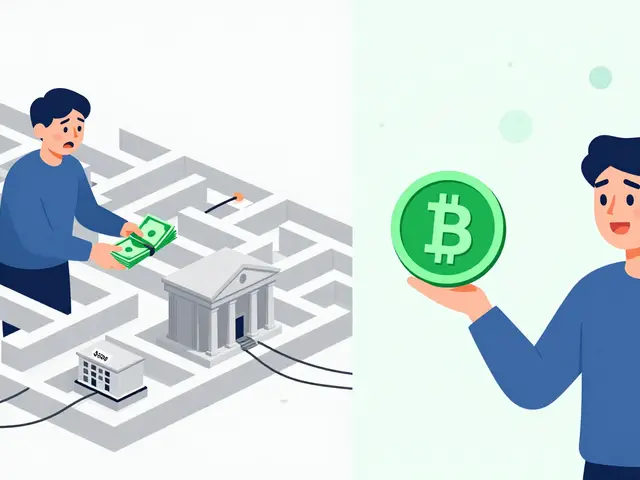
Imagine trying to send money abroad for a simple medical bill or to pay for imported goods, only to find every traditional banking door slammed shut. For millions of Iranians, this isn't a hypothetical nightmare; it is daily life. The FATF blacklist, formally known as the 'Call for Action,' has effectively severed Iran's connection to the global financial system. While the intent was to curb illicit finance, the result has been a massive, forced migration into cryptocurrency. As we move through 2026, being an Iranian crypto user means navigating a high-stakes maze of frozen accounts, surveillance risks, and technical workarounds. This article breaks down exactly how these restrictions impact your wallet, your privacy, and your ability to transact globally.
The Core Problem: Financial Isolation and Forced Adoption
To understand why crypto usage has skyrocketed in Iran, you have to look at the mechanics of the Financial Action Task Force (FATF). Since October 2019, Iran has sat on the blacklist alongside North Korea due to strategic deficiencies in anti-money laundering (AML) frameworks. This designation triggers mandatory enhanced due diligence for any global bank touching Iranian money. In practical terms, correspondent banking relationships dropped from 28 in 2018 to just 3 by 2025. With SWIFT access virtually non-existent for individuals, crypto became the only viable bridge to the outside world.
The numbers tell a stark story. According to Chainalysis data from early 2025, sanctioned jurisdictions received $15.8 billion in crypto transactions in 2024, with Iran driving the majority of that growth. By late 2025, estimates suggest over 18.7 million adults in Iran-roughly 42% of the adult population-are now active crypto users. This isn't speculative investing; it's survival. When 78% of crypto activity serves as a sanctions evasion mechanism, you aren't trading for profit; you're trading for access.
- Total Crypto Inflow to Sanctioned Jurisdictions (2024): $15.8 billion
- Iran's Share: Approximately $9.2 billion (58%)
- User Base Growth: From niche adoption to 42% of adults by 2025
- Primary Driver: Closure of conventional monetary exchange windows with the EU and US
Operational Realities: How Iranians Actually Use Crypto
If you are holding a wallet in Tehran, your behavior looks different from a trader in London. You don't park large sums in centralized exchanges. The risk is too high. Instead, the ecosystem has adapted to minimize exposure. Data shows that 92% of Iranian crypto transactions originate from mobile wallets like Trust Wallet or Exodus. These non-custodial solutions keep keys local, away from servers that might be subpoenaed or blocked.
Transaction sizes have also shrunk dramatically. To avoid detection thresholds and regulatory scrutiny, average transaction values dropped by 40% between 2023 and 2025, hovering under $1,500. This fragmentation allows users to move capital in small, less noticeable increments. Bitcoin remains the king here, accounting for 78% of all transactions in sanctioned jurisdictions because its censorship-resistant nature is unmatched. Ethereum follows at 14%, while privacy coins like Monero make up about 5% for those seeking extra layers of obscurity.
| Method | Success Rate | Average Premium/Cost | Risk Level |
|---|---|---|---|
| Peer-to-Peer (P2P) via LocalBitcoins | 78% | 22% premium | Medium (KYC required) |
| Decentralized Exchanges (DEXs) | 63% | 15% slippage | Low (No KYC) |
| Global CEXs (Binance/Bybit) | Variable | Standard fees | High (Freeze risk) |
| HalalChain P2P Networks | High (if vetted) | 15-20% premium | Medium (Counterparty risk) |
The Compliance Paradox: KYC vs. Surveillance
Here lies the trap for many users. Global exchanges like Binance and Bybit require strict Know Your Customer (KYC) verification to comply with FATF travel rules. But for an Iranian user, submitting ID documents to a foreign entity creates a double-edged sword. On one hand, it unlocks access to global liquidity. On the other, it increases surveillance risks from domestic authorities who monitor digital footprints closely.
The consequences are real. A survey of 14,200 domestic users conducted by Nobitex in September 2025 revealed a 33% account freeze rate among Iranians using global exchanges. One user on Reddit’s r/CryptoIran reported losing $8,200 after three small transactions triggered automated FATF compliance blocks. Meanwhile, domestic exchanges like Wallex operate under restrictive 'halal blockchain' frameworks that prohibit cross-border transfers entirely. You are left choosing between being blocked by the West or restricted by the East.
This paradox forces many toward decentralized alternatives. Decentralized exchanges (DEXs) like PancakeSwap show a 63% success rate but come with higher slippage due to liquidity constraints. However, they offer the critical advantage of no central authority to freeze your funds. Community-driven tools, such as the GitHub repository 'IranCryptoKit,' help users configure nodes to bypass national firewalls, though security experts warn that 37% of users face compromises from unvetted software.
Infrastructure Challenges and Technical Workarounds
Using crypto in Iran isn't just about financial regulations; it's a battle against infrastructure. Internet access requires mandatory SIM card registration, meaning your IP address is always tied to your identity. Consequently, 89% of users rely on Iranian-made anti-surveillance apps like Soroush+ to mask their activities, though KPMG notes these tools have a 41% blocking rate during peak hours.
Network throttling is another major hurdle. Telegram channels dedicated to crypto alerts report that 74% of users experience transaction failures between 8 PM and 10 PM Tehran time, when the Central Bank actively throttles bandwidth to slow down capital flight. This unpredictability demands patience and technical savvy. New users often spend 72 hours just mastering non-custodial wallet setup, with 61% needing help managing seed phrases securely.
Despite these hurdles, innovation persists. In August 2025, the Central Bank piloted a 'Halal Stablecoin' (HSC) pegged to gold. While it attracted 4.2 million users and processed $280 million in its first month, experts note it remains isolated from global liquidity pools. It solves domestic stability issues but does little to help you pay a supplier in Turkey or Europe.
Future Outlook: Will the Blacklist Lift?
There is talk of change. Iran ratified some conventions related to terrorist financing in 2024 and 2025, leading some experts to hope for gray-list removal. However, FATF President Raja Kumar maintained in June 2025 that countermeasures must continue until full compliance is met. Dr. Emad Kiyaei, a sanctions expert, argues that the blacklist has become counterproductive, accelerating crypto adoption without reducing proliferation risks.
Looking ahead to 2026 and beyond, the trend is clear. FATF predicts sustained crypto adoption exceeding 25 million users in Iran by 2027. Unless diplomatic relations shift drastically, cryptocurrency will remain the de facto international payment infrastructure for Iranians. For users, this means continuing to prioritize self-custody, diversifying across multiple platforms, and staying vigilant about changing regulations. The window for easy, compliant global finance remains closed, making crypto not just an option, but a necessity.
Why are Iranian crypto accounts frequently frozen on global exchanges?
Global exchanges like Binance and Bybit must comply with FATF travel rules and sanctions. Because Iran is on the 'Call for Action' blacklist, automated systems flag transactions originating from Iranian IPs or linked to Iranian IDs. This leads to mandatory account freezes for enhanced due diligence, affecting roughly 33% of Iranian users on these platforms according to 2025 surveys.
Is it safe to use peer-to-peer (P2P) networks in Iran?
P2P networks offer a way to bypass direct exchange restrictions, but they carry significant counterparty risk. While methods like 'HalalChain' allow fast transfers without KYC, they often charge a 15-20% premium. Users must vet counterparts carefully, as there is no central recourse if a trade goes wrong. Additionally, meeting in person or sharing contact details can expose users to local surveillance.
What is the best wallet for Iranian users to avoid confiscation?
Non-custodial mobile wallets like Trust Wallet and Exodus are the most popular, used by 92% of Iranian crypto transactions. These wallets store private keys locally on your device, meaning no central server holds your assets. This makes them resistant to remote freezing by exchanges or governments, provided you secure your seed phrase offline.
Will Iran ever be removed from the FATF blacklist?
As of mid-2026, removal is unlikely in the short term. Although Iran has taken steps to ratify certain anti-terrorism financing conventions, FATF requires full implementation of its action plan. Experts predict that without major diplomatic shifts, the blacklist status-and the resulting reliance on crypto-will persist through 2027.
How does internet throttling affect crypto trading in Iran?
The Central Bank of Iran actively throttles internet bandwidth during peak hours (8-10 PM Tehran time) to hinder capital flight. This causes transaction failures for 74% of users during these windows. Traders often use anti-surveillance apps and schedule trades during off-peak hours to mitigate this issue, though network instability remains a constant challenge.