You’ve probably heard the phrase "not your keys, not your coins." It’s the golden rule of cryptocurrency. But what actually keeps those keys safe when you’re using a mobile app or a desktop program? The answer lies in end-to-end encryption. It is the invisible shield that ensures only you can access your digital assets, even if hackers breach the company behind your wallet software.
In 2026, with cyber threats becoming more sophisticated, understanding how this technology works isn't just for developers. It’s essential for anyone holding Bitcoin, Ethereum, or other tokens. If you don’t know how your data is protected, you might be taking risks without realizing it. Let’s break down exactly what end-to-end encryption does for your crypto wallet and why it matters more than you think.
What Is End-to-End Encryption in Crypto?
End-to-end encryption (E2EE) is a communication method where data is encrypted on the sender's device and only decrypted on the recipient's device. In the context of messaging apps like Signal or WhatsApp, this means the service provider cannot read your messages. For crypto wallets, the concept is slightly different but equally critical. Here, the "sender" and "recipient" are often the same person-you, accessing your funds from one device to another, or simply unlocking them on your phone.
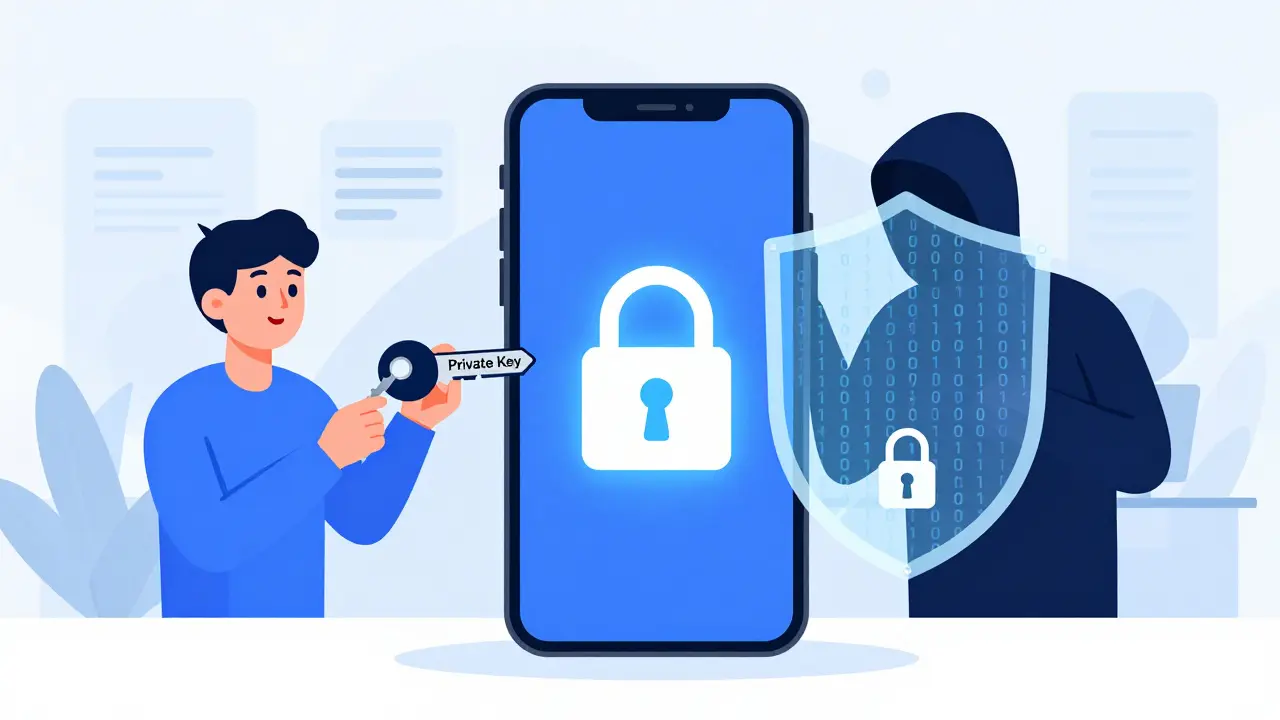
The core principle is simple: your sensitive data-specifically your private key and seed phrase-never leaves your device in a readable format. Even if the wallet developer stores a backup on their servers (which reputable non-custodial wallets rarely do for keys), they only store an unreadable blob of encrypted data. Without your password, that data is useless gibberish.
This differs fundamentally from traditional banking. When you log into a bank account, the bank decrypts your data on their server to show you your balance. They hold the keys. In a true E2EE crypto wallet, the decryption happens locally on your hardware. The server never sees your private key. This distinction is the bedrock of decentralized finance security.
How E2EE Protects Your Private Keys
To understand the protection, we need to look at the technical workflow. It’s not magic; it’s mathematics. Here is the four-stage process that occurs every time you create or unlock a secure crypto wallet:
- Local Key Generation: When you set up a new wallet, your device generates a random number sequence. This becomes your private key. Crucially, this generation happens offline within your device’s secure environment. No internet connection is required, and no external server is involved in creating these credentials.
- Password-Based Encryption: You choose a password. The wallet uses a Key Derivation Function (KDF), such as PBKDF2 or Argon2, to turn your human-readable password into a complex cryptographic key. This derived key is then used to encrypt your private key. This step ensures that even if someone steals your encrypted file, they still need your specific password to unlock it.
- Secure Storage: The now-encrypted private key is stored. In many modern wallets, this stays entirely local on your device’s secure enclave or keystore. Some wallets offer cloud backups for convenience, but remember: only the encrypted version goes to the cloud. The plaintext key never touches the internet.
- Local Decryption: When you want to send funds, you enter your password. The wallet derives the decryption key locally, unlocks the private key in memory, signs the transaction, and then discards the key from memory. The signed transaction is broadcast to the blockchain, but the key itself remains hidden.
This flow eliminates the "man-in-the-middle" risk. Even if a hacker intercepts the data packet traveling between your phone and the blockchain node, they see only ciphertext. Without the private key, which never left your device, they cannot alter or steal the funds.
Custodial vs. Non-Custodial: The Security Gap
Not all wallets use E2EE in the same way. The biggest divide is between custodial and non-custodial solutions. Understanding this difference is vital for your financial safety.
| Feature | Custodial Wallet (e.g., Exchange) | Non-Custodial Wallet (E2EE) |
|---|---|---|
| Key Ownership | Service Provider | User (You) |
| Encryption Type | Server-side encryption (provider holds keys) | End-to-end encryption (user holds keys) |
| Hack Risk | High (single point of failure) | Low (distributed risk) |
| Recovery Process | Password reset via email/KYC | Seed phrase only (no support team) |
| Privacy | Low (provider sees transactions) | High (transactions are pseudonymous) |
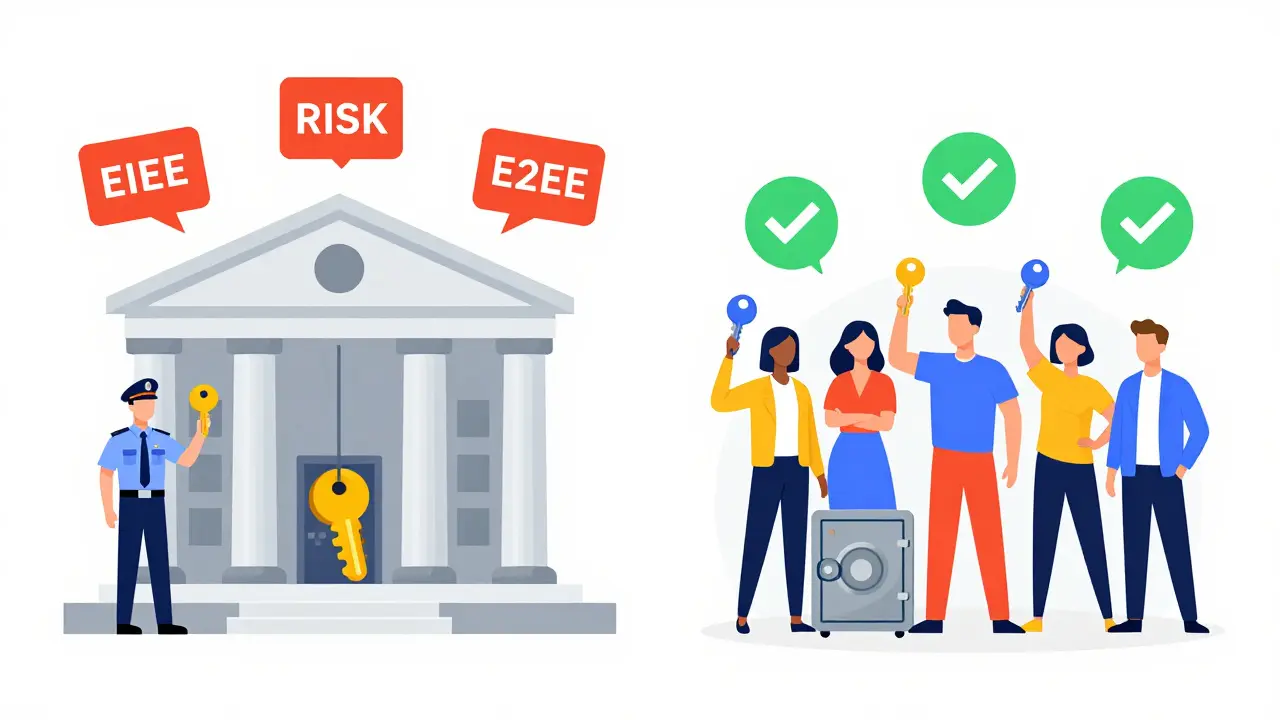
Custodial wallets, like those offered by major exchanges, act like a digital bank. They encrypt your data, yes, but they also hold the master keys. If their database is breached, millions of accounts can be compromised simultaneously. We saw this with Mt. Gox years ago, and smaller hacks happen regularly today.
Non-custodial wallets, such as MetaMask, Trust Wallet, or Ledger Live, rely on E2EE. Because the private key never leaves your possession in an unencrypted state, there is no central database for hackers to target. Each user’s security is isolated. One hacked device doesn’t endanger the entire network. However, this shifts the burden of responsibility to you. There is no "forgot password" button because the support team literally cannot help you recover your funds without your seed phrase.
The Role of Asymmetric Cryptography
Under the hood, E2EE relies on asymmetric cryptography, also known as public-key cryptography. This system uses two mathematically linked keys:
- Public Key: Think of this as your email address or bank account number. You can share it openly with anyone who wants to send you money. It identifies your wallet on the blockchain.
- Private Key: This is your secret PIN. It must never be shared. It proves ownership and allows you to sign transactions.
In an E2EE setup, the private key is kept strictly confidential on your device. When you initiate a transaction, your wallet uses the private key to create a digital signature. This signature verifies that you authorized the transfer without revealing the private key itself. The network validates the signature against your public key. This process ensures integrity and authentication, confirming that the message hasn’t been tampered with and truly came from you.
Advanced implementations also use hash functions to ensure data integrity. If even a single bit of data changes during transmission, the hash value will mismatch, and the transaction will be rejected. This prevents malicious actors from altering transaction amounts or addresses mid-flight.
Real-World Examples of E2EE Wallets
Most reputable wallet providers have adopted E2EE standards due to regulatory pressure and user demand. Here are some prominent examples operating in 2026:
- MetaMask: A popular browser extension and mobile app. It generates keys locally and encrypts them with your password. The encrypted vault is stored locally on your device. If you back up to the cloud, only the encrypted vault is uploaded.
- Ledger & Trezor: These are hardware wallets. They take E2EE to the physical level. The private key is generated inside a secure chip and never exposed to the connected computer or phone. Transactions are signed internally, making them immune to malware on the host device.
- Exodus: A desktop and mobile wallet that manages multiple cryptocurrencies. It uses local encryption for its database, ensuring that your private keys are protected by your PIN and OS-level security features.
Even messaging apps like Signal and ProtonMail use similar E2EE principles to protect communications. The technology is proven, scalable, and widely trusted across different industries. Its adoption in crypto signifies a maturation of the space, moving away from wild-west insecurity to robust, bank-grade protection.
User Responsibility: The Human Firewall
Technology is only as strong as its weakest link. In E2EE systems, that link is often the user. Since the wallet provider cannot reset your password, you become the sole guardian of your access. Here are the critical pitfalls to avoid:
- Saving Passwords in Plain Text: Never write your wallet password in a note app or on a piece of paper stored with your device. Use a reputable password manager that supports E2EE, or memorize it.
- Ignoring Seed Phrase Security: Your 12 or 24-word recovery phrase is the master key to your life savings. Write it down on metal or paper, store it in a fireproof safe, and never digitize it. Screenshots, emails, and cloud notes are vulnerable to phishing and hacking.
- Falling for Phishing Scams: Hackers know you hold the keys. They will try to trick you into entering your seed phrase on fake websites claiming to be "wallet support" or "airdrop claims." Legitimate services will never ask for your private key or seed phrase.
- Using Weak Passwords: A short, common password can be cracked by brute-force attacks. Use a long, complex passphrase. Consider using a password generator to create a unique string for each wallet.
Educational initiatives in the crypto community emphasize "offline storage" for recovery phrases. This means keeping your backup completely disconnected from the internet. It sounds paranoid, but given the irreversible nature of blockchain transactions, paranoia is a feature, not a bug.
Future Trends: Beyond Basic Encryption
As we move through 2026, E2EE is evolving to solve usability issues without compromising security. Two emerging technologies are gaining traction:
Multiparty Computation (MPC): Instead of generating one private key, MPC splits the key into several shards distributed across different devices or parties. To sign a transaction, these shards come together temporarily to compute the signature without ever reconstructing the full key. This reduces the risk of a single point of failure while maintaining high security.
Social Recovery: This mechanism allows users to appoint "guardians" (trusted friends or family) who can help restore access if the primary seed phrase is lost. It uses threshold cryptography, requiring a certain number of guardians to approve a recovery request. This bridges the gap between the security of non-custodial wallets and the convenience of custodial ones.
Zero-knowledge proofs (ZKPs) are also being integrated to enhance privacy. ZKPs allow you to prove you have sufficient funds or authority to transact without revealing the actual amount or details of your wallet. This adds a layer of anonymity on top of the encryption, protecting your financial privacy from blockchain analysts.
Regulatory frameworks in the EU, US, and Asia-Pacific are increasingly mandating strong encryption standards for financial applications. This drives widespread adoption of E2EE across the ecosystem. Developers are focusing on making these complex cryptographic processes seamless for the average user, hiding the technical complexity behind intuitive interfaces.
Is end-to-end encryption foolproof for crypto wallets?
No encryption is 100% foolproof. While E2EE protects your data from hackers and service providers, it cannot protect you from social engineering, phishing scams, or losing your own password and seed phrase. The security model relies heavily on user behavior. If you give away your seed phrase, the encryption offers no protection.
Can I recover my wallet if I forget my E2EE password?
If you lose your password but have your seed phrase, you can usually reinstall the wallet and import the seed phrase, setting a new password. However, if you lose both the password and the seed phrase, your funds are permanently inaccessible. No support team can help you because they do not have the decryption keys.
Do hardware wallets use end-to-end encryption?
Yes, hardware wallets like Ledger and Trezor use advanced forms of E2EE. The private key is generated and stored in a secure element chip that never exposes the key to the outside world. Transactions are signed internally, ensuring that even if your computer is infected with malware, your keys remain safe.
Is it safer to use a custodial exchange or a non-custodial E2EE wallet?
For long-term storage and maximum security, non-custodial E2EE wallets are safer because you control the keys and there is no central honeypot for hackers. Custodial exchanges are convenient for trading but carry higher risk due to potential server breaches and regulatory freezes. Most experts recommend keeping large holdings in non-custodial wallets.
What should I do with my seed phrase after setting up an E2EE wallet?
Write your seed phrase on paper or etch it onto a metal plate. Store it in a secure, offline location like a safe deposit box or a home safe. Never save it digitally, take photos of it, or type it into any website. Treat it like the combination to a bank vault containing your life savings.