For years, if you traded Bitcoin or Ethereum in Indonesia, you were technically participating in a commodity market. You dealt with the Commodity Futures Trading Regulatory Agency, also known as BAPPEBTI. But that era ended abruptly on January 10, 2025. On that date, oversight of cryptocurrency shifted entirely to the Financial Services Authority, or OJK. This wasn't just a bureaucratic shuffle; it was a fundamental redefinition of what crypto is in the eyes of Indonesian law.
The shift means crypto is no longer treated merely as a tradable commodity like gold or rice futures. Instead, it is now classified as a "digital financial asset." This change brings stricter capital requirements, tighter anti-money laundering (AML) rules, and a complete overhaul of how taxes are applied. For traders, exchanges, and investors, understanding this new landscape is not optional-it's essential for staying legal and profitable in 2026.
The End of the Commodity Era
To understand where we are, we need to look at where we came from. Under the old system, BAPPEBTI supervised crypto trading. They maintained a whitelist of approved assets, which grew to over 850 tokens by early 2025. The focus was largely on ensuring that these digital tokens could be traded without disrupting the broader commodity markets.
However, the regulatory gap between crypto and traditional finance was widening. BAPPEBTI lacked the tools to enforce strict consumer protection standards typical of banking and securities regulation. This changed with the enactment of Law No. 4 of 2023, officially known as the Development and Strengthening of the Financial Sector Law (PPSK). Passed in January 2023, this law laid the groundwork for moving crypto into the financial sector.
The transition became effective on January 10, 2025, via Government Regulation 49 (GR-49). This regulation formally transferred authority from BAPPEBTI to OJK. Why does this matter? Because OJK regulates banks, insurance companies, and capital markets. By bringing crypto under its umbrella, the government signaled that digital assets are now part of the formal financial system, subject to much higher scrutiny.
OJK’s New Rules: Capital and Compliance
The move to OJK didn’t just change the label; it changed the rules of the game. The cornerstone of the new regime is OJK Regulation No. 27 of 2024, issued in December 2024. This regulation sets out rigorous operational requirements for any business wanting to trade digital financial assets in Indonesia.
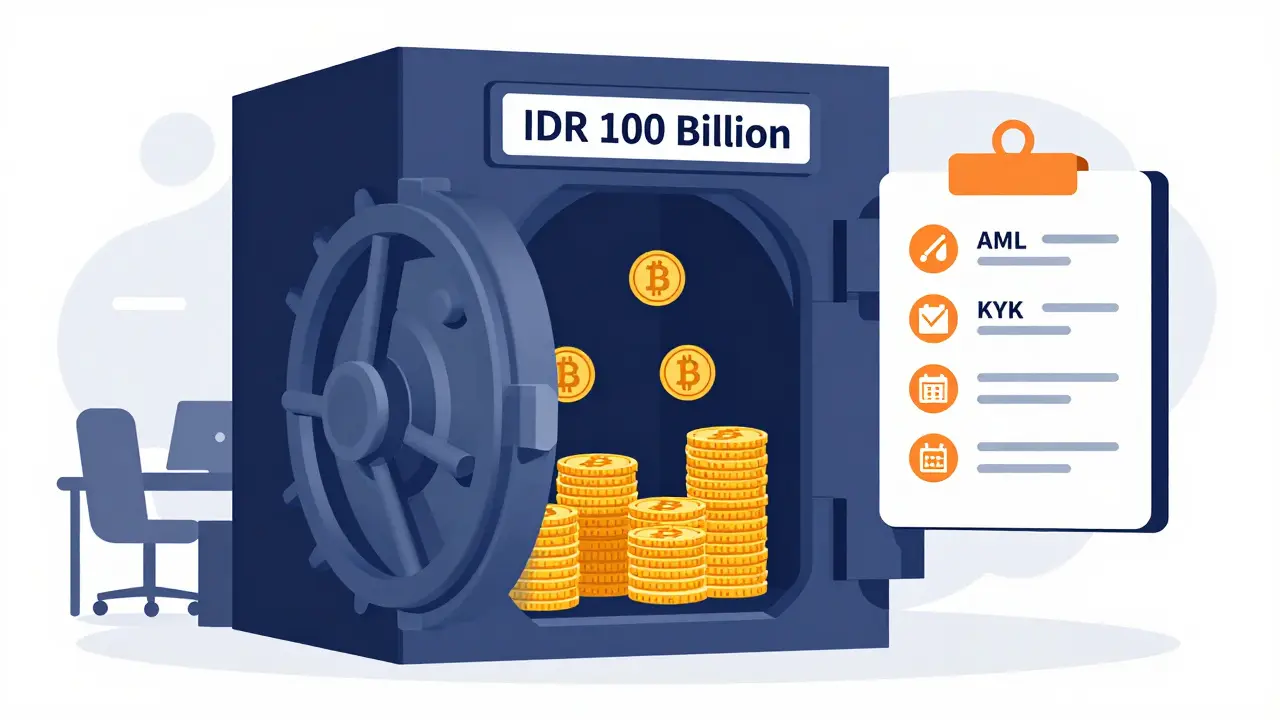
The most significant hurdle is capital. To operate as a Crypto Asset Trader, a company must maintain a minimum paid-up capital of IDR 100 billion (approximately USD 6 million). Furthermore, they must sustain a minimum equity of IDR 50 billion. OJK reserves the right to demand even more capital if a firm’s activities pose systemic risks. Crucially, this capital cannot come from illicit sources; strict checks are in place to ensure funds aren’t linked to money laundering or terrorism financing.
| Feature | Old Regime (BAPPEBTI) | New Regime (OJK) |
|---|---|---|
| Classification | Commodity | Digital Financial Asset |
| Minimum Capital | Lower thresholds | IDR 100 Billion Paid-Up |
| Asset Whitelist | Over 850 assets | Strictly reviewed and reduced |
| Tax Treatment | VAT + Final Income Tax | No VAT + Standard Income Tax |
| Payment Use | Illegal | Still Illegal |
Beyond capital, compliance is non-negotiable. Operators must obtain specific licenses from OJK and submit both periodic and incidental reports. While the regulation doesn't detail every KYC step, it mandates robust consumer data protection and comprehensive AML measures. All suspicious transactions must be reported to PPATK (the Financial Transaction Reports and Analysis Center).
Tax Overhaul: PMK 50 Changes Everything
If the regulatory shift was a earthquake, the tax changes were the aftershocks that reshaped the landscape. For years, crypto trading in Indonesia was taxed under Minister of Finance Regulation No. 68/2022 (PMK 68). This treated crypto as an intangible commodity, meaning traders paid Value Added Tax (VAT) on the delivery of assets, plus a final income tax on sales.
This changed dramatically on August 1, 2025, with the implementation of Minister of Finance Regulation No. 50 of 2025 (PMK 50). This new rule revoked PMK 68 and aligned tax treatment with the financial sector classification.
Here is the critical difference: under PMK 50, the transfer of crypto assets is no longer subject to VAT. This simplifies administration significantly. Instead, profits from crypto trading are treated as ordinary income, subject to standard corporate or individual income tax rates. This aligns crypto taxation with stocks and bonds, rather than physical goods. Additionally, PMK 53 and PMK 54 were enacted to support this framework, removing outdated articles and providing clarity on withholding taxes.
This shift aims to provide greater legal certainty. Previously, the dual nature of crypto (commodity vs. financial asset) created confusion for accountants and tax authorities. Now, the path is clearer: treat crypto like a financial investment for tax purposes.
The Payment Ban Remains
Despite the massive regulatory upgrade, one thing has not changed: you still cannot use crypto to buy coffee or pay bills in Indonesia. Cryptocurrency remains illegal as a payment method. This prohibition stems from Bank Indonesia’s stance on monetary policy and financial stability. Only the Rupiah is legal tender.
This creates a unique duality. Crypto is a regulated financial asset for investment and speculation, but it is not recognized as money for commerce. This distinction is crucial for businesses. If you try to accept Bitcoin for goods, you are violating central bank regulations, regardless of whether your exchange is licensed by OJK.
Industry stakeholders continue to push for exceptions, particularly for stablecoins pegged to the Rupiah or US Dollar. However, as of mid-2026, OJK and Bank Indonesia have not lifted this ban. The focus remains on preventing capital flight and maintaining control over the national currency.

Impact on Exchanges and Traders
The new regulations have forced a consolidation in the Indonesian crypto market. The high capital requirement of IDR 100 billion has acted as a barrier to entry. Many smaller, local exchanges found it impossible to meet these standards by the July 2025 compliance deadline. Some shut down, while others merged or formed strategic partnerships with larger international firms.
For traders, the result is a cleaner, safer market. The "wild west" era of unverified tokens is largely over. Exchanges had to revalidate their whitelists by April 2025. Any asset not reapproved by February 2025 was delisted. This means fewer obscure altcoins are available, but the ones that remain are vetted for higher quality and security.
Consumer protection has improved. With OJK overseeing operations, there are clearer channels for dispute resolution. If an exchange fails or acts fraudulently, investors have recourse within the formal financial regulatory framework. Real-time transaction monitoring by OJK, combined with PPATK’s AML capabilities, makes it harder for bad actors to operate openly.
What’s Next for Indonesian Crypto?
As we move through 2026, the focus shifts from implementation to optimization. The initial shock of the regulatory transition has settled, but questions remain. How will OJK handle foreign investors? Will the ban on payments ever lift? These are the topics dominating industry discussions.
OJK is working to balance innovation with stability. They are keen to attract global fintech talent and investment to Jakarta, positioning Indonesia as a regional hub for digital assets. However, they are cautious about systemic risk. The agency continues to refine its guidelines, issuing circulars to clarify licensing procedures and reporting obligations.
For users, the advice is simple: stick to licensed platforms. Verify that your exchange holds an OJK license. Understand that your gains are taxable income, not exempt commodity trades. And remember, while you can invest in crypto, you cannot spend it. Until the law changes, keep your Rupiah for daily expenses and your crypto for long-term growth.
Is cryptocurrency legal in Indonesia in 2026?
Yes, trading cryptocurrency is legal in Indonesia, provided it is done through platforms licensed by the Financial Services Authority (OJK). However, using crypto as a payment method for goods and services remains illegal.
Who regulates crypto in Indonesia now?
Since January 10, 2025, the Financial Services Authority (OJK) has been the primary regulator for cryptocurrency, replacing the Commodity Futures Trading Regulatory Agency (BAPPEBTI).
How is crypto taxed in Indonesia after PMK 50?
Under PMK 50, effective August 1, 2025, crypto transfers are no longer subject to VAT. Instead, profits from crypto trading are treated as ordinary income and subject to standard corporate or individual income tax rates.
What is the minimum capital required to run a crypto exchange in Indonesia?
According to OJK Regulation No. 27 of 2024, Crypto Asset Traders must maintain a minimum paid-up capital of IDR 100 billion and a minimum equity of IDR 50 billion.
Can I use Bitcoin to pay for goods in Indonesia?
No. Bank Indonesia prohibits the use of cryptocurrency as a payment method. Only the Rupiah is legal tender for transactions in Indonesia.