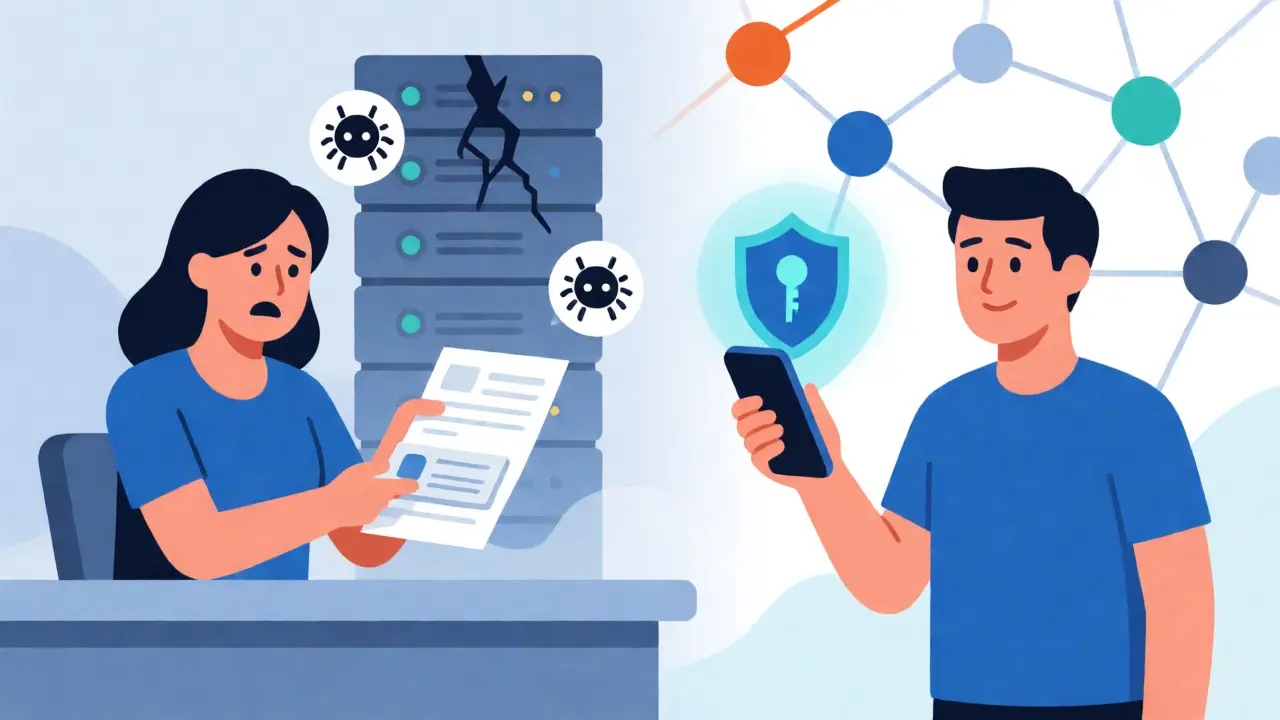
Imagine walking into a bank or signing up for a new healthcare provider. You pull out your wallet, hand over a driver's license, and maybe a utility bill. The clerk photocopies them, scans them, and uploads them to a central server that might get hacked next Tuesday. Now, imagine doing that without handing over the physical documents at all. Instead, you prove who you are using a cryptographic key on your phone. This isn't science fiction; it's Blockchain-Based Identity Verification. It is a method of authenticating individuals using distributed ledger technology, allowing users to control their own data rather than trusting centralized authorities.
The core promise here is simple: stop storing copies of your identity in databases owned by other people. Traditional systems are broken. They create honeypots for hackers and force us to share more information than necessary. When you apply for a loan, do they really need to see your address history, or just proof that you live where you say you do? Blockchain solutions aim to fix this by letting you share only what’s needed, verified instantly, with no middleman holding your secrets hostage.
How Decentralized Identifiers Work
To understand how this works, we need to talk about Decentralized Identifiers (DIDs). These are unique strings that resolve to a DID Document, which contains public keys and other attributes needed to establish an interaction mechanism with the controller of the identifier. Think of a DID as a username that doesn't belong to any single company like Facebook or Google. It belongs to you. When you create a DID, you generate a pair of cryptographic keys: a private key (which stays secret on your device) and a public key (which lives on the blockchain).
When someone wants to verify your identity, they don't look up your name in a central database. They look up your DID on the blockchain. They find your public key and use it to check if a signature you provided matches. If it does, they know the person presenting the credential is the same person who created the key. This process relies on Verifiable Credentials, which are digital attestations issued by trusted entities, such as governments or universities, that can be cryptographically verified.
| Feature | Traditional Centralized System | Blockchain-Based System |
|---|---|---|
| Data Storage | Central servers (vulnerable to breaches) | User-controlled wallets + off-chain storage (IPFS) |
| Control | Held by issuing authority (Govt, Bank) | Held by the individual (Self-Sovereign) |
| Verification Speed | Minutes to days (manual checks) | Seconds (automated cryptographic check) |
| Privacy | Often requires sharing full documents | Selective disclosure via Zero-Knowledge Proofs |
| Single Point of Failure | Yes | No (distributed network) |
The Role of Verifiable Credentials
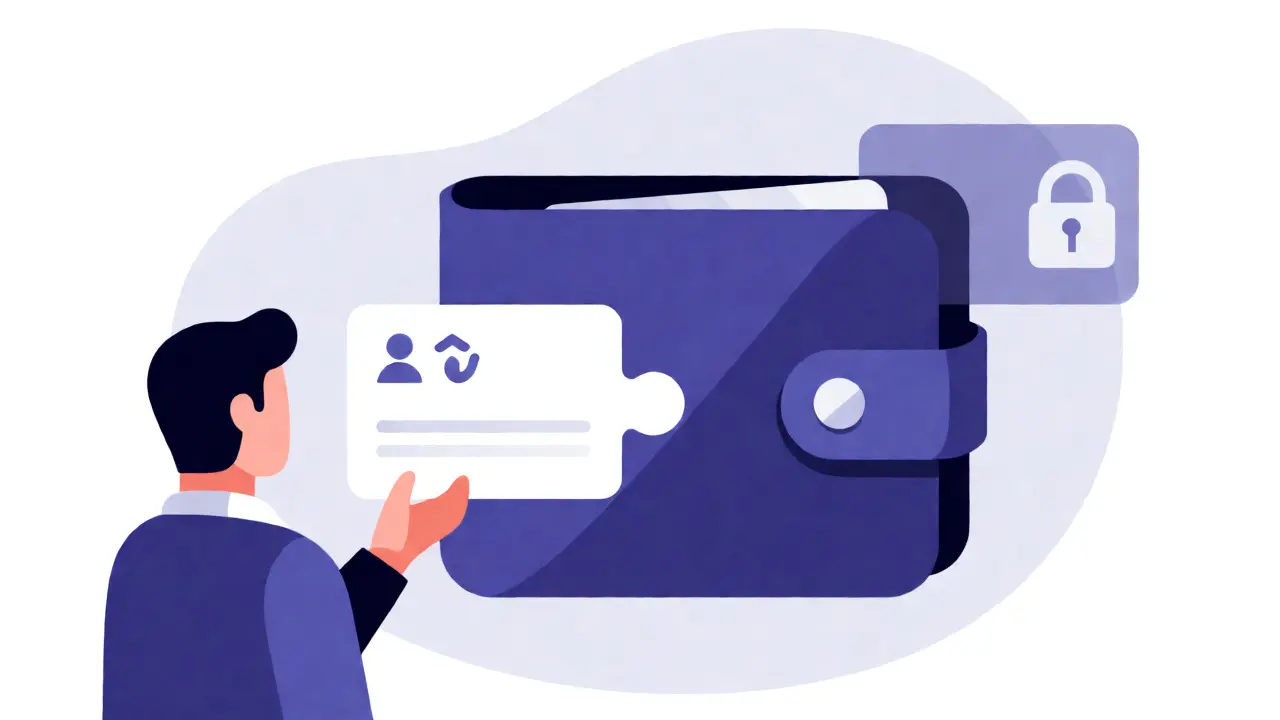
If DIDs are the usernames, Verifiable Credentials are the passwords or badges that prove specific facts about you. For example, a university issues a degree credential to your digital wallet. Later, when you apply for a job, you present this credential to the employer. The employer doesn't call the university. They scan a QR code or read the data structure, check the cryptographic signature against the university's public key on the blockchain, and boom-verified.
This system supports something called "selective disclosure." Let's say you're buying alcohol. The shop needs to know you're over 18. In a traditional system, you show your ID, and the clerk sees your name, address, height, and exact birthdate. With blockchain-based verification, your digital wallet can generate a proof that says "This person is over 18" without revealing your name, address, or even your actual birthdate. This reduces data leakage significantly.
Implementation Steps for Users and Enterprises
Getting started looks different depending on whether you are an individual user or a business integrating these tools. For users, the process is increasingly mobile-first. Most solutions require downloading a digital wallet app. During setup, you usually upload scanned documents (like a passport). These documents aren't stored directly on the blockchain because blockchains are expensive and slow for large files. Instead, the document is hashed (turned into a unique string of characters) and stored on IPFS (InterPlanetary File System), a decentralized storage network. Only the hash and the public key go on the blockchain.
For enterprises, implementation is heavier. Companies like IBM and Consensys offer permissioned networks where participants must be approved. Here is a typical workflow:
- Integration: Connect existing HR or KYC (Know Your Customer) software to the blockchain node.
- Credential Issuance: Set up smart contracts that allow trusted issuers (like government bodies) to sign credentials.
- User Onboarding: Direct customers to download a compatible wallet and link their existing IDs.
- Verification Endpoint: Create an API endpoint that accepts verifiable credentials and returns a "true/false" validation result.
Technical teams often underestimate the learning curve. Understanding cryptographic key management is crucial. If a user loses their private key, they lose access to their identity. There is no "forgot password" button in a truly decentralized system yet, though recovery mechanisms are being developed.
Real-World Adoption and Market Trends
You might wonder if this is actually happening or just hype. It's real, but uneven. Financial services lead the pack, accounting for about 42% of implementations. Banks are eager to cut down the time it takes to onboard new clients. In one case study from Dock.io, patient onboarding time in healthcare dropped from 45 minutes to under 5 minutes using blockchain verification.
Government sectors are also testing the waters. Estonia has been a pioneer, using blockchain for citizen records since the early 2010s. More recently, the European Union's eIDAS 2.0 framework has explicitly included support for decentralized identity, signaling regulatory acceptance. However, adoption isn't universal. Many legacy systems resist change because migrating data is risky and expensive. Gartner predicted that by 2025, half of organizations would start implementing these solutions, but comprehensive rollout remains below 10% for most Fortune 500 companies.
The market size reflects this growth trajectory. Estimates suggest the sector grew from $0.87 billion in 2021 to $1.84 billion in 2023, with projections hitting $17.24 billion by 2030. This growth is driven by the rising cost of data breaches and stricter privacy laws like GDPR in Europe.
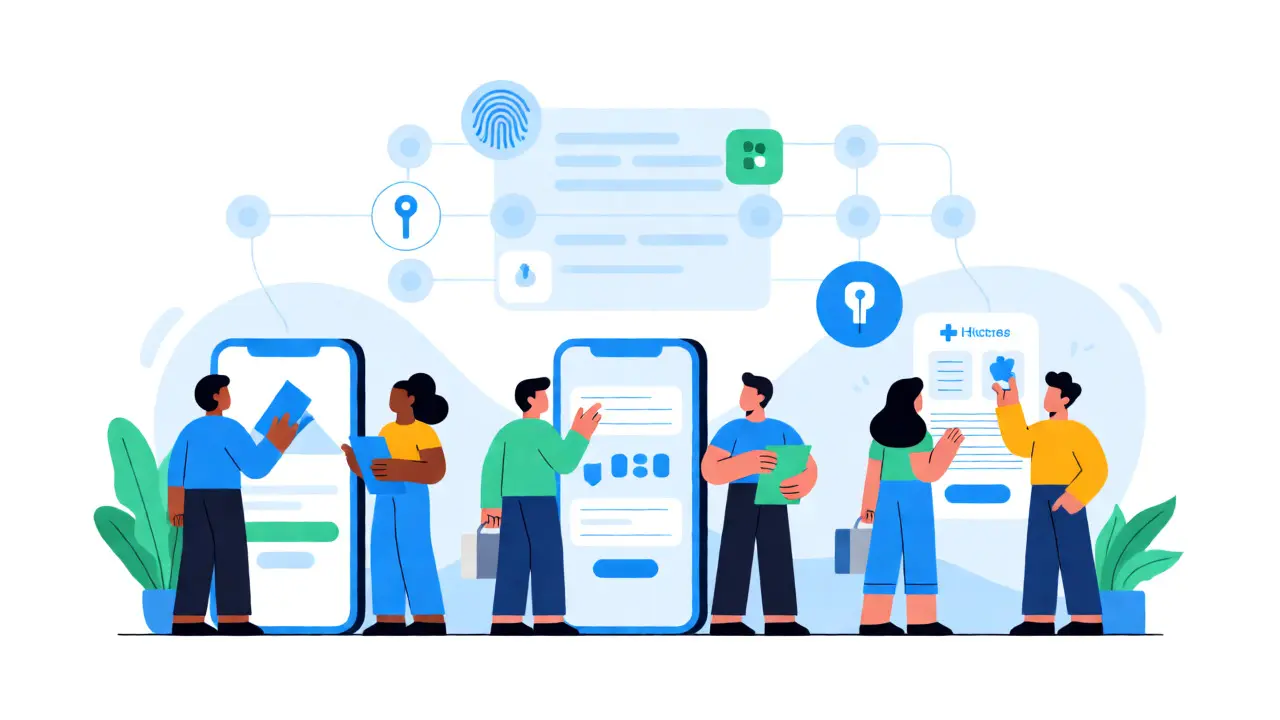
Challenges and Security Risks
It's not all smooth sailing. The biggest hurdle right now is usability. Managing cryptographic keys is scary for average users. If you lose your seed phrase, you could lose access to your digital identity forever. Some platforms are addressing this with social recovery features, where trusted friends or family members can help restore access, but standards vary.
Another issue is interoperability. If Company A uses Ethereum-based DIDs and Company B uses Solana-based ones, can they talk to each other? Not easily. The W3C Verifiable Credentials Data Model 2.0 standard, finalized in January 2023, aims to fix this by creating a common language for these credentials. Until widespread standardization occurs, fragmentation will persist.
Security researchers like Bruce Schneier warn that blockchain isn't a magic bullet. While the ledger itself is secure, the endpoints (your phone, the issuer's server) are vulnerable. If a hacker compromises the device holding your private key, they can impersonate you. Therefore, hardware security modules and biometric locks (fingerprint/FaceID) are becoming essential layers of protection in modern wallets.
The Future of Digital Identity
Looking ahead, we expect convergence with DeFi (Decentralized Finance). By 2025, many providers plan to integrate identity directly into lending and borrowing protocols, allowing users to take out loans without credit checks from banks, relying instead on on-chain reputation scores. AI is also entering the chat, with fraud detection algorithms analyzing transaction patterns to flag suspicious identity claims in real-time.
Ultimately, blockchain-based identity shifts power back to the individual. It turns your identity from a file in someone else's cabinet into a portable, secure asset you carry with you. As regulations catch up and user interfaces simplify, this technology will likely become invisible infrastructure-working quietly in the background every time you log in, buy insurance, or vote online.
Is my personal data stored on the blockchain?
No, typically not. Storing large amounts of personal data directly on the blockchain is expensive and raises privacy concerns regarding the "right to be forgotten." Instead, systems store a cryptographic hash (a unique fingerprint) of the data on the blockchain. The actual data is kept in secure off-chain storage, such as IPFS or encrypted local devices, accessible only by those with the correct keys.
What happens if I lose my private key?
In a purely decentralized system, losing your private key means losing access to your identity proofs associated with that key. However, newer implementations are introducing recovery methods. These include social recovery (where designated contacts can help reset access), multi-signature setups, or custodial hybrid models that offer backup options while maintaining some decentralization benefits.
Can blockchain identity replace my physical passport?
Not entirely, at least not yet. While digital IDs are gaining traction for domestic transactions, banking, and online services, physical passports remain the gold standard for international travel due to border control requirements and lack of global interoperability. However, initiatives like mobile driver's licenses (mDL) are bridging this gap, offering legally recognized digital alternatives in specific jurisdictions.
How does selective disclosure work?
Selective disclosure allows you to prove a claim without revealing the underlying data. Using zero-knowledge proofs, your digital wallet can mathematically demonstrate that you meet a criteria (e.g., "over 18") without showing your date of birth. The verifier receives a yes/no confirmation along with a cryptographic proof that the statement is true, preserving your privacy.
Are blockchain identity systems compliant with GDPR?
Compliance is complex. Because blockchain data is immutable, deleting personal data (the "right to erasure") is difficult. Solutions address this by keeping personal data off-chain and only storing hashes on-chain. Since hashes cannot be reversed to reveal personal data, they are often considered non-personal data under GDPR interpretations, helping maintain compliance while leveraging blockchain benefits.