Running a cryptocurrency exchange in Taiwan is a jurisdiction that balances strict financial oversight with cautious support for digital innovation requires navigating a complex web of rules set by the Financial Supervisory Commission (FSC) is Taiwan's primary regulatory body responsible for overseeing banks, securities, and insurance sectors, including emerging virtual assets. If you are looking to launch or operate an exchange here, you need to understand one fundamental truth: the FSC does not treat crypto as money. It treats it as a "virtual commodity." This distinction changes everything about how you must structure your business, protect your users, and report your activities.
The regulatory landscape has shifted dramatically since the global fallout from the FTX collapse in late 2022. The FSC moved quickly to tighten controls, introducing stringent guidelines for Virtual Asset Service Providers (VASPs) are entities that facilitate the buying, selling, exchanging, or holding of cryptocurrencies on behalf of others. As we move through 2026, these guidelines have evolved from soft recommendations into hard requirements backed by severe penalties. For any exchange operator, ignoring these rules is no longer just a risk; it is a guaranteed path to shutdown and criminal liability.
The Core Requirement: Mandatory AML Registration
The single most important step for any exchange operating in Taiwan is completing the mandatory Anti-Money Laundering (AML) Registration is a legal process where VASPs register with the FSC to demonstrate compliance with anti-money laundering and counter-terrorism financing laws. You cannot legally operate without this. The FSC solidified this requirement through measures passed in July 2024, which apply to both domestic entities and foreign exchanges serving Taiwanese residents.
This registration is not a simple formality. It requires you to prove that your internal systems can detect suspicious transactions, verify customer identities, and maintain records for at least five years. The FSC views this registration as the gatekeeper for market integrity. Without it, you are operating illegally. The penalty for non-compliance includes significant administrative fines and potential custodial sentences for executives involved in financial crimes.
- Identity Verification: You must implement robust Know Your Customer (KYC) protocols that meet international standards.
- Transaction Monitoring: Automated systems must flag unusual trading patterns or large transfers.
- Record Keeping: All transaction data must be stored securely and made available to regulators upon request.
VASP Guidelines: The Eight Pillars of Compliance
In September 2023, the FSC introduced comprehensive Guidelines for Virtual Asset Service Providers are a set of eight operational standards designed to ensure transparency, security, and fairness in the crypto industry. While initially presented as guidance, the industry now expects full compliance. These guidelines cover every aspect of your operation, from how you store funds to how you communicate with users.
Let’s break down what this means for your daily operations. First, you must separate customer assets from your own company funds. This is non-negotiable. If your exchange goes bankrupt, customer funds must remain untouched. Second, you need a comprehensive management system for information security. This includes specific protocols for managing both cold wallets (offline storage) and hot wallets (online storage). Third, you must publish a "whitepaper" or equivalent documentation for any new tokens you list, ensuring investors understand the risks.
Fair and transparent transaction conduct is another pillar. You cannot manipulate prices or hide fees. The FSC demands clear disclosure of all costs associated with trading. Additionally, you must establish strong internal control and audit mechanisms. Regular audits by independent third parties are expected to verify that you are following these rules. For exchanges operating outside of Taiwan but serving Taiwanese clients, these guidelines still apply if you have a physical presence or targeted marketing efforts within the country.
Security Tokens vs. Virtual Commodities
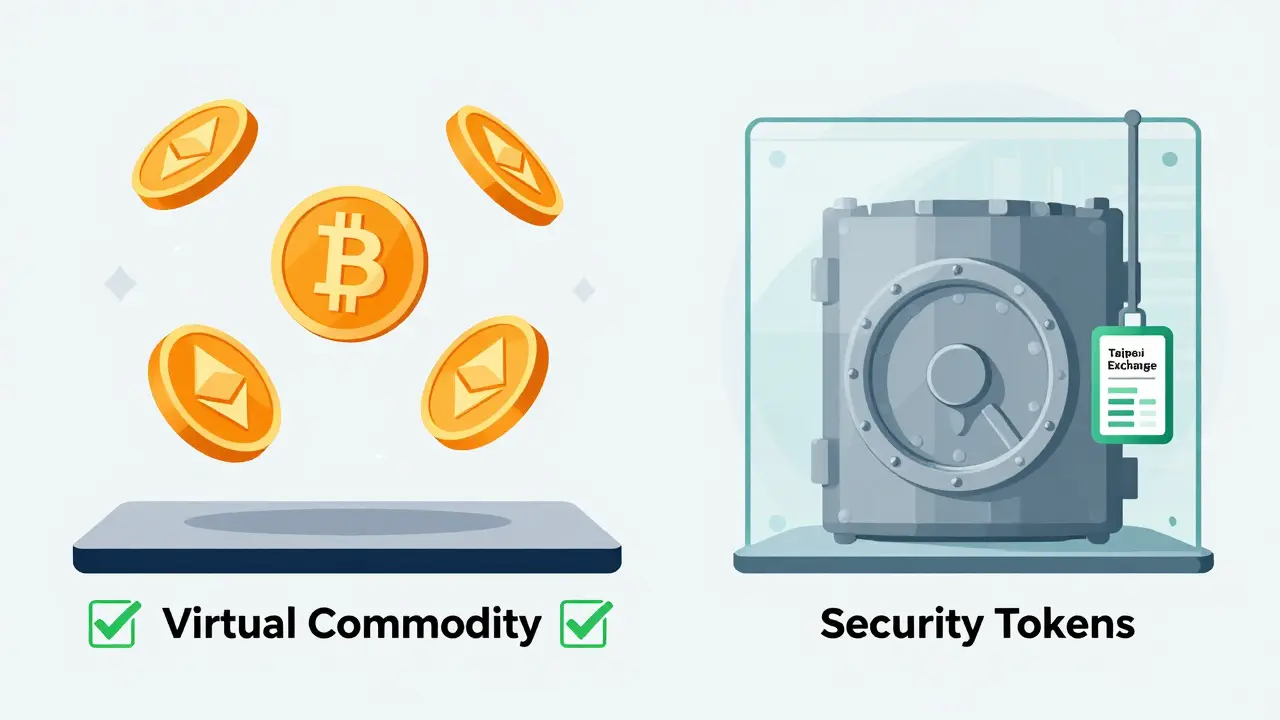
Not all digital assets are created equal in the eyes of the FSC. The regulator draws a sharp line between Security Tokens are digital representations of traditional financial instruments like stocks or bonds, subject to securities laws and general virtual commodities. If a token qualifies as a security, it falls under the Securities and Exchange Act. This means you cannot just list it on your exchange. You must be a licensed securities dealer.
The FSC has authorized the Taipei Exchange (TPEx) is the only official platform in Taiwan authorized to trade security tokens, implementing strict STO regulations to handle Security Token Offerings (STOs). Due to high regulatory thresholds and compliance burdens, the STO market in Taiwan remains extremely limited. To date, there has been only one officially approved security token issuance program. For most exchanges, this means focusing on virtual commodities rather than trying to navigate the complex world of security tokens unless you have a specific license.
| Asset Type | Regulatory Classification | Governing Law | Trading Platform |
|---|---|---|---|
| Bitcoin, Ethereum | Virtual Commodity | AML Act / VASP Guidelines | Licensed VASP Exchanges |
| Security Tokens | Securities | Securities and Exchange Act | Taipei Exchange (TPEx) |
ETF Access and Institutional Integration
The FSC is also opening doors for institutional investment. Working with the Securities Business Association of the Republic of China is an industry group that facilitates cooperation between financial institutions and the government on regulatory matters, the regulator has established five key points allowing professional investors to access foreign virtual asset exchange-traded funds (ETFs). This is a significant shift. It signals that the FSC sees value in integrating crypto products into the traditional financial system, but only for sophisticated investors who can bear the risk.
For exchanges, this creates an opportunity to partner with traditional financial institutions. However, it also raises the bar for trust and reliability. Professional investors will demand higher levels of security, transparency, and compliance. If you want to attract institutional capital, you need to exceed the basic VASP guidelines. You need to demonstrate robust risk management, clear audit trails, and a track record of stability.

Industry Self-Regulation and Cooperation
Interestingly, the crypto industry in Taiwan has largely cooperated with the FSC. Major exchanges formed the Taiwan Virtual Asset Service Provider Association is a self-regulatory organization comprising 24 major crypto exchanges committed to promoting compliance and industry standards during legislative debates. This association helps shape practical implementation of regulations and provides a channel for industry feedback. Being part of this ecosystem is beneficial. It shows good faith and gives you a voice in future regulatory discussions.
The FSC’s approach is often described as a "middle path." It avoids the total prohibition seen in some countries while rejecting the wild west of unregulated markets. It looks to models from the European Union, South Korea, and Japan for inspiration. For operators, this means stability. The rules are clear, even if they are strict. You know exactly what is expected of you.
Future Outlook: What to Expect in 2026 and Beyond
The regulatory framework is not static. The FSC is actively considering a comprehensive cryptocurrency law. A feasibility study was completed in late 2024, and draft legislation is anticipated in mid-2025. This new law aims to provide enhanced customer protection and clearer definitions for various digital assets. As an operator, you should monitor these developments closely. Changes could affect licensing requirements, tax obligations, and reporting standards.
Market implications include increased operational costs due to compliance needs. Smaller players may struggle, leading to market consolidation. Larger, well-capitalized exchanges will likely dominate. Consumer confidence is rising as regulated operations become the norm. This is good for the long-term health of the industry. It attracts serious investors and reduces fraud.
Is it legal to run a crypto exchange in Taiwan?
Yes, it is legal provided you complete the mandatory Anti-Money Laundering (AML) Registration with the Financial Supervisory Commission (FSC) and comply with the Guidelines for Virtual Asset Service Providers (VASPs). Operating without this registration is illegal and carries severe penalties.
What is the difference between a virtual commodity and a security token in Taiwan?
A virtual commodity, like Bitcoin, is treated as a digital asset under AML laws. A security token represents ownership in a traditional financial instrument and is governed by the Securities and Exchange Act. Security tokens can only be traded on licensed platforms like the Taipei Exchange (TPEx), while virtual commodities can be traded on registered VASP exchanges.
Do foreign exchanges need to comply with FSC regulations?
Yes, if they serve Taiwanese residents or have a physical presence in Taiwan. The FSC’s jurisdiction extends to foreign entities operating within its borders, requiring them to adhere to the same AML and VASP guidelines as domestic exchanges.
What happens if an exchange fails to segregate customer assets?
Failure to segregate customer assets violates the VASP Guidelines. This can result in heavy administrative fines, revocation of registration, and potential criminal charges against executives for misappropriation of funds. The FSC prioritizes consumer protection, making this a critical compliance area.
Can retail investors buy crypto ETFs in Taiwan?
Currently, only professional investors are allowed to invest in foreign virtual asset ETFs under the five key points established by the FSC and the Securities Business Association. Retail investor access is restricted to mitigate risk, though this may change as regulations evolve.