For years, if you wanted to trade Bitcoin or Ethereum in Indonesia, you looked to Bappebti, the Commodity Futures Trading Supervisory Body. They treated crypto like gold or crude oil-just another commodity you could buy and sell on an exchange. But that era ended on January 10, 2025. On that date, regulatory authority officially moved from Bappebti to the Financial Services Authority (OJK). This wasn't just a change of name; it was a fundamental shift in how Indonesia views digital money. Crypto is no longer a "commodity" in the eyes of the law. It is now a "digital financial asset." If you are an investor, a business owner, or a developer looking at the Indonesian market, understanding this transition is critical. Your license, your compliance strategy, and even how your product is classified have all changed.
Why Did Indonesia Change Its Crypto Regulator?
The move wasn't random. It was driven by Law No. 4 of 2023, known as the Financial Sector Development and Strengthening (P2SK) Law. Passed by the House of Representatives in December 2020, this law laid the groundwork for modernizing Indonesia's financial sector. For a long time, there was confusion about where crypto fit. Was it a currency? A security? A commodity? Bappebti said commodity. But as the market grew, so did the complexity. By 2023, Indonesia had over 17 million crypto investors, with transaction volumes surpassing IDR 300 trillion. That kind of scale demands more than commodity oversight; it requires the robust infrastructure of financial services regulation.
The government realized that treating crypto like physical goods limited its potential. Under the new framework, specifically Government Regulation No. 49 of 2024, crypto assets are now integrated into the formal financial architecture. This means they fall under the same rigorous standards as stocks and bonds. The goal is to protect consumers while allowing institutions to enter the space with confidence. It’s a strategic pivot to make Indonesia a hub for Digital Financial Innovation (DFI), not just a place for retail traders to speculate on price movements.
What Exactly Is Bappebti and What Did It Do?
To understand the current landscape, you need to know what Bappebti actually controlled. Established to supervise commodity futures trading, Bappebti extended its reach to crypto assets starting around 2018-2019. Their main job was to ensure that exchanges were legitimate and that the assets listed were approved for trading. They didn't regulate the technology itself, but rather the marketplace where these assets were bought and sold.
Under their watch, specific regulations governed the industry:
- Bappebti Regulation No. 8/2021: Set the guidelines for conducting crypto asset physical market trading on commodity exchanges.
- Bappebti Regulation No. 13/2022: Amended earlier rules to tighten controls and improve clarity.
- Bappebti Regulation No. 4/2023: Focused on determining which crypto assets were eligible for physical market trading.
By mid-2023, Bappebti had recognized 501 cryptocurrencies, including major players like Bitcoin, Solana, and Ethereum. They also established key infrastructure entities, such as official crypto exchanges, clearing houses, and storage managers, to provide legal certainty. This institutional building block was crucial because it gave the market a foundation to stand on before the handover occurred.
The New Reality: OJK and Digital Financial Assets
Now that OJK is in charge, the terminology has shifted. You won't hear "crypto commodity" anymore. The official term is "digital financial asset." This change is significant because it brings crypto trading, offering, settlement, and supporting infrastructure under comprehensive financial services regulation. Think of it like moving from a local shopkeeper's rulebook to a national banking standard.
The primary regulation governing this new era is OJK Regulation No. 27 of 2024, dated December 10, 2024. This regulation replaces Bappebti's framework entirely. It defines who can operate in the market, how they must report data, and what protections investors receive. One of the biggest wins here is continuity. Existing licenses granted by Bappebti weren't thrown out. Instead, they were preserved during the transition period to prevent market disruption. However, going forward, any new entrants or significant changes in business models must comply with OJK's stricter financial service standards.

Licensing and Compliance: What Changes for Businesses?
If you run a crypto exchange, wallet provider, or brokerage in Indonesia, your compliance checklist has grown. Previously, you focused on commodity trading rules. Now, you must align with financial services expectations. Here is what that looks like in practice:
- Reclassification of Entities: Your company might be re-designated. For example, a "Crypto Asset Trader" under Bappebti may now fall under broader definitions of Digital Financial Asset Traders regulated by OJK.
- Enhanced Investor Protection: OJK expects stronger safeguards against fraud, better transparency in fees, and clearer disclosure of risks. This mirrors how stock brokers are treated.
- Infrastructure Standards: Clearing houses and custodians must meet higher operational resilience standards, similar to those required for traditional securities firms.
- Reporting Requirements: Expect more frequent and detailed reporting to regulators regarding transactions, customer holdings, and systemic risks.
This isn't just red tape. It’s a signal to international players that Indonesia is serious about being a stable, regulated market. For global firms looking to expand into Southeast Asia, this clarity reduces the risk of operating in a gray zone. It creates a level playing field where only compliant businesses thrive.
How Bank Indonesia Fits Into the Picture
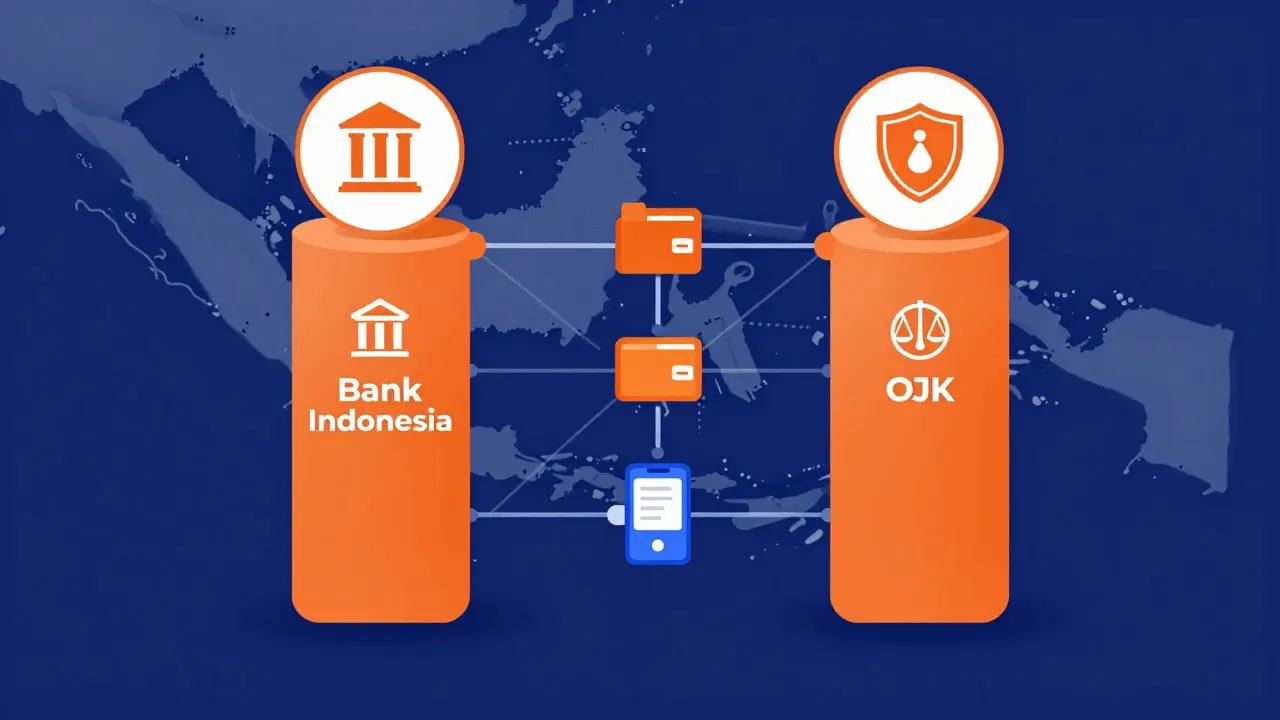
You might wonder, "If OJK handles everything, what does the central bank do?" This is where the dual regulatory structure comes in. While OJK oversees the trading and services side of crypto, Bank Indonesia (BI) retains authority over payment system aspects. Why does this matter? Because if you use crypto for payments, you’re touching BI’s domain. If you’re just trading assets for investment purposes, it’s mostly OJK’s territory.
This split ensures that monetary policy remains stable. BI worries about inflation and currency stability, so they keep an eye on how digital assets interact with the Rupiah. OJK worries about market integrity and investor protection. Together, they cover the full spectrum of crypto activity. For businesses, this means you might need to satisfy two different sets of requirements depending on your specific use case. A pure exchange platform focuses on OJK, while a payment gateway using stablecoins might need additional scrutiny from BI.
| Feature | Bappebti Era (Pre-Jan 2025) | OJK Era (Post-Jan 2025) |
|---|---|---|
| Asset Classification | Commodity | Digital Financial Asset |
| Primary Regulator | Bappebti | OJK (with BI for payments) |
| Key Regulation | Bappebti Reg No. 8/2021 & 13/2022 | OJK Reg No. 27/2024 |
| Investor Base (2023) | ~17 Million | Growing rapidly post-transition |
| Market Volume (2024) | IDR 650+ Trillion | Continued growth under new rules |
| Focus Area | Trading mechanics & listing approval | Financial services standards & investor protection |
Impact on Investors and Market Growth
Will this change hurt the market? Quite the opposite. The transition happened during a period of massive growth. In 2024, transaction volumes skyrocketed to over IDR 650 trillion. Investors welcomed the shift because it brought legitimacy. When your regulator is the same body that oversees banks and insurance companies, trust levels go up. This is especially important for institutional investors who were previously hesitant to enter the Indonesian market due to regulatory ambiguity.
For retail investors, the day-to-day experience hasn't changed dramatically yet. You still log into your exchange, buy Bitcoin, and hold it in a wallet. But behind the scenes, the safety nets are thicker. There is less chance of a shady operator disappearing with funds because the oversight is more rigorous. As DeFi, NFTs, and other complex technologies emerge, OJK’s financial expertise will likely lead to more sophisticated rules tailored to these innovations, rather than trying to force them into old commodity boxes.
Future Outlook: Where Does Indonesia Stand?
Indonesia is positioning itself as a leader in Southeast Asian crypto adoption. The completion of the Bappebti-to-OJK transition establishes a clear path forward. We expect to see more clarity on how tokens are classified-whether they lean more toward securities or utilities. This will help developers know exactly what they need to do to launch a project in Indonesia. The focus on Digital Financial Innovation suggests that the government wants to foster growth, not just police it. If you are planning to operate in or invest in Indonesia’s crypto sector, now is the time to align your strategies with OJK’s framework. The days of navigating a fragmented regulatory landscape are over. The future is structured, transparent, and integrated into the mainstream financial system.
Did Bappebti stop regulating crypto completely?
Yes, effective January 10, 2025, Bappebti transferred its crypto oversight responsibilities to OJK. Bappebti no longer issues new crypto licenses or regulates crypto trading activities. Its role in the crypto space has ended, though it continues to oversee other commodity futures markets.
Are my existing crypto licenses still valid after the transfer to OJK?
Generally, yes. The transition was designed to ensure continuity. Existing licenses, registrations, and approvals granted by Bappebti were preserved during the handover to prevent market disruption. However, businesses must now comply with OJK Regulation No. 27 of 2024 for ongoing operations and any new activities.
How is crypto classified under the new OJK rules?
Crypto assets are now classified as "digital financial assets" rather than commodities. This reclassification subjects them to financial services regulations, bringing them closer to the treatment of stocks and bonds in terms of oversight and investor protection.
Does Bank Indonesia regulate crypto trading?
Not directly. OJK handles the trading, offering, and settlement of crypto assets. Bank Indonesia (BI) retains authority over payment system aspects. So, if you are using crypto primarily for payments, BI’s rules apply. For pure investment trading, OJK is the primary regulator.
What is the main benefit of the shift from Bappebti to OJK for investors?
The main benefit is enhanced investor protection and greater market legitimacy. By placing crypto under the same financial services umbrella as traditional investments, Indonesia signals a commitment to stability and transparency, which helps attract both retail and institutional capital.