
You send a cryptocurrency payment. You sign a digital contract. You store a medical record on the ledger. In all these cases, you are told the data is permanent. It is carved in stone. But what if you made a mistake? What if that data needs to go? The short answer is: technically, yes, it can be changed or deleted, but practically, it is incredibly difficult and often expensive.
Most people think of blockchain as an unchangeable history book. This idea comes from its core design principle called immutability. When Satoshi Nakamoto wrote the Bitcoin whitepaper in 2008, he created a system where once a block of transactions was added, it could not be altered without redoing all the work that came after it. For most users, this means your data stays exactly as you put it there forever. However, reality is messier than the theory. There are technical loopholes, community votes, and legal pressures that challenge this absolute permanence.
How Blockchain Keeps Data Locked Down
To understand how data might change, you first need to know why it usually doesn't. Blockchain uses three main tools to lock data in place:
- Cryptographic Hashing: Every block has a unique digital fingerprint (hash). If you change even one letter in a transaction inside Block 10, the hash for Block 10 changes. Since Block 11 contains the hash of Block 10, its hash also changes. This creates a chain reaction. To hide a change, you would need to recalculate the hashes for every single block that followed.
- Consensus Mechanisms: Networks like Bitcoin use Proof-of-Work (PoW), while Ethereum uses Proof-of-Stake (PoS). These systems require the majority of the network to agree on the current state of the ledger. One person cannot just edit a file; they need the approval of thousands of nodes.
- Distribution: The ledger isn't stored on one server. It exists on thousands of computers worldwide. To change the history, you would need to hack more than half of those computers at the same time.
This setup makes altering data computationally infeasible for large networks. According to research from the University of Cambridge, changing the Bitcoin blockchain would cost roughly $12.7 billion in mining equipment plus millions in daily electricity bills. That is why we call it immutable-it is too expensive to break.
When Immutability Fails: Real-World Exceptions
Despite the strong security, history shows us that blockchain data can be changed under specific circumstances. Here are the most common ways it happens.
The Hard Fork: Changing History by Vote
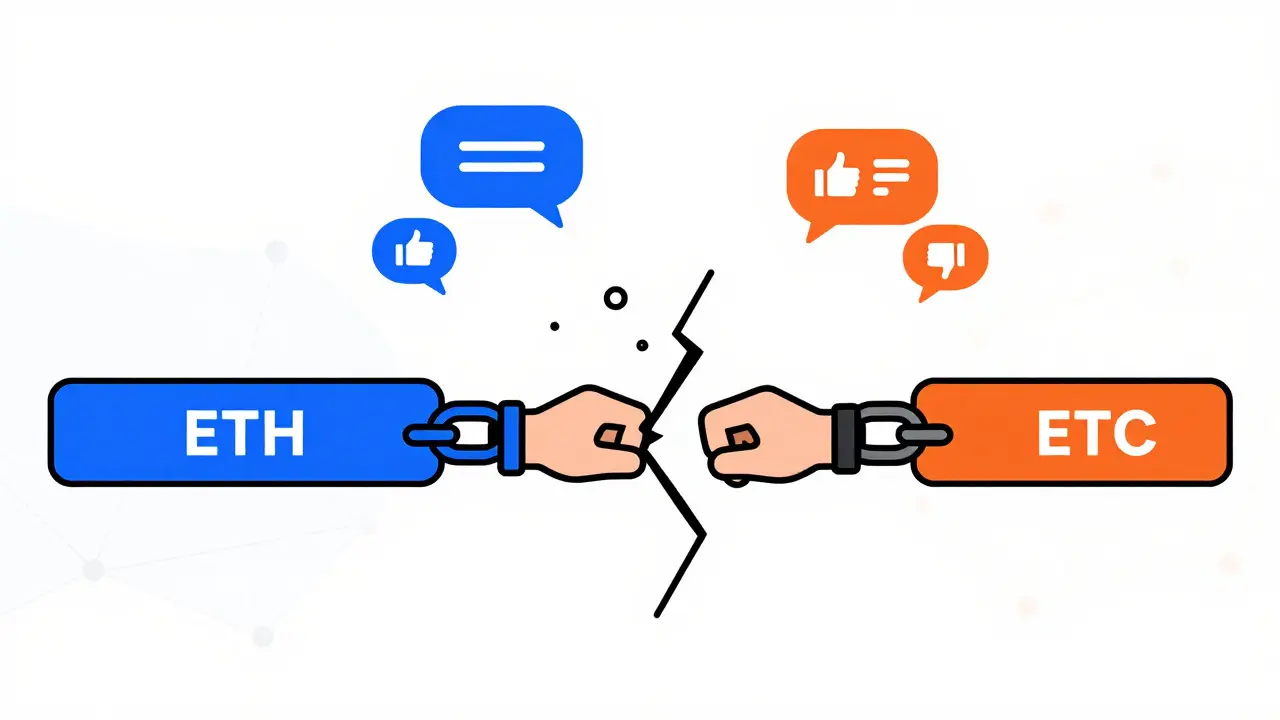
The biggest example of changed blockchain data happened in July 2016. A decentralized autonomous organization (DAO) on Ethereum was hacked, and millions of dollars were stolen. The Ethereum community faced a choice: stick to the code (let the theft stand) or fix the error (reverse the transactions).
They chose to fix it. They executed a "hard fork," which essentially rewrote the recent history of the blockchain to move the stolen funds back to their owners. This split the network into two: Ethereum (ETH), which had the altered history, and Ethereum Classic (ETC), which kept the original, immutable chain. This proved that if enough people agree, even "immutable" data can be rewritten.
The 51% Attack: Buying Control
If one entity controls more than 50% of a blockchain's computing power (in PoW) or stake (in PoS), they can rewrite recent blocks. This is called a 51% attack. In May 2018, Bitcoin Gold suffered such an attack. Hackers controlled enough mining power to double-spend about $18 million worth of coins. They reversed their own transactions, effectively deleting their spending from the ledger so they could spend the same coins again.
While rare on massive networks like Bitcoin, Cornell University research shows that smaller blockchains with fewer than 1,000 active nodes have a 34% chance of facing a successful 51% attack within a year. So, for small projects, immutability is fragile.
Private Blockchains: Admin Rights
Not all blockchains are public. Many companies use private or permissioned blockchains (like Hyperledger Fabric). In these systems, a central authority manages who can write to the ledger. IBM’s 2024 report notes that 62% of private blockchain setups allow administrators to override rules during emergencies. If the admin wants to delete a record, they can. This sacrifices true decentralization for control and compliance.
The Legal Clash: GDPR vs. Immutable Ledgers
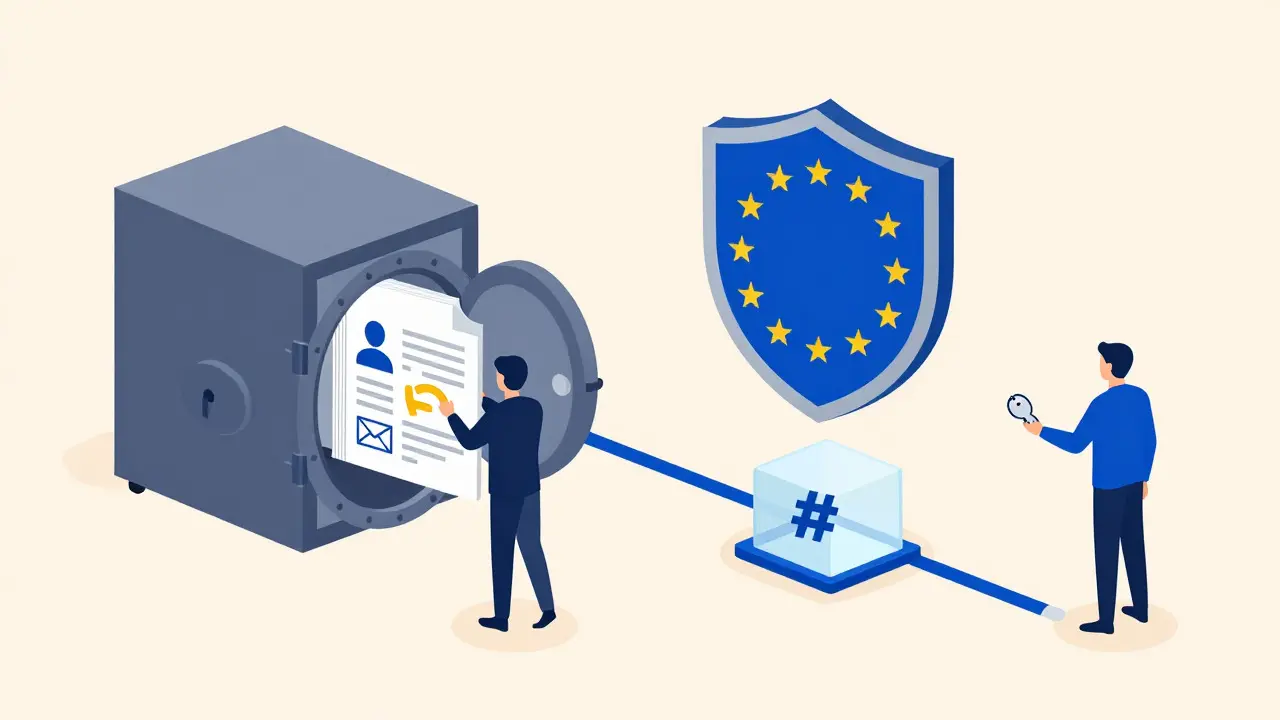
Here is where things get tricky for businesses. The European Union’s General Data Protection Regulation (GDPR) gives citizens the "right to be forgotten." If you ask a company to delete your personal data, they must do it. But if that data is on a public blockchain, they physically cannot delete it without breaking the chain.
This creates a direct conflict. A 2025 report from the EU Blockchain Observatory found that 58% of European blockchain projects had to change their architecture to comply with privacy laws. How do they solve this?
- Off-Chain Storage: Companies store sensitive personal data on traditional servers (which can be deleted) and only put a cryptographic hash (a non-personal reference number) on the blockchain.
- Encryption Keys: They encrypt the data before putting it on-chain. To "delete" it, they destroy the decryption key. The data remains on the ledger, but it becomes unreadable gibberish, satisfying the spirit of the law.
For enterprise users, this means pure immutability is often a liability. They need flexibility to meet legal standards.
| Blockchain Type | Immutability Level | Who Can Change Data? | Primary Risk |
|---|---|---|---|
| Public (e.g., Bitcoin) | Very High | No one (practically) | 51% Attack (unlikely) |
| Public (e.g., Ethereum) | High | Community via Hard Fork | Network Split / Governance Failure |
| Small/Crypto Altcoins | Low to Medium | Majority Miners/Stakers | 51% Attack (common) |
| Private/Permissioned | Variable | Administrators | Centralized Control / Insider Threat |
Future Trends: Hybrid Solutions
As we move through 2026, the industry is shifting away from "all or nothing" approaches. Forrester predicts that by 2027, hybrid solutions will dominate. These systems keep the financial transactions and critical logs on the immutable chain but handle personal identity and sensitive metadata off-chain.
New technologies like the W3C Verifiable Credentials Data Model 2.0 allow for selective disclosure. You can prove you are over 18 without revealing your birthdate or name on the public ledger. Additionally, Microsoft announced a new compliance layer for Azure Blockchain Service in early 2025, helping enterprises manage data privacy without compromising the integrity of the core chain.
Quantum computing is another factor. By 2028, experts expect quantum-resistant cryptography to become standard. While this doesn't change whether data can be deleted, it ensures that old data cannot be easily cracked and re-read by future supercomputers, adding a new layer of effective "deletion" through obscurity.
Practical Takeaways for Users and Developers
If you are using blockchain today, remember these points:
- Double-check everything: On public chains like Bitcoin, assume your transaction is final. There is no customer support to reverse a wrong address.
- Understand the network size: Smaller coins are less secure against history rewriting. Stick to major networks for high-value storage.
- Plan for privacy: If you are building an app, never put raw personal data (names, emails) directly on a public chain. Use hashing or off-chain storage to stay compliant with laws like GDPR.
- Watch for forks: In volatile ecosystems like Ethereum, governance decisions can alter history. Stay informed about community votes.
Blockchain data is not truly unchangeable in a philosophical sense, but it is economically unchangeable for most practical purposes. The cost to alter it outweighs the benefit, except in cases of extreme consensus failure or centralized control.
Can I delete a transaction from Bitcoin?
No, you cannot delete a transaction from the Bitcoin blockchain once it is confirmed. To remove it, you would need to perform a 51% attack, which requires controlling more than half of the network's mining power. For Bitcoin, this costs billions of dollars and is considered practically impossible for individuals.
Does GDPR apply to blockchain?
Yes, GDPR applies to any entity processing EU citizens' data, even on a blockchain. However, since public blockchains are immutable, companies often use workarounds like storing data off-chain or encrypting data on-chain and destroying the keys to achieve "functional deletion."
What is a hard fork and does it change data?
A hard fork is a protocol upgrade that splits the blockchain into two separate chains. It can be used to change historical data, as seen with Ethereum in 2016 when the community voted to reverse the DAO hack. One chain keeps the old history (Ethereum Classic), and the other accepts the new, altered history (Ethereum).
Are private blockchains immutable?
Not necessarily. Private or permissioned blockchains are controlled by a central authority or consortium. Administrators often have the ability to override consensus rules, revert transactions, or delete records if needed for business or legal reasons.
How does a 51% attack affect data integrity?
In a 51% attack, the attacker gains control of the majority of the network's computing power. This allows them to reorder, reverse, or double-spend transactions in recent blocks. While they cannot change older, deeply buried blocks easily, they can alter the immediate history of the chain, breaking trust in the ledger.