Imagine proving you’re over 21 at a bar without handing over your driver’s license, or verifying a university degree for a job application without sending a PDF of your transcript. This isn’t sci-fi; it’s the current promise of blockchain identity standards. For years, our digital lives have been held hostage by centralized databases-Facebook, banks, governments-that hold our data in silos prone to breaches and misuse. Blockchain identity shifts the power dynamic. It moves control from the institution holding your data to you, the holder. But how does this actually work under the hood? And more importantly, are these standards ready for prime time?
The Core Problem with Centralized Identity
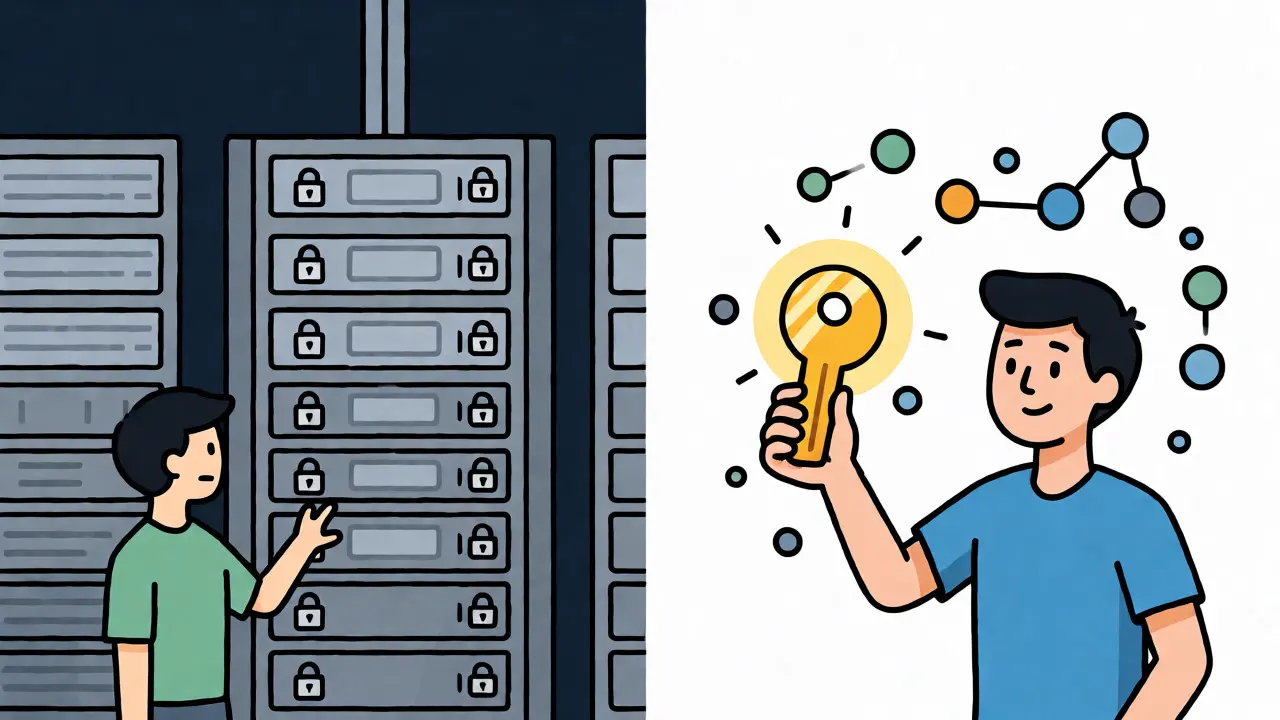
You’ve likely experienced the frustration of "identity fragmentation." You create an account on Site A, use the same password on Site B, and hope Site C doesn’t get hacked. When they do, your personal data is exposed. According to the Identity Theft Resource Center, single points of failure in these traditional systems contributed to 83% of data breaches involving identity theft in 2023. Traditional systems require you to trust a third party with your most sensitive information. If that third party fails, you pay the price.
Decentralized identity (DID) solves this by using cryptographic keys instead of passwords. Your identity isn’t stored in one company’s server; it’s anchored in a distributed ledger. You hold the private key. No one can impersonate you without that key. This isn’t just about security; it’s about privacy. In a centralized model, you often share all your data to prove one fact. In a decentralized model, you share only what’s necessary.
Understanding Decentralized Identifiers (DIDs)
At the heart of blockchain identity lies the Decentralized Identifier, or DID. Think of a DID as a URL, but for identity. Instead of pointing to a website hosted on a specific server, a DID points to a document containing public keys and other metadata, stored on a blockchain or similar distributed system. The W3C published the DID Specification 1.0 as a formal recommendation in July 2022, creating a universal language for these identifiers. As of late 2024, there are 37 distinct DID methods registered, each operating on different blockchains or networks.
The format looks like this: did:method:identifier. For example, did:ion:abc123... indicates an identifier managed by Microsoft’s ION network on Bitcoin. did:sov:xyz789... refers to the Sovrin Network. These methods determine where the DID document lives and who manages the underlying infrastructure. Why so many methods? Because different industries have different needs. Banks might prefer permissioned ledgers for speed and compliance, while open-source projects might choose public chains for transparency.
Verifiable Credentials: The Digital Passport
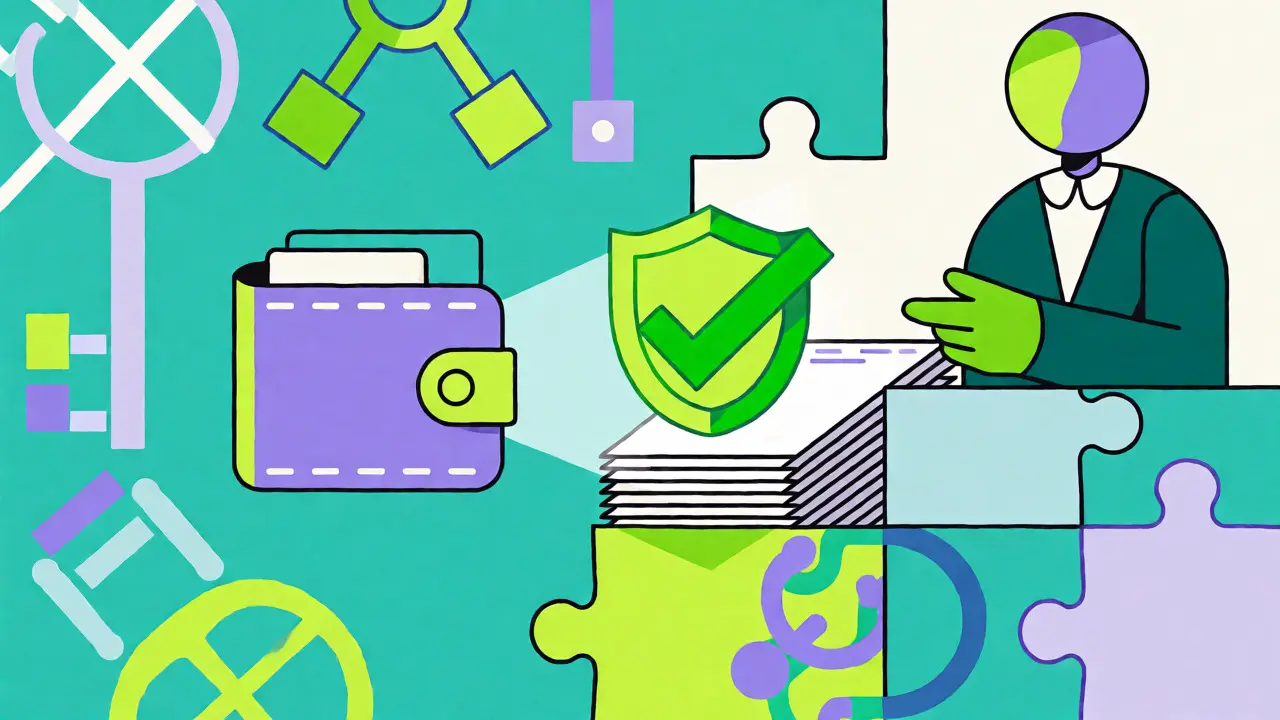
If DIDs are the usernames, Verifiable Credentials (VCs) are the badges or certificates attached to them. Standardized by the W3C in May 2022, VCs are digital statements made by one entity (the issuer) about another (the subject). Examples include a driver’s license issued by a state DMV, a diploma from a university, or a credit score from a financial institution.
The magic of VCs is in their cryptographic proofs. They allow for selective disclosure. Let’s say you need to prove your age to buy alcohol. With a VC, you can generate a proof that says "Age > 21" without revealing your actual birthdate. This is achieved through zero-knowledge proofs or similar cryptographic techniques. You show the bouncer a verified claim, not your entire life story. This drastically reduces the amount of personal data floating around the internet, lowering the risk of exposure if a database is breached.
Major Frameworks and Networks
Not all blockchain identity solutions are created equal. They generally fall into two camps: permissioned and public. Permissioned networks restrict who can run nodes and validate transactions, offering higher speed and easier regulatory compliance. Public networks are open to anyone, offering greater decentralization but often slower transaction speeds.
| Framework | Type | Key Feature | Performance | Best For |
|---|---|---|---|---|
| Hyperledger Indy | Permissioned | Designed specifically for self-sovereign identity | High throughput, fast finality | Enterprise pilots, government IDs |
| Sovrin Network | Permissioned | Governance by trusted stewards | Stable, predictable costs | Financial services, healthcare |
| Microsoft ION | Public (Bitcoin Layer 2) | Anchors DIDs to Bitcoin for security | Scalable via batching | Global interoperability, high-security needs |
| Ethereum ENS | Public | Human-readable names mapped to addresses | Lower TPS, variable gas fees | Crypto-native users, Web3 apps |
Hyperledger Indy, developed by the Linux Foundation, was built from the ground up for identity. It doesn’t try to be a general-purpose smart contract platform. This specialization makes it efficient for identity tasks. On the other hand, Microsoft’s ION leverages the security of the Bitcoin network while adding scalability layers. It’s a popular choice for those who want the immutability of Bitcoin without clogging its main chain with millions of small identity transactions.
Real-World Adoption and Challenges
We aren’t just talking theory anymore. The Philippines’ Department of Social Welfare and Development used a Hyperledger Indy-based system to cut identity verification fraud by 94% in its cash assistance program. That’s a massive win for efficiency and cost savings. Similarly, banks using R3 Corda’s identity solutions have reported a 72% reduction in KYC (Know Your Customer) onboarding times. Instead of taking days to verify a new client, it now takes hours.
However, adoption isn’t smooth sailing. User experience remains a significant hurdle. A 2024 study found that only 41% of non-technical users successfully completed a self-sovereign identity setup without help. Key recovery is another pain point. If you lose your private key, you lose your identity. Unlike a password reset email, there’s no central authority to call. Some wallets are experimenting with social recovery mechanisms, but it’s still a risky area for the average person.
Interoperability is the next big frontier. Right now, a DID created on Sovrin might not easily talk to a wallet built for Ethereum. The Universal Resolver framework attempts to bridge this gap, allowing cross-chain verification. The European Blockchain Services Infrastructure (EBSI) recently launched cross-border identity verification across 27 EU member states, processing 1.2 million verifications in its first month. This suggests that when standards align, scale follows.

Regulatory Landscape and Future Outlook
Regulations are catching up to technology. In the EU, eIDAS 2.0, effective June 2026, will mandate that member states recognize blockchain-based qualified electronic identities. This is a game-changer. It means a digital ID issued in Germany must be accepted in France. In the US, Executive Order 14067 directed NIST to develop blockchain identity standards, signaling federal interest in standardizing this space.
Experts remain cautiously optimistic. Dr. Kim Hamilton Duffy, co-chair of the W3C Credentials Community Group, notes that while technical interoperability is solved, governance frameworks are the critical path forward. Who decides which issuers are trustworthy? How do we revoke a credential if it’s stolen? These questions don’t have simple answers yet.
Looking ahead, the market is projected to explode, growing from $1.57 billion in 2025 to nearly $119 billion by 2032. Integration with AI is also on the horizon. Many platforms plan to use AI for fraud detection within identity ecosystems by 2026. However, ethical concerns about algorithmic bias in identity verification need addressing before widespread rollout.
Practical Steps for Implementation
If you’re a developer or business leader looking to implement blockchain identity, here’s a roadmap:
- Choose the right method: Do you need public transparency (ION/Ethereum) or private control (Indy/Sovrin)? Match the network to your compliance needs.
- Focus on UX: Hide the crypto complexity. Users shouldn’t need to know what a seed phrase is. Use biometric authentication to secure wallets.
- Start small: Pilot a single use case, like employee badge issuance or customer KYC, before scaling.
- Plan for key management: Decide how users will recover their identities. Social recovery or multi-sig wallets are better than single-key setups for enterprise users.
Blockchain identity standards represent a fundamental shift in how we manage digital trust. They offer a way out of the data breach crisis and toward a future where users own their data. While challenges in usability and governance remain, the technical foundation is solid. The question is no longer "if" this technology will be adopted, but "how quickly" organizations can adapt to this new paradigm.
What is a Decentralized Identifier (DID)?
A Decentralized Identifier (DID) is a new type of globally unique identifier that does not rely on a centralized registration authority. It is resolvable to a DID Document containing cryptographic material, enabling individuals and entities to prove control over their identity independently of any third party.
How do Verifiable Credentials differ from traditional digital documents?
Verifiable Credentials (VCs) are cryptographically signed digital statements. Unlike traditional PDFs or images, VCs contain mathematical proofs that allow verifiers to check authenticity and integrity instantly. They also support selective disclosure, letting holders share only specific attributes (like age) rather than the entire document.
Is blockchain identity safe from hackers?
Blockchain identity reduces risks associated with centralized database breaches because data isn't stored in one place. However, security depends on key management. If a user loses their private key, they lose access. Smart contracts and network protocols themselves can also have vulnerabilities, so robust implementation practices are essential.
Can I use my existing phone number as a DID?
Not directly. A DID is a cryptographic string linked to a blockchain method. However, some services offer mapping tools where a phone number or email can serve as a lookup alias for a DID, simplifying the user experience while maintaining the underlying decentralized structure.
What happens if I lose my private key?
In strict self-sovereign models, losing your private key means permanent loss of identity control. To mitigate this, many modern implementations use "social recovery" or multi-signature schemes, allowing trusted contacts or devices to help restore access without relying on a central password reset service.