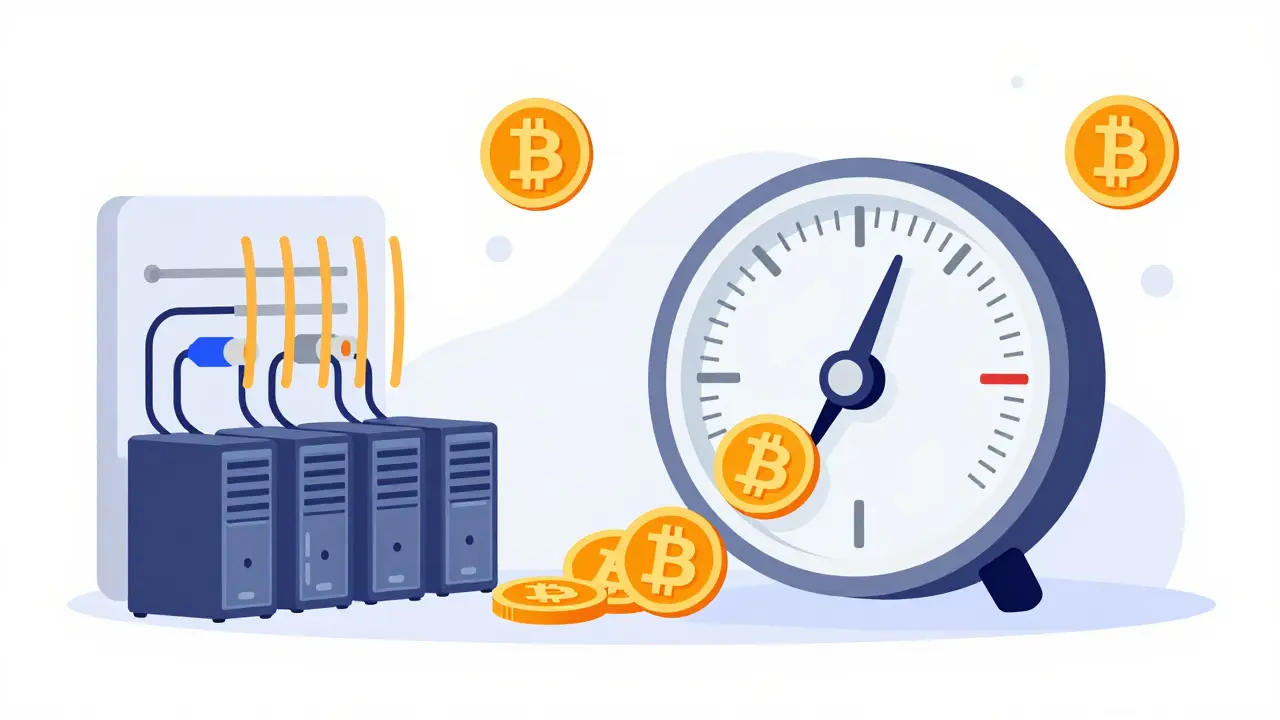
Imagine a world where a digital currency's supply depended on how many fast computers were plugged into the wall. If a thousand new supercomputers joined the network tomorrow, they could potentially mine all the remaining coins in a few weeks, crashing the economy and breaking the system. To stop this from happening, Bitcoin mining difficulty is an algorithmic self-correction mechanism that ensures new blocks are found every 10 minutes, regardless of how much computing power is active on the network. It is essentially the network's thermostat, keeping the production of new coins steady and predictable.
The 10-Minute Rule and the Hash Rate
At the heart of Bitcoin is the Proof-of-Work consensus mechanism. Miners compete to solve a mathematical puzzle. The goal isn't to be "smart" but to be lucky; they guess millions of random numbers until one produces a hash that meets a specific target. When more miners join or hardware gets faster-increasing the Hash Rate (the total computational power of the network)-the puzzles are solved faster. Without an adjustment, blocks would be found in seconds instead of minutes.
If blocks came too fast, the network would struggle to synchronize, and the predetermined issuance schedule-ending in 2140-would be accelerated. To prevent this, the protocol automatically makes the puzzle harder or easier. This ensures that whether there are ten miners or ten million, the average time to find a block remains roughly 10 minutes.
How the Adjustment Actually Works
Bitcoin doesn't change its difficulty every second. Instead, it waits for a specific window of time. Specifically, the network looks back at every 2,016 blocks. Since each block is targeted for 10 minutes, this window represents roughly two weeks (14 days).
The math is surprisingly straightforward. The network compares the actual time it took to mine those 2,016 blocks against the ideal time of 1,209,600 seconds. If the actual time was shorter than the ideal, the puzzle becomes harder. If it took longer, the puzzle becomes easier.
| Actual Time for 2,016 Blocks | Network State | Difficulty Change |
|---|---|---|
| 13 Days | More hash power added | Increases by ~8% |
| 7 Days | Massive surge in power | Increases by 100% (Doubles) |
| 21 Days | Miners leaving the network | Decreases by ~33.3% |
To avoid extreme volatility that could crash the network, the protocol includes a safety valve: the difficulty cannot increase or decrease by more than 4x in a single adjustment period. This prevents a sudden "flash crash" of mining power from making the network completely stagnant.

Real-World Impact: The China Mining Ban
The most dramatic test of this system occurred in June 2021. When China banned cryptocurrency mining, a huge portion of the global hash rate vanished almost overnight. Suddenly, the network was missing half its muscle. This meant blocks were being found much slower than every 10 minutes.
On July 3, 2021, the network reached the 2,016-block mark. The protocol looked at the data and saw the slowdown. In response, it triggered a 27.94% decrease in difficulty-the largest drop in Bitcoin's history. This effectively lowered the bar, making it easier for the remaining miners to find blocks and bringing the 10-minute average back into balance.
The Profitability Loop for Miners
For someone running a mining farm, the difficulty adjustment is the most important date on the calendar. There is a direct link between difficulty and profit. When difficulty rises, the cost of finding a block increases. If you are using older, less efficient hardware, a difficulty hike can turn your operation from profitable to a money-pit overnight.
For example, a 10% increase in difficulty typically cuts a miner's profitability by about 10%, assuming the price of Bitcoin and electricity stays the same. This creates a natural feedback loop: high Bitcoin prices attract more miners, which raises the difficulty, which eventually pushes out the inefficient miners. This "survival of the fittest" ensures that only the most efficient hardware-like the Bitmain S21 Hydros-stays viable.

Is the 14-Day Window Still Effective?
Some experts argue that the 2,016-block window is too slow for the modern era. With the massive scale of today's mining warehouses, hash rate can swing wildly in a few days. Some suggest a "Dynamic Difficulty Adjustment" (DDA) that would update after every single block. This would remove the "lag" and keep the block time even more precise.
However, the Bitcoin Core development team generally disagrees. They argue that the current system provides a necessary "smoothing" effect. By averaging over two weeks, the network avoids reacting too aggressively to short-term noise, maintaining a level of stability that has worked for over 16 years.
The Big Picture: Security and Monetary Policy
Why go through all this trouble? Because this mechanism is what makes Bitcoin's monetary policy a mathematical certainty. By locking the block time, Bitcoin ensures that coins are released at a steady pace. We know exactly when the last bitcoin will be mined (around April 2140) because the difficulty adjustment prevents any group of miners from "speed-running" the supply.
Beyond supply, this also drives security. As the network grows and difficulty increases, the cost to attack the network becomes astronomical. With the current hash rate, a 51% attack-where someone tries to take over the network-would cost billions of dollars in hardware and electricity. The difficulty adjustment doesn't just manage time; it builds a fortress around the ledger.
What happens if all miners suddenly stop mining?
The network would essentially freeze until the next 2,016-block window. However, since the difficulty only adjusts every 2,016 blocks, the network would wait until that height is reached. Once the remaining miners finally complete those blocks (which would take much longer than 14 days), the difficulty would plummet-potentially by the maximum 4x-making it very easy for new miners to jump back in.
Does the difficulty adjustment affect my Bitcoin holdings?
Not directly. The adjustment affects miners and the speed of block production. Whether you hold 0.1 BTC or 100 BTC, the amount you own doesn't change. However, it affects the overall security and scarcity of the network, which indirectly influences the market value.
Why can't Bitcoin just use a fixed difficulty?
A fixed difficulty would be disastrous. If it were too low, the first few miners would finish the supply in days. If it were too high, it might take decades to find a single block, making the network unusable. The adjustment allows Bitcoin to evolve alongside technology, from home PCs to industrial-scale ASICs.
How often does the difficulty change?
Every 2,016 blocks. In a perfect scenario, this happens exactly every 14 days. Because the block time varies slightly, it might happen every 13 or 15 days, but the 2,016-block count is the hard rule.
What is a "difficulty bomb"?
While Bitcoin uses a steady adjustment, some other cryptocurrencies use a "difficulty bomb" to force a network upgrade. This is a programmed increase in difficulty that makes mining nearly impossible unless the software is updated. Bitcoin does not use this; its adjustment is purely based on network performance.