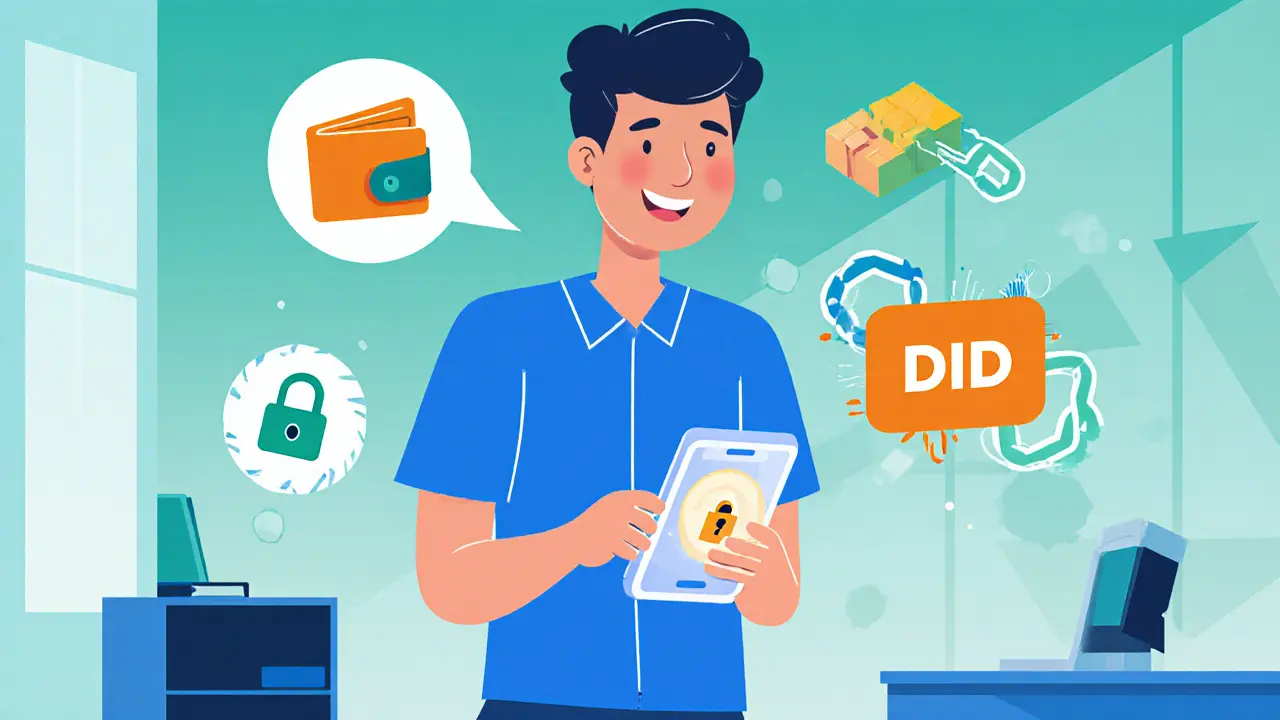
Self‑Sovereign Identity (SSI)
When talking about Self‑Sovereign Identity, a model that puts personal data control in the hands of the individual rather than a central authority. Also known as SSI, it aims to give you full ownership over who sees your information and for what purpose. Self‑Sovereign Identity rests on three core ideas: you own the data, you decide how it’s shared, and you can prove it without handing over the raw details.
The technology that makes SSI possible is blockchain, a decentralized ledger that records transactions in an immutable, tamper‑proof way. By anchoring identity attributes to a blockchain, you get a trustworthy timestamp and a public verification point that no single party can alter. This is where Decentralized Identifiers (DIDs), unique strings that resolve to a set of cryptographic keys and service endpoints come in. DIDs let you create a portable identifier that lives on the ledger, and the associated public keys let you sign claims about yourself. The result is a system where verification is possible without exposing the underlying personal data – a big win for privacy‑focused services and for regulators who need proof of identity without a data dump.
To actually use SSI, you need a digital wallet, software that stores your private keys, DIDs and verifiable credentials securely on your device. The wallet acts as a personal data manager: it receives credentials (like a driver’s license or university degree) from issuers, stores them encrypted, and presents only the needed proof to verifiers. Because the wallet never shares the raw credential, you keep full privacy while still satisfying KYC/AML checks. Many wallets now integrate biometric locks and hardware‑based secure enclaves, making them as safe as a bank vault for your identity data. As more governments and companies adopt SSI, expect wallets to sync across devices, support recovery options, and offer ready‑made templates for common use cases such as on‑ramp crypto purchases, voting, or health record access.
All these pieces – SSI, blockchain, DIDs, and digital wallets – form a tightly knit ecosystem that reshapes how we think about trust online. By shifting authority from institutions to individuals, the model lowers friction for cross‑border services, reduces costs for identity verification, and gives users a real lever over their privacy. Below you’ll find articles that dive deeper into each component, explore real‑world pilots, and show how the technology is already being used in Southeast Asia and beyond.